
California’s Penal Code 647(b) defines prostitution as: engaging in a sexual act in exchange for money or other consideration, and makes it a misdemeanor for anyone 18 or older to:
It is important to mention that all people involved in facilitating the crime can be arrested and face prostitution charges. This includes the supposed prostitute, customer, and any other person that knowingly facilitates the encounter.
Some prostitutes also have middlemen, known generally as “pimps.” Pimps are more likely to be arrested for violating:
Entrapment is when a government agency originates the idea of the illegal act, persuades a person to commit a crime and then allows a crime to happen. A person is not considered guilty of a crime if he was coerced or harassed to commit a crime that he was not predisposed to commit. In California’s law system entrapment is considered an affirmative defense, so the defendant has the burden of proving in case he or she was entrapped.
Lack of Evidence is a common defense under California Penal Code 647(b). In many cases prosecution lacks substantial evidence to prove that the defendant committed a crime punishable by conviction.
Misunderstanding: While the defendant may have performed sexual activity but did not have the specific intent to engage in prostitution, he or she cannot be convicted under section 647.
Engagements in prostitution, soliciting prostitution or agreement to engage in prostitution are considered misdemeanors under California Penal Code section 647(b).
Usually the court places a defendant on a period of probation and orders to perform community service. Moreover, in all prostitution cases, the court orders the defendant to obtain an HIV test.
Subsequent convictions: According to Penal Code 647(b) prostitution is a "priorable" offense, meaning that punishment for prostitution/solicitation increases with each subsequent conviction:
For second offense a court may sentence mandatory minimum a minimum of 45 days in county jail, and a minimum of 90 days for third or subsequent offense:
Additional penalty if committed in a car
If the offense was committed while using an automobile and within 1,000 feet of a residence, the defendant can face additional penalty:
There are a few legal defenses to penal code section 273.5 and are as follows:
Hire the most dedicated Glendale criminal defense lawyer to the legal services you require! Our attorneys at KAASS LAW are highly dedicated to help our clients in every way possible. You can rely on our experienced lawyers in Glendale, Los Angeles, California, to carefully analyze the facts of your case to prove the facts necessary. We back all of our clients and we invite you to give us a toll free call at (310) 943-1171 to speak to our experienced Glendale domestic violence attorney today. Get in touch with us at KAASS LAW, 815 E Colorado St #220, Glendale, CA 91205, (310) 943-1171 at any time!
KAASS LAW is authorized to practice law in California. The above content is intended for California residents only. This content provides only general information which may or may not reflect current legal developments. KAASS LAW expressly disclaims all liability in respect to actions taken or not taken based on any of the contents of this website. The above content DOES NOT create an attorney-client relationship. KAASS LAW does not represent you unless you have expressly retained KAASS LAW in person at the KAASS LAW office.
KAASS LAW helps clients in: Los Angeles, Burbank, Hollywood, Glendale, Van Nuys, North Hollywood, Studio City, Highland Park, Eagle Rock, Sunland, Tujunga, Sylmar, San Bernardino, La Crescenta, La Canada, Beverly Hills, Westwood, Santa Monica, Brentwood. Pacoima, Montebello, Commerce, Alhambra, Downey, Bell, Maywood, Walnut Park, Vernon, Lynwood, Echo Park, Silverlake, Mission Hills, Northridge, Woodland Hills, Encino, Canoga Park, North Hills, Porter Ranch, Chatsworth, Reseda.

The Terms and Conditions of Use and Why You Really Should Have One
You’ve seen it. Pretty much every website or online service you use makes you agree to it. Yet, even though it’s everywhere on the internet, many misconceptions still exist. We’re talking, of course, about the Terms and Conditions of Use that you agree to every time you do pretty much anything online. Seeing as how Terms and Conditions exist on every platform, you stand to benefit greatly by understanding why it is so important that every site has their own version of it.
Contrary to popular belief, while the Terms and Conditions of Use agreement is greatly recommended to have for your website or online platform, you are not required by law to have this agreement. From a legal standpoint, only policies regarding user privacy are required to be displayed publicly, and that’s only if you gather personal data from users of your service or platform. Data can refer to such things as email addresses, names, physical addresses, gender, age, telephone numbers and other pieces of personal information. Terms and Conditions of Use can also be called Terms and Conditions or Terms of Service or even just Terms of Use.

KAASS Law fights hard to help victims involved in Uber and Lyft accidents, including both drivers and passengers, as well as third-party drivers and pedestrians who were injured, to get the compensation they deserve.
Under California law, Transportation Network Companies, including Uber and Lyft, must provide primary third-party liability insurance. They must maintain $200,000 of excess liability coverage during "Period 1". Period 1 occurs when the Uber or Lyft app is on but still waiting for a passenger. Therefore, you’ll still want rideshare insurance to cover you during Period 1 when your App is on driver mode. Period 2 Match Notification begins when you accept a ride request, as such Auto Liability Coverage and Uninsured/Underinsured Motorist Coverage, as well as Contingent Collision and Comprehensive Coverage, is in effect. Likewise, during period 3, when you're dropping off your passenger(s), the same coverage applies.
Lyft’s third-party automobile liability policy will be your primary policy during Period 1. Lyft will also maintain $200,000 of excess liability coverage during Period 1. The rideshare app is on, but you haven't been paired with a passenger. California law has the following minimum requirements.
California Penal Code Section 273.5 Corporal Injury on a Spouse also referred to as "domestic violence" outlines the specific elements the prosecution is required to prove in order to be found guilty of domestic violence.
California Penal Code Section 243(e), domestic battery is similar to PC 273.5. The primary difference between the two domestic violence laws is the level of injuries sustained by the victim. Penal Code 243(e)(1) is the least serious of California domestic violence laws and is always considered to be a misdemeanor offense. One key aspect to consider is you can be convicted of domestic abuse under California Penal Code 243 (e) even if there was no physical injury.
A Temporary Restraining Order, "TRO", is issued by a court which temporarily protects people from Civil Harassment, Workplace Violence, Domestic Violence, and Elder Abuse or Dependent Adult Abuse. A TRO directs the abuser to not contact and abuse the victim. It regulates and restricts the behavior of the abuser. A TRO is generally issued for 21 days. In some cases it can last a bit longer, usually until the abuser is served with the TRO. There are several types of Restraining Orders.
Domestic Violence Restraining Orders – Domestic Violence Restraining Orders require a special relationship between the parties such as: married or registered domestic partners, divorced or separated, dating or used to date, living together or used to live together, or persons closely related by blood such as parent, child, brother, sister, grandmother, grandfather, in-law.

A promissory note is a legally binding agreement in which the issuer promises in writing to pay a set amount of money to the payee at a determined point in the future.
In effect, a promissory note is a fancy way of promising to pay someone back. It’s a type of document that is found commonly in many aspects of financial transactions. Sometimes, promissory notes are also called loan agreements or IOUs.
If you are loaning or borrowing money, a promissory note is extremely useful to establish because it clearly outlines the terms of the arrangement, including payment details, interest, late fees, collateral, and timeframes and deadlines.
Another reason you would want to use a promissory note is that it is a legally enforceable document as it creates a legal obligation to repay the loan within the specified time. It can be used for mortgages, student loans, car loans, business and personal loans. In short, you’ll want to use a promissory note if:
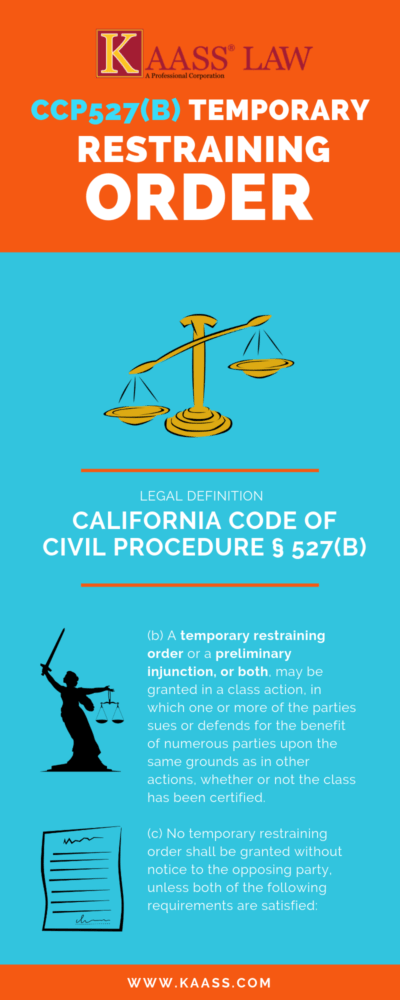
(b) A temporary restraining order or a preliminary injunction, or both, may be granted in a class action, in which one or more of the parties sues or defends for the benefit of numerous parties upon the same grounds as in other actions, whether or not the class has been certified.
(c) No temporary restraining order shall be granted without notice to the opposing party, unless both of the following requirements are satisfied:
(1) It appears from facts shown by affidavit or by the verified complaint that great or irreparable injury will result to the applicant before the matter can be heard on notice.
(2) The applicant or the applicant’s attorney certifies one of the following to the court under oath:
(A) That within a reasonable time prior to the application the applicant informed the opposing party or the opposing party’s attorney at what time and where the application would be made.
(B) That the applicant in good faith attempted but was unable to inform the opposing party and the opposing party’s attorney, specifying the efforts made to contact them.
Adjective / Adverb
Quasi comes from Latin, meaning not fully, partly, or somewhat
Synonymous: alike, partly, mimic, pertaining some qualities, in part, resembling, having attributes of
Analogous: fully, all, entirely, not at all
Example: A Temporary Restraining Order hearing is a Quasi-Criminal proceeding.
KAASS LAW, 815 E Colorado St #220, Glendale, CA 91205, (310) 943-1171
Our lawyers in Glendale, Los Angeles, CA at KAASS LAW are authorized to practice law in California. The above content is intended for California residents only. This content provides only general information which may or may not reflect current legal developments.
A temporary restraining order (TRO) is a type of Injunction.
A TRO restricts contact with the applicant until the hearing date of the Temporary Restraining Order Hearing. It is limited in time and can be secured with or without notice to the Respondent, depending on the circumstances. outlined in the California Code of Civil Procedure.
A TRO hearing can be considered a quasi-criminal proceeding.
Both the Applicant and the Respondent have the right to a restraining order attorney at the hearing.
KAASS LAW is authorized to practice law in California. The above content is intended for California residents only. This content provides only general information which may or may not reflect current legal developments. KAASS LAW expressly disclaims all liability in respect to actions taken or not taken based on any of the contents of this website. The above content DOES NOT create an attorney-client relationship. KAASS LAW does not represent you unless you have expressly retained KAASS LAW in person at the KAASS LAW office.
KAASS LAW helps clients in: Los Angeles, Burbank, Hollywood, Glendale, Van Nuys, North Hollywood, Studio City, Highland Park, Eagle Rock, Sunland, Tujunga, Sylmar, San Bernardino, La Crescenta, La Canada, Beverly Hills, Westwood, Santa Monica, Brentwood. Pacoima, Montebello, Commerce, Alhambra, Downey, Bell, Maywood, Walnut Park, Vernon, Lynwood, Echo Park, Silverlake, Mission Hills, Northridge, Woodland Hills, Encino, Canoga Park, North Hills, Porter Ranch, Chatsworth, Reseda.

Service agreements are legal documents between a service provider and a client, in which the service provider agrees to perform certain services for a client. These services can range from small, individual services like babysitting or dog walking, to much larger scale, more professional services such as accounting or consulting. Regardless of the scale or difficulty of the service that is to be provided, the service agreement acts as a clear outline for the expectations and agreements between provider and client. Independent contractors, freelancers, and consultants, and, they typically involve one party agreeing to pay the other party a set amount of money for a specific service.
While it can be extremely tempting to simply operate by word of mouth or by the honor system, it’s inadvisable to do so. In fact, it’s always a great idea to establish your understanding with the other party in writing. While this is more formal, it also ensures that both parties are very explicit and clear about the expectation from the other and, most importantly, it establishes a clear paper trail indicating the assent of both party to those terms. So while the temptation to simply operate on a handshake or verbal agreement can be very great, especially when working with a small business or a family-owned company, it’s always best to take the time to draft up an agreement in writing. This simply solidifies the responsibilities of both sides and ensures that the service will perform at a fair price.
Regardless of what you want to call it, a Terms of Use Agreement is a series of rules and conditions to which users must give their consent and understanding in order to utilize a service or product. In short, it is an agreement that establishes the rules that users must agree to if they want to use your website. While you aren’t legally obligated to have a Terms of Use, there are many advantageous reasons why you should include one on your site.
The Terms of Use Agreement serves as a legally binding contract between you and your users. Specifically, the agreement establishes the rules and protocols that users have to follow and abide by if they want to utilize your website or application. On the other hand, a Privacy Policy agreement serves to let your users know about the kinds of data you may collect as they make use of your site, as well as what you plan to do with that collected data. It’s in this agreement that you would write several sections talking about the rules and guidelines that come with using your site, and what the consequences of breaking those rules or abusing them are. Different users can exploit or abuse your site in different ways but some common examples of abusive actions are: spamming other users, posting defamatory content, or using your content in a way that is unintended, etc. However, you can include a clause within your Terms of Use Agreement that outlines that certain actions will not be tolerated, such as harmful language or hate speech, constantly posting spam, and harassing other users. As a consequence for engaging in those forbidden actions, you can ban users who abuse your site.
Since you are the owner of your platform, be that a website, an app, or a brand, you have the ability to call the shots with how your stuff can get used. In particular, your branding designs, logos, videos, articles, and software are yours to decide how to use and share, if at all. Moreover, you can let your users know that you are the owner of that content and that your content is protected by international copyright laws. This is a crucial clause to add in your Terms of Use Agreement and it most often gets referred to as the Intellectual Property Clause. Having this clause can really make or break your platform because it directly informs users as to how they can and can’t use your intellectual property without infringing on your original creations. As such, be sure to include a well-written Intellectual Property Clause in your Terms of Use Agreement, or it just might come back to haunt you later down the line.
Terms of Use can also provides a way to end the abusers. Besides helping you deal with abusive users and owning your content, the Terms of Use can also provide a nifty way to permanently end the accounts of particularly problematic users. Specifically, you’ll want to include a clause in the Terms of Use called the Termination Clause.
It lets users know that abusive accounts which violate the Terms of Use can be subject to termination and may get banned from using the service. This clause is especially good for sites, apps, and services that require their users to register an account before being able to use the service because you can outright terminate, disable, or even ban abusive users on the basis of the illicit activity tied to their accounts. Thus, you always an option for dealing with misbehaving users, even in worst case scenarios.
Another important perk that comes along with having a Terms of Use on your site is that such agreements often include a disclaimer which serves to limit the owner’s (i.e. your) liability, in the event that errors, misinformation, or mistakes are found in the contents of your website. Essentially, the Limited Liability Clause lets users know that there are limitations to how liable or responsible the owner can be for any harm that may come to the user because of incomplete, inaccurate, or untrue information. Thus, the content of your website gets even more protection since the degree of liability you would be accountable for much smaller.
The interesting part of international and online commerce is that our entire economies are becoming ever-increasingly interconnected and linked. Many avenues of business and commerce have bled over into other countries, despite them originating from another country entirely. A great example of this would be Amazon, which serves customers from many parts of the world, but is ultimately based in the United States. This is where the Governing Law clause of your Terms of Use Agreements comes into play. In short, it establishes the jurisdiction which is relevant to the terms outlined in your agreement. Basically, the Governing Law clause states that your agreement is bound by the law of the land in which your company, business, service, or application is headquartered. This clause serves to identify the home country and region that your company is registered in, effectively establishing the kinds of laws and rules that it has to follow. As an example, if your company is headquartered in San Francisco, your Governing Law clause should state that your site is operated by a registered business in the state of California in the United States. That will ensure that your users are aware that your site works in accordance to California and to U.S. federal laws.
Any website, online service, software, or application, should have a dedicated Terms and Conditions of Use section. While it may be the most skipped over section in your site, it is imperative to have users of your service consent to the terms presented in the agreement, as that gives you the opportunity to write in some very helpful clauses. Those clauses will limit your liability, protect your original content, allow for banning and termination of abusive users, and establish your governing law by which you conduct your services. By providing all of this information and requiring your users to consent to the presented terms, you give yourself a lot more wiggle room should any situation ever escalate into a legal issue.
At KAASS LAW, our Los Angeles business lawyers do all that we can do help our clients build sustainable, safe, and profitable businesses. We recognize the hard work and dedication that goes into delivering a final finished product and we stand by our clients to make sure they have as simple and smooth an experience as possible, especially when they initially set up their business. We invite you to give us a toll free call at (310) 943-1171 to speak to our business lawyers and to see how we can help your business grow today.
KAASS LAW, 815 E Colorado St #220, Glendale, CA 91205, (310) 943-1171
KAASS LAW is authorized to practice law in California. The above content is intended for California residents only. This content provides only general information which may or may not reflect current legal developments. KAASS LAW expressly disclaims all liability in respect to actions taken or not taken based on any of the contents of this website. The above content DOES NOT create an attorney-client relationship. KAASS LAW does not represent you unless you have expressly retained KAASS LAW in person at the KAASS LAW office.
KAASS LAW helps clients in: Los Angeles, Burbank, Hollywood, Glendale, Van Nuys, North Hollywood, Studio City, Highland Park, Eagle Rock, Sunland, Tujunga, Sylmar, San Bernardino, La Crescenta, La Canada, Beverly Hills, Westwood, Santa Monica, Brentwood. Pacoima, Montebello, Commerce, Alhambra, Downey, Bell, Maywood, Walnut Park, Vernon, Lynwood, Echo Park, Silverlake, Mission Hills, Northridge, Woodland Hills, Encino, Canoga Park, North Hills, Porter Ranch, Chatsworth, Reseda.
Periods 2 and 3: Once you've been paired with a passenger and after they've entered your vehicle, the rideshare company, such as Uber or Lyft, are required to carry a $1 million liability insurance policy in California. This covers you and your passengers during Periods 2 and 3. Depending on the company, it may offer additional coverage during these periods as well.
If an Uber driver is involved in an accident with a passenger in the car, Uber and Lyft’s insurance will provide liability and collision coverage. However, they often won’t cover things like rental cars, lost wages, and medical expenses. Thus, It is in your best interest to consult with a Los Angeles Uber accident lawyer about your case before speaking with Uber or an insurance adjuster. With professional legal assistance, you will have more leverage in settlement negotiations with Uber and get the compensation you deserve.
A Los Angeles Uber accident lawyer can help Uber drivers recover damages for the following:
If you were involved in an Uber or Lyft accident in California, we invite you to hire our dedicated Los Angeles Uber and Lyft accident lawyer today. Our skilled Uber and Lyft accident attorneys leverage their considerable experience into obtaining significant settlements from insurance companies that are known for being reluctant to pay out on claims. You can rely on our experienced lawyer to carefully analyze the facts of your case to prove the facts necessary. To schedule a free consultation with one of our rideshare lawyers, call Kaass law today at (310) 943-1171 or send us an email through our online appointment form.
There are a few legal defenses to penal code section 273.5 and are as follows:
People have the legal right of self-defense when they are attacked. The most common legal defense strategy is to make the argument you were acting in self-defense or defense of another person. Injuries caused while acting defensively should not lead to a conviction under PC 273.5(a). The amount of force one can legally use to defend him or herself depends upon the circumstances of each case. Under Judicial Council of California Criminal Jury Instructions 505 and 506, you are considered to have used reasonable self-defense if:
In order for this defense to be successful, it must be proved that you did not have the intent to strike or injure the victim. Individuals charged with PC 273.5(a) must willfully harm an intimate partner to be convicted. If you accidentally inflicted corporal injury on someone this should not lead to fines and incarceration.
There are plenty reasons you might be facing a false accusations of Penal Code 273.5 PC violations. It is common for individuals to be mistakenly accused for corporal injury. In these cases, the accusation is characteristically grounded on false allegations instigated out of a desire for revenge, anger or jealousy
Corporal injury to spouse under California Penal Code Section 273.5 is known as a “wobbler, and can be filed as either a felony or a misdemeanor. Their decision is typically based on the facts and circumstances of the case and your prior criminal record. If the victim sustained serious injuries or you have a history of domestic violence incidents, the case will normally be filed as a felony crime. If you are convicted of a misdemeanor case for PC 273.5 inflicting corporal injury on a spouse, you will face:
If convicted of a felony spousal abuse case, you will face:
Additionally, the legal penalties for a felony conviction can be increased if you have a prior conviction within the past 7 years for corporal injury on a spouse, domestic battery, assault causing serious bodily injury, assault with a deadly weapon, or sexual battery.
The penalties of a misdemeanor or felony corporal injury conviction will probably include a protective or restraining order stopping you from getting into any contact with the victim, for a maximum of ten years. Furthermore, a conviction under PC 273.5(a) can lead to additional punishments. Individuals in Los Angeles convicted of corporal injury to a spouse may lose their right to Firearm Ownership and Professional Licenses.
Often times the victim may file a domestic violence restraining order which is a court order which directs the abuser to not contact and abuse the victim. Furthermore, it regulates and restricts the behavior of the abuser. To obtain a domestic violence restraining order the victim must prove by a preponderance of the evidence that the victim has suffered some type of abuse which could include bodily injury, including causing or attempted to cause bodily injury, sexual assault, or show that the victim has been placed in reasonable apprehension of receiving imminent serious bodily injury.
Hire the most dedicated Glendale criminal defense and Los Angeles restraining order attorney. Our attorneys at KAASS LAW are highly dedicated to help our clients in every way possible. You can rely on our experienced lawyer to carefully analyze the facts of your case to prove the facts necessary. We back all of our clients and we invite you to give us a toll free call at (310) 943-1171 to speak to our experienced Glendale domestic violence attorney today.
KAASS LAW, 815 E Colorado St #220, Glendale, CA 91205, (310) 943-1171
See Stalking
See our Criminal Law Page for Further Info.
Follow us on Facebook at Kaass Law.
To obtain a domestic violence restraining order the victim must prove by a preponderance of the evidence that the victim has suffered some type of abuse which could include bodily injury, including causing or attempted to cause bodily injury, sexual assault, or show that the victim has been placed in reasonable apprehension of receiving imminent serious bodily injury.
Workplace Violence – An employer may obtain a restraining order to protect an employee from being subjected to unnecessary violence and threats of violence at the workplace. The restraining order extends protection to certain family members or household members and other employees at the workplace.
Civil Harassment - Restraining Orders involving Civil Harassment(s) there does not need to be a special relation between the parties. A civil harassment restraining order is issued when a person is being subjected to stalking, threat of violent, sexual assault, or some kind of harassment, such as unlawful assault and battery or conduct that severely alarms, annoys, or harasses the other person and serves no legitimate purpose. Civil harassment restraining orders are usually issued between neighbors, roommate, friend, family member more than 2 degrees removed, like an aunt or uncle, a niece or nephew, cousins, and more distant relatives, or strangers. A few scenarios considered as "harassment" by the court include:
Elder or Dependent Adult Abuse – An elder or dependent adult may request a restraining order to seek protection against abuse. An elder is defined as anyone 65 years or older and a Dependent Adult is a person between the ages of 18 and 64 years of age that has disabilities that prevent that person from performing the normal activities in life. The restraining order may be filed for the elder or dependent adult by a conservator or a trustee of the elder or dependent adult, a guardian ad litem, or any person legally authorized to seek relief.
For a person to obtain a TRO in California, that person must go to court and fill out the required paperwork explaining to the judge what occurred and why that person needs a restraining order. This person can ask the judge to issue a Temporary Restraining Order without notifying the other party. Most judges are inclined to issue the Temporary Restraining Order if enough facts demonstrate the need for a restraining order. The Temporary Restraining Order is valid and in effect until the actual court hearing, which is scheduled three weeks after issuing the TRO. The person obtaining the TRO must have the court papers and TRO served on the other party within five days of the scheduled court hearing. It is after personal service the TRO is in full force and effect. This means there must be proof that the defendant was personally served with the TRO.
Hire the most dedicated Los Angeles restraining order attorney. Our attorneys at KAASS LAW are highly dedicated to help our clients in every way possible. You can rely on our experienced restraining order lawyer to carefully analyze the facts of your case to prove the facts necessary. Whether you would like to to have a restraining order filed against a person, or if you are in need of defense against a restraining order. We back all of our clients and we invite you to give us a toll free call at (310) 943-1171 to speak to our experienced restraining order lawyers today.
You may also contact us by using the form below and one of our team members will contact you back at your earliest convenience.
[contact-form-7 id="5673" title="KAASS LAW Contact Form"]
Crucially, a promissory note states all of the relevant terms of the loan. Some of the important information to include in a promissory note would be:
It’s worth noting that which information and details you need to include in your promissory note are going to vary depending on your specific transaction.
For instance, a simple promissory note may be for a lump sum repayment on a certain date. Let’s say you lent your friend some money and they agree to repay you by the beginning of next month. In that agreement, the full amount is due on that date, and there is no payment schedule to worry about. As for interest, there may or may not be interest involved in the transaction, depending on what agreement you both came to.
A demand promissory note, on the other hand, requires repayment of the loan when the lender asks for the money back, however, typically a reasonable amount of notice is needed.
Even with a promissory note, there is no guarantee that the person or entity will actually pay you back. However, with a promissory note, you do have several options and courses of actions that you can take to get your money back.
[video width="1280" height="720" mp4="https://kaass.com/wp-content/uploads/2020/02/output_HD72022.mp4"][/video]
We Can Help
At KAASS LAW, we understand accountability and mutual respect with business partners. It can be hard to mix friends and business but it’s always a good idea to keep emotions out of business transactions.
If you or a loved one need help writing a promissory note, or following up to get your payment from the promissory note, our Glendale business lawyers are here to help. We back all of our clients and we invite you to give us a toll free call at (310) 943-1171 to speak to our experienced business lawyers today.
KAASS LAW, 815 E Colorado St #220, Glendale, CA 91205, (310) 943-1171
(C) That for reasons specified the applicant should not be required to so inform the opposing party or the opposing party’s attorney.
(d) In case a temporary restraining order is granted without notice in the contingency specified in subdivision (c):
(1) The matter shall be made returnable on an order requiring cause to be shown why a preliminary injunction should not be granted, on the earliest day that the business of the court will admit of, but not later than 15 days or, if good cause appears to the court, 22 days from the date the temporary restraining order is issued.
(2) The party who obtained the temporary restraining order shall, within five days from the date the temporary restraining order is issued or two days prior to the hearing, whichever is earlier, serve on the opposing party a copy of the complaint if not previously served, the order to show cause stating the date, time, and place of the hearing, any affidavits to be used in the application, and a copy of the points and authorities in support of the application. The court may for good cause, on motion of the applicant or on its own motion, shorten the time required by this paragraph for service on the opposing party.
(3) When the matter first comes up for hearing, if the party who obtained the temporary restraining order is not ready to proceed, or if the party has failed to effect service as required by paragraph (2), the court shall dissolve the temporary restraining order.
(4) The opposing party is entitled to one continuance for a reasonable period of not less than 15 days or any shorter period requested by the opposing party, to enable the opposing party to meet the application for a preliminary injunction. If the opposing party obtains a continuance under this paragraph, the temporary restraining order shall remain in effect until the date of the continued hearing.
(5) Upon the filing of an affidavit by the applicant that the opposing party could not be served within the time required by paragraph (2), the court may reissue any temporary restraining order previously issued. The reissued order shall be made returnable as provided by paragraph (1), with the time for hearing measured from the date of reissuance. No fee shall be charged for reissuing the order.
(e) The opposing party may, in response to an order to show cause, present affidavits relating to the granting of the preliminary injunction, and if the affidavits are served on the applicant at least two days prior to the hearing, the applicant shall not be entitled to any continuance on account thereof. On the day the order is made returnable, the hearing shall take precedence over all other matters on the calendar of the day, except older matters of the same character, and matters to which special precedence may be given by law. When the cause is at issue it shall be set for trial at the earliest possible date and shall take precedence over all other cases, except older matters of the same character, and matters to which special precedence may be given by law.
(f) Notwithstanding failure to satisfy the time requirements of this section, the court may nonetheless hear the order to show cause why a preliminary injunction should not be granted if the moving and supporting papers are served within the time required by Section 1005 and one of the following conditions is satisfied:
(1) The order to show cause is issued without a temporary restraining order.
(2) The order to show cause is issued with a temporary restraining order, but is either not set for hearing within the time required by paragraph (1) of subdivision (d), or the party who obtained the temporary restraining order fails to effect service within the time required by paragraph (2) of subdivision (d).
(g) This section does not apply to an order issued under the Family Code.
(h) As used in this section:
(1) “Complaint” means a complaint or a cross-complaint.
(2) “Court” means the court in which the action is pending.(Amended by Stats. 2000, Ch. 688, Sec. 4. Effective January 1, 2001.)
You have the right to receive assistance from a restraining order lawyer regarding legal matters.
Simply having an agreement in writing is meaningless if the agreement does not touch on the most important aspects of the business transaction in question. Therefore, it is crucial to hammer out and clearly state the important details of the service, such as:
In general, the more specific and detailed your agreement is, the better for both parties. Specificity brings with it more clarity regarding the transaction and the expectations involved on both sides. Be sure to include details surrounding the hows, whats, and when of the service and payment. Stating all of these details in the agreement is essential in case anything goes wrong as that will give you more leverage and assurance.
At KAASS LAW, we understand the importance of a clear and simple agreement. We work closely with many clients who need service agreements due to the nature of their freelance work. If you are considering drafting a service agreement for your business or to have a service provider be accountable for their work, we invite you to give us a toll free call at (310) 943-1171 to speak to our experienced contract lawyers today. We always stand by our clients so even in the unlikely event that your service provider or client breaches your agreement, we will work closely with you to explore your legal options. Our goal is to ensure our clients get paid their fair share of compensation for their work and nothing less. Get in touch with us to see what solutions we can provide you.
KAASS LAW, 815 E Colorado St #220, Glendale, CA 91205, (310) 943-1171
KAASS LAW is authorized to practice law in California. The above content is intended for California residents only. This content provides only general information which may or may not reflect current legal developments. KAASS LAW expressly disclaims all liability in respect to actions taken or not taken based on any of the contents of this website. The above content DOES NOT create an attorney-client relationship. KAASS LAW does not represent you unless you have expressly retained KAASS LAW in person at the KAASS LAW office.
KAASS LAW helps clients in: Los Angeles, Burbank, Hollywood, Glendale, Van Nuys, North Hollywood, Studio City, Highland Park, Eagle Rock, Sunland, Tujunga, Sylmar, San Bernardino, La Crescenta, La Canada, Beverly Hills, Westwood, Santa Monica, Brentwood. Pacoima, Montebello, Commerce, Alhambra, Downey, Bell, Maywood, Walnut Park, Vernon, Lynwood, Echo Park, Silverlake, Mission Hills, Northridge, Woodland Hills, Encino, Canoga Park, North Hills, Porter Ranch, Chatsworth, Reseda.