
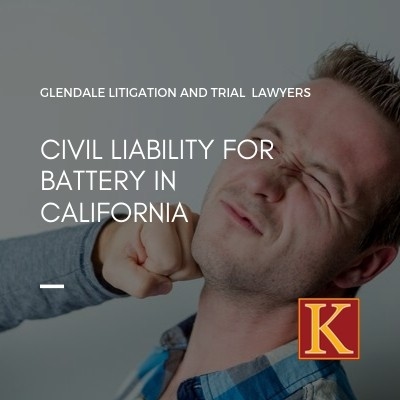
Battery is an intentional harmful or offensive touching of another person without his consent. Frequently used in a single phrase and often thought of as one offense, the terms "assault" and "battery" are two separate torts. These two offenses are usually almost alongside, that is, an assault is immediately by a battery. Though, an assault doesn’t include a battery since it is just the apprehension of a contact that if made would establish a battery.
According to CACI 1300 the plaintiff must be able to prove all the following elements to establish the claim:
A battery is a violation of a person’s interest in freedom from intentional illegal, offensive and harmful unconsented contacts with his person. To successfully establish a claim for battery a plaintiff must show that the defendant intentionally subjected him to an offensive or harmful touching which actually lead to injuries.
Civil liability means that the attacker can be liable for payment of the damages to the victim in a lawsuit, as opposed to criminal liability when the attacker faces punishment for a crime. In a civil lawsuit, the victim will have the burden of proving that the attacker caused him harm and injuries. The victim has a right to file a lawsuit against the attacker whether or not he has a conviction of a crime of battery and against other parties who may have contributed to the circumstance leading to the battery.
As mentioned above when harm and injuries were a cause by an intentional act of battery, the victim has a right to sue the attacker for the following measures of damages:
Are you in need of more individualized information about civil liability for battery in California? Our experienced criminal defense attorneys at KAASS Law are here to take your call.
Under personal injury law, assault is defined as a purposeful act by one person which causes a reasonable apprehension of immediate harm or offensive contact to another person. Assault is known as an intentional tort when it is made the subject of a civil case.
According to CACI 1301 to establish the claim of assault, a plaintiff must prove all the following elements:
Assault does not always involve physical contact, at least not when it comes to civil liability. Even fear of offensive or harmful touching is usually enough for an assault to have occurred. In case the touching actually occurs, the physical contact is usually classified as a battery in civil law, though both claims are often made together.

Wrongful termination occurs when an employment relationship is ended by an employer in violation of the employee’s legal rights.
In California, wrongful termination claims can arise when an employer violates a federal or state statute, the worker’s employment contract, general principles of public policy, or some other aspect of the law.
The majority of employees in California are considered to be “at-will” employees. This means the employees are free to end the employment relationship at any time they want and likewise the employers are free to fire them at any time for any legal reason, or even without any reason. Employment is presumed to be at-will, in case there is no specific contractual relationship between the employee and employer which bounds the employer from firing the employee.
Not all employees are considered at-will and some of them have contracts which limit the employer’s ability to fire them without a reason. For example, when the employee is hired for a specific period of time, but the contract doesn’t specify the circumstances under which the employee can be terminated, he can only be fired under the following circumstances:

In California, victims who suffer emotional distress as a result of another person’s conduct can file a lawsuit for the intentional or negligent infliction of emotional distress. There is no need that a victim suffers a physical injury.
The plaintiff must be able to prove the following elements for a successful claim for intentional infliction of emotional distress:
Under California law, outrageous behavior means that the conduct is so extreme that it goes beyond all possible bounds of decency. Conduct is considered outrageous when a reasonable person finds the behavior uncivilized, goes beyond minor annoyances and poor manners that must be anticipated in day-to-day activities. As defined by CA case law, outrageous conduct can be shown in different ways including showing a pattern of behavior and not just an isolated incident, abusing the position of authority, using the victim’s vulnerability to emotional distress, or acting with knowledge that the conduct would likely cause emotional distress.
Intentional interference with economic relations is an unfair business practice in California which includes three types of actions:
Elements of a claim for intentional interference with contractual relations According to CACI 2201, the plaintiff must be able to prove the following elements to establish the claim:
In California malicious prosecution is a civil cause of action aimed to go after individuals who file frivolous lawsuits and cause damages as a result. Malicious prosecution claims are having a chilling effect on an ordinary citizen’s readiness to bring a dispute to the court, and are often characterized as a “disfavored cause of action.”
An injured person must be able to prove all the elements for this claim. Failing to prove any one of the elements of this cause of action will result in a loss at trial.
According to CACI 1501 to prove a claim of malicious prosecution the plaintiff must be able to show the following:
Defamation involves a false statement made by one person about another person which causes harm to a person’s property, profession, business, or occupation.
The plaintiff must be able to prove the following elements to establish a defamation claim in California:
Defamatory statements are made using two methods: slander or libel
Under California Penal Code Section 118 (PC 118) perjury is an act of knowingly and willfully making false statements after taking an oath, telling the truth, or signing a document that knowingly contains false statements.
The prosecutor must establish the following element to convict the defendant of perjury.
Being under oath is any legal method of confirming the truth of a statement. The most obvious way to be charged with committing perjury is lying under oath during a court proceeding. In case the defendant testified in a civil or criminal or civil case and made a false statement he has committed perjury. A person can also face perjury charges for willfully making false statements while he:

The Rev 973 LLC v. John Mouren-Laurens, et al case (Case Number: 2:98-cv-10690-DSF-EX) involves environmental litigation concerning two major sites: the Mouren-Laurens Site (ML Site) and the Leach Oil Site. These sites are accused of causing significant environmental contamination. Rev 973 LLC, along with the ML Site and the Leach Oil Site, are the main parties in this lawsuit. However, the case also includes thousands of potentially responsible parties (PRPs), who play a significant role in the legal proceedings under the Comprehensive Environmental Response, Compensation, and Liability Act of 1980 (CERCLA). This law holds various parties accountable for the cleanup of hazardous waste. In this article, we will explore the lawsuit, the role of PRPs in environmental litigation, and how CERCLA defines and holds them responsible.
The Rev 973 lawsuit claims that the ML Site and Leach Oil Site improperly handled, disposed of, or released hazardous substances. As a result, widespread environmental damage occurred. While the primary goal is to address the contamination, thousands of PRPs are also involved. These PRPs, in accordance with CERCLA, may share legal responsibility for the cleanup.

When starting a new business or launching a startup, one of the most important steps to protect your brand is to file a trademark for your business. This process requires time, effort, and creativity, but with the right approach, you can navigate it easily. In this guide, we’ll walk you through the steps of filing for a trademark, explain the importance of prior research, and offer tips to improve your chances of approval by the United States Patent and Trademark Office (USPTO).
A trademark is a unique symbol, word, or phrase that identifies your goods or services. It helps distinguish your brand from others. Whether it’s your business name, logo, or tagline, securing a trademark protects your brand and prevents competitors from using similar marks. Filing a trademark for your business does more than just protect your identity. It also:
Assault can be filed under civil and criminal laws and in both cases the elements to prove are similar. Both require that the defendant’s conduct create a reasonable apprehension of harm to the plaintiff. Though, the difference between criminal assault and civil assault lies mainly in the legal remedies that result from the action. In civil law, it is required that the defendant either meant to cause apprehension or that the defendant should have known that his conduct would cause apprehension to the plaintiff. In contrast, criminal law requires that the defendant had the intention to commit physical injury or battery to the plaintiff. In a civil assault claim, it is a private lawsuit between two persons, where a plaintiff can normally collect monetary damages, but a jail sentence is not usually imposed in civil assault claims. In contrast, with a criminal trial, the involved parties are the state (the prosecution) and the victim. Any damages awards can be limited by state statutes that cover how much a victim can recover in a criminal trial. On the other hand, criminal laws generally impose a jail sentence for the defendant, which can range from a few months to several years depending on the severity of the assault.
In case the defendant was acting in self-defense or defense of another person he can’t be found liable.
In some cases, the defendant could have a limited right to commit assault. For instance, when a police officer attempts to place a suspect under arrest.
In a successful claim, the plaintiff must prove all the elements of assault: the apprehension of harm, cause of action and the defendant’s purpose or knowledge of harm to the plaintiff. Damages that can be recovered
https://www.youtube.com/watch?v=gFVAMLJRCVE
These types of employment contracts can be entered into in writing or verbally, but it must be specified that the agreement is for a set period of time.
Exceptions to “at-will” employment give to allow the employees to sue their employers for wrongful termination.
Even though employers can fire at-will employee for seemingly arbitrary reasons, they are still prohibited from terminating employees for illegal reasons. According to the California Fair Employment and Housing Act, it is illegal for employers to discriminate in employment decisions on the basis of the following factors:
In case the decision to terminate the employee was motivated by any of the above-mentioned reasons, the termination is unlawful under the law. Employees that have become the victims of wrongful termination have the right to file a lawsuit against their former employers and seek monetary damages.
According to the law, wronged employees can recover:
[video width="1280" height="720" mp4="https://kaass.com/wp-content/uploads/2020/02/Wrongful-Termination.mp4"][/video] Are you in need of additional information about wrongful termination in California? Our employment law attorneys in Los Angeles at KAASS Law should be able to answer and specific questions that you have. Feel free to get in touch with us anytime at (310) 943-1171 or fill out the form below. [contact-form-7 id="5673" title="KAASS LAW Contact Form"]
Severe emotional distress means that the distress is so lasting or substantial that no reasonable person could be expected to bear it. It includes highly unpleasant mental reactions, such as shame, fright, worry, grief or anger.
Unexpected accidents may cause life-altering physical injuries, disabilities to people or make a victim suffer from emotional distress. A victim can be entitled to recover compensation in case another person’s negligent conduct has caused him to suffer from emotional distress.
The plaintiff must be able to prove the following elements for a successful claim for negligent infliction of emotional distress:
Negligence takes place when one person has and breaches a duty of care that he owes to another person. A victim must be able to establish the following elements to prove the negligence.
In California law, a bystander who witnesses an accident when another person is injured or killed, may also be able to recover damages for emotional distress. The bystander must be able to prove the following elements for a successful claim for negligent infliction of emotional distress:
Some examples of situations when a bystander can be eligible for monetary damages
Are you in need of legal assistance regarding emotional distress? Our litigation attorneys in California can provide you with services involved with personal injury, employment law, and many other practice areas of law. No need to fight a battle on your own. Get in touch right away to find out how KAASS Law can help you!
The claim of intentional interference with contractual relations requires the existence of an underlying enforceable contract. In case there is no contract or the contract is unenforceable, then the plaintiff will have a claim for interference with prospective economic advantage.
Elements of a claim for interference with prospective economic advantage According to CACI 2202, The plaintiff must be able to prove the following elements to establish the claim:
Though generally, a claim for intentional interference with prospective economic advantage includes the defendant’s interference with a prospective contract, liability can be based on interference with any economic relationship containing a probability of future benefits to the plaintiff, including interference with any lawful trade, business, or occupation. Some common examples of intentional interference with prospective economic advantage include conduct constituting libel fraud, or misappropriation of trade secrets.
Elements of a claim for negligent interference with prospective economic advantage According to CACI 2204, the plaintiff must be able to prove the following elements to establish the claim:
Damages for interference with economic relations can include recovery for all resulting harm, including expenses, damage to business reputation, mental distress. The victim can also recover punitive damages in case the defendant acted with fraud, malice, or oppression. [video width="1280" height="720" mp4="https://kaass.com/wp-content/uploads/2019/11/output_HD7202.mp4"][/video]
[video width="1280" height="720" mp4="https://kaass.com/wp-content/uploads/2020/04/output_HD720.mp4"][/video] Do you feel as though you or a loved one have been a victim of malicious prosecution in California? KAASS Law would be happy to take a look into your situation to see what we can do to help you out. Give us a call now at (310) 943-1171 or get in touch by filling out the form below. [contact-form-7 id="5673" title="KAASS LAW Contact Form"]
A statement is a defamation per se in case there is no need for extrinsic evidence to explain the statement's defamatory nature. A plaintiff doesn’t need to show special damages as damages to the plaintiff's trade, business, property, profession or occupation if the statement is defamation per se.
Defamation per quod means that the statement is not defamatory on its face and requires proof and allegations of special damages. Examples of special damages can include lost profits and adverse employment consequences.
According to the First Amendment of the U.S. Constitution, when a public figure brings an action for defamation, in addition to all mentioned elements, he should also prove that the statement was made with actual malice. Thus, the public figure must prove that the person who made the defamatory statement knew that is was false. Here are some examples of a public figure under California law:
There are different types of compensation available to the victims, who win defamation lawsuits. These include:
There are several defenses available in defamation cases. Here are some of them:
[video width="1280" height="720" mp4="https://kaass.com/wp-content/uploads/2019/11/Defamation-claim-in-California.mp4"][/video] Do you have any additional questions or concerns regarding defamation claims in California? Get in touch with KAASS Law for more information now.
Material information is the one that can influence or has a probability of affecting the outcome of the proceeding. There is no requirement that the information actually influence the proceedings
Under California Penal Code Section 127 in addition to committing perjury a person can also be convicted for a “suborning perjury”. Suborning perjury means that the defendant intentionally persuaded, invited or coerced another person to commit perjury either in writing or verbally.
Legal defenses for California PC 118 perjury charges include the following:
In case the defendant did not knowingly make a false statement and honestly but mistakenly believed that his statement was true, this can be a valid defense.
In case the defendant corrected a false statement in a timely manner, the attempt can show that he did not have the intent to provide false information.
The defendant can’t be found guilty in case he was not legally under oath when he made a false statement.
Violation of California PC Section 118 is a felony. The judge has the discretion to issue the penalty based on the seriousness of perjury, the defendant’s criminal record, and whether another person was harmed as a result of the perjury. Possible penalties are the following:
In case the defendant is convicted of perjury that leads to the conviction and execution of another person, he will be sentenced for aggravated perjury, which is punishable by a death sentence or a life sentence without the possibility of parole. Perjury conviction will damage the defendant’s credibility and can lead to other potentially long-term and serious and consequences. Are you someone who is in need of legal assistance due to being accused or charged with perjury? If so, you can get in touch with a criminal defense lawyer near you in order to receive the help that you need. In case you are located within the service area of KAASS Law, we may be able to assist you. https://www.youtube.com/watch?v=jwF5rSHLE7Q
CERCLA—also known as the Superfund law—is a federal law that Congress passed in 1980. Its purpose is to provide a legal framework for cleaning up hazardous waste sites and making responsible parties cover the costs. Under this law, the Environmental Protection Agency (EPA) can take action to address contamination. Moreover, CERCLA allows federal agencies, states, and Native American tribes to recover damages caused by the release of hazardous substances. Consequently, it empowers communities to protect public health and the environment.
CERCLA provides for two types of responses to contamination:
Short-term removal actions address immediate threats to public health or the environment. These removals are classified based on urgency:
For example, if hazardous chemicals spill into a community, an emergency removal would quickly contain the threat and protect public health.
Long-term remedial actions aim to permanently reduce risks from hazardous substances. These actions typically focus on sites listed on the EPA’s National Priorities List (NPL), which highlights the most contaminated locations. Remedial actions include:
These actions often require more time but lead to a significant reduction in environmental risks.
CERCLA defines Potentially Responsible Parties (PRPs) as individuals or entities that may be liable for contamination. Under this law, PRPs are divided into four categories:
In the Rev 973 v. Mouren-Laurens case, PRPs play a crucial role. Thousands of PRPs may have contributed to contamination at the ML Site or Leach Oil Site. CERCLA holds these parties liable for cleanup costs, even if they did not intentionally or negligently cause the contamination. Additionally, PRPs often face joint and several liability, meaning a single PRP can be held responsible for the entire cleanup cost, regardless of their level of involvement.
If you or your business has been identified as a PRP in an environmental lawsuit like the Rev 973 v. Mouren-Laurens case, it is crucial to seek legal guidance. Environmental litigation can be complex, and the financial stakes are high. At Kaass Law, we have experienced attorneys who can help you navigate the legal process, represent your interests in court, and protect your business from excessive liability. Contact us today to discuss your case and explore your legal options.
While the process may take time, the legal protection it offers is worth it.
Before filing your application, perform a trademark search. It’s vital to ensure no one else has registered a similar mark. If another trademark exists, your application will be rejected, and you’ll lose the filing fee. You can search the USPTO’s database using the Trademark Electronic Search System (TESS). TESS allows you to search for existing trademarks. If a similar mark appears, your application will likely be denied. Consider working with a trademark attorney for a comprehensive search.
The USPTO organizes trademarks into 45 different classes. Each class corresponds to a specific category of goods or services. When you file a trademark for your business, you must select the correct class for your goods or services. Choosing the right class ensures proper protection. For example, if you are filing a trademark for clothing, choose the class for apparel. If you are also offering retail services, you may need to file under a different class. Incorrectly selecting a class could lead to a rejected application.
Once you’ve done your research and chosen your class, prepare and file your application with the USPTO. Your application will include:
You’ll also need to indicate whether you’re already using the trademark in commerce or plan to do so. If you're using it, provide evidence such as product packaging, advertisements, or a website that shows your goods or services. File your application online through the USPTO’s Trademark Electronic Application System (TEAS). The fee typically ranges from $225 to $400 per class.
After submission, the USPTO will review your application. This process can take several months. During this time, they’ll check for any issues or conflicts with existing trademarks. If the USPTO finds any problems, they’ll send you an Office Action outlining what needs to be fixed. You’ll have a limited time to address the issue. If all goes well, your trademark will be published in the USPTO’s Official Gazette, allowing others to object if they think it conflicts with their trademark. Here is the USPTO trademark search page to guide you in conducting a trademark search.
After your trademark is registered, it’s important to keep it active. You’ll need to file documents and pay fees periodically. Trademarks must be renewed every 10 years. Additionally, you may need to submit proof that your trademark is still in use. Failing to maintain your trademark could result in losing your registration.
Researching prior trademarks before you file your application minimizes costs and time. If you skip this step and your trademark is rejected, you won’t get your filing fees back. Proper research ensures your mark doesn’t infringe on someone else’s intellectual property, which helps avoid future legal disputes. Working with a trademark attorney can streamline the process and ensure you meet all the requirements.
Filing a trademark for your business is essential to protect your brand. By conducting thorough research, selecting the correct classes, and following the right procedures, you can increase your chances of approval. If you need help with the trademark process, contact the experienced business startup attorneys at KAASS Law. We specialize in intellectual property law and can assist you in protecting your business. Get in touch with us today to start securing your trademark and protecting your brand!