

Under California law manufacturers, distributors and sellers of commercial products have a responsibility to consumers to ensure their products are safe for consumer use. The examples of product liability claims can include unsafe children’s toys, defective autos and auto parts, faulty kitchen, defective motorcycle gear, appliances, defective pharmaceutical drugs, specialized equipment and tools for manufacturing and construction. These are important factors of Product Liability in California.
When a product is more dangerous than a reasonable user would expect, then you can claim the product to be defective. The product is defective in case the consumer is using it in an ordinary way for which of its intent, but it causes injury because of essential fault in the product itself. However, if the consumer uses a product in a dangerous and unusual way, the product cannot apply to it being defective.
There are the three main types of product liability claims in California, which include, design defect, manufacturing defect, and marketing/ advertising defect.
A design defect occurs when a product fails to perform as safely as a consumer expects, and the risk of its danger outweigh the benefits of the design. Defective designs have created dangerous products as child products, medical devices, safety products and much more. Defective design claims must include a proof that the whole product line is unsafe, regardless of the fact that the dangerous product is in accordance with the manufacturer’s specifications.
A manufacturing defect takes place when the product differs from the manufacturer's specifications and design, or it differs from other units of the same product line. Manufacturing defects can make a product too dangerous to use. A plaintiff must prove there is a flaw in the manufacturing process, and product is different from the manufacturer's design and it is different than the prototype.
A marketing/ advertising defect is when a company can be liable for advertising a product for a purpose for which it was inappropriate or for failing to include proper warnings or instructions with the product. Companies are responsible to market their products in a safe manner. Marketing a product without promoting off-label use of a product or sufficient warning labels are examples of a marketing defect.
According to California strict product liability, a defendant who is aware that the consumer is using the product in a reasonably foreseeable manner that exposes him to a risk of injuries needs to warn the consumer of the risk of injury or harm. The defendant can be liable for failure to warn when such failure could have been a different outcome. So, in case a typical consumer would have become aware of the risk of injuries or harm on his own, then the defendant can’t be found liable for failing to warn of an already-known hazard.
In California different parties in the distribution chain can be liable for a defective product. Defendants can include, product manufacturer and designer, distributor, parties that assemble or install the product, and retailers.
In the case that someone has suffered due to a defective product, the first thing a person should do is see a doctor and receive sufficient treatment for his injuries, the next thing a person should do is document the defective product by using a camera to photograph both his injures and the defective product. If anyone saw the accident, person should also record their testimony and contact information, lastly it is very important to stop using the defective product and put it with all labels and packaging in a safe place. In case a person is aware about the defect but is still using the product, he can lose his right to make a claim against the defendants.
The type of product liability claim determines what a person must prove for winning his case.
In some product liability claims a consumer must prove that the defective product's distributor, manufacturer or seller was negligent. Other product liability claims a consumer is only required to prove that the product was defective. In product liability claims that are based on negligence, a person must establish that a distributor, manufacturer or seller owed a duty or responsibility to him as a consumer, and they breached that duty.
In product liability claims that are based on strict liability a person must only prove that the product that caused an injury to him was defective. Then distributor, manufacturer or seller must be able prove that the harm was due to abuse, modification or misuse of the product. So a person doesn’t have to prove that the company was negligent, only that the product was defective.
Generally, a plaintiff must be able to establish the following elements, to prevail on a claim for products liability in California, defendant designed, distributed, manufactured, or sold a defective product, product contained the defect when it left the defendant's possession, plaintiff used the product in a reasonably foreseeable manner, as a result of the defect the plaintiff suffered harm.
If the above mentioned elements are proven, a plaintiff may be eligible for compensation. The plaintiff may recover for economic damages, these include costs of medical treatment, rehabilitation, nursing care and lost wages. They can also recover for non- economic damages, these include pain and suffering that are difficult to value in terms of money. These damages are very subjective and usually depend on the harshness of the injury and the degree of care that the distributor, manufacturer or seller took to protect the consumer.
If you or someone you know would like to file a product liability lawsuit in California, contact the attorneys at KAASS Law at 310-943-1171. They can provide you with legal assistance by taking a look into your situation.
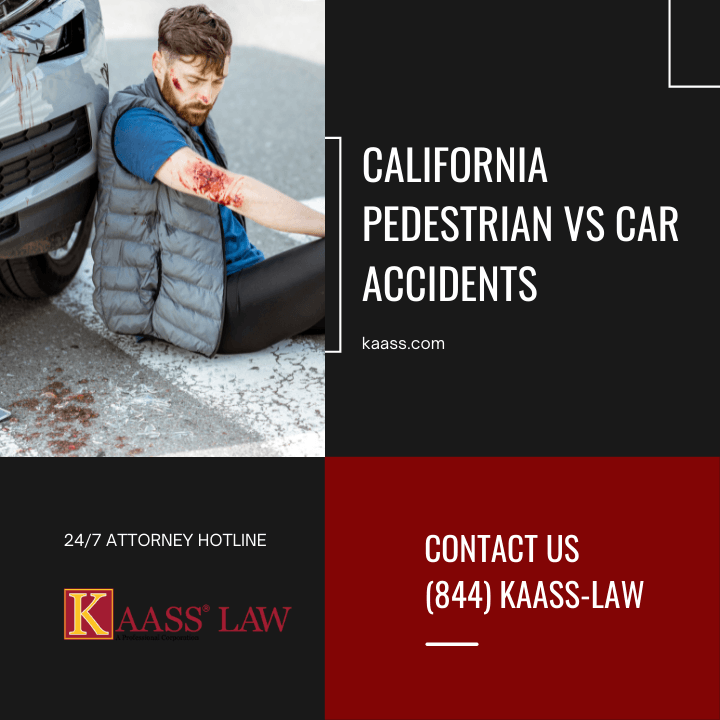
Pedestrian vs vehicle accidents occurs far often than one may believe, especially in Los Angeles. California has several right-of-way laws designed to protect pedestrians and may serve to show that a driver is liable for an accident.
CVC 21950(a) provides that "the driver of a vehicle shall yield the right-of-way to a pedestrian crossing the roadway within any marked crosswalk or within any unmarked crosswalk at an intersection, except as otherwise provided..."
In order for an injured pedestrian to recover in a personal injury lawsuit they must prove:
An experienced Glendale personal injury lawyer can evaluate the facts and circumstances of a case and help recover for damages such as:
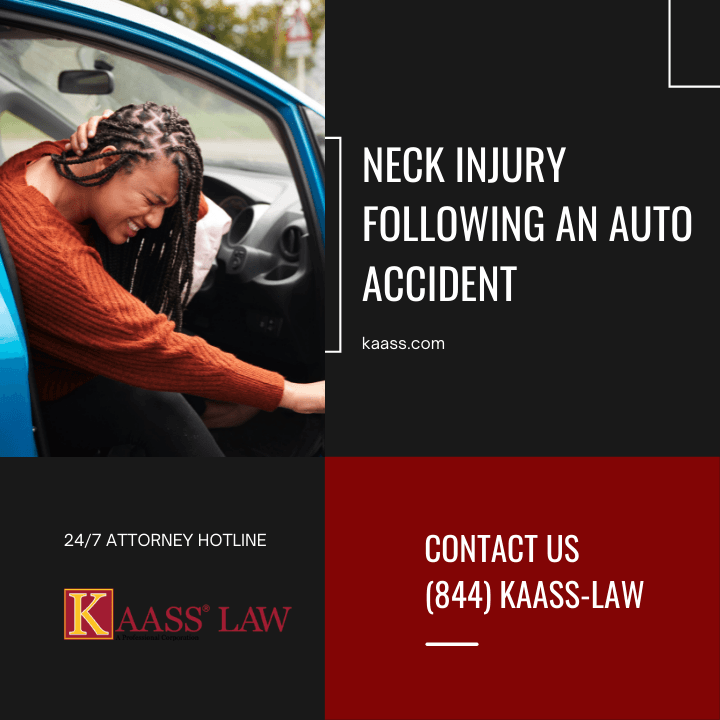
Injuries to the neck, resulting from snapping or jerkin are known as "whiplash". Whiplash describes a range of neck injury 'soft tissue' damages, which is a common result of rear-end accidents. In a rear-end accident, the impact forces the driver's and passengers' bodies to be thrown forward. At the same time, their heads stay in place, causing the neck to suddenly extended, which follows a whip-like motion.
While whiplash and any other types of neck injuries generally occur in rear-end auto accidents, neck injuries and whiplash injuries can also result from different types of accidents and personal injury matters as well. Some types of accidents that may cause whiplash or neck injuries are:
Uber is typically considered a technology company that provides a service of connecting people who want a ride with people who want to drive them around. Using an app is often convenient, quick, and cheaper than using a taxi.
Thus, Uber drivers are not considered employees of the company, rather, they are independent contractors. This is problematic for passengers who are injured in an accident since employers are generally liable for the actions of their employees. Although, it is to be noted that California Assembly Bill AB5 is hoping to provide protection to employees of gig app sharing economy companies such as Uber and Lyft.
If a passenger was hurt in an accident, he must seek prompt medical attention. Even if the passenger doesn’t have pain right away, he can experience symptoms several days after the accident. Under California law, victims of car accidents have a right to recover compensation equal to the full value of caused damages. Passengers can recover for both monetary losses and intangible, noneconomic damages.
An injured passenger involved in an Uber accident may be entitled to the following compensation:
There are two types of damages that are recoverable in California personal injury cases, which include special damages and general damages. Special damages are those damages that are financial in nature, such as hospital and medical bills or lost wages. On the other hand, general damages are those that are non-financial losses, including pain and suffering, loss of consortium, and emotional distress.
The statute of limitation for bringing a pedestrian vs car accident is 2 years from the date of the accident. However, claims involving government tort or injury involving a government entity, such as a car accident with a government city vehicle, requires the injured party to first file a claim with the appropriate governmental agency within 6 months from the date of the accident. Finally, depending on the outcome of the claim, the claimant will then have either 6 months or two years to file suit. If you fail to follow the guidelines for the statute of limitations, you may lose your right to file a claim.
California Code of Civil Procedure section 335.1 provides, an injured pedestrian has two years to file a claim against those who may be liable for their accident.
Our personal injury attorneys specialize in various personal injury matters including complex personal injury cases, government torts specifically related to auto accidents, motorcycle accidents, left turn motorcycle accidents, truck accidents, multi-car accidents, which involve a government vehicle such as Metro Bus, fire truck, U.S Postal Service, and Water & Power Truck. If you have been involved in an accident involving a Government vehicle, give our office a call at (310) 943-1171 for a free consultation. [contact-form][contact-field label="Name" type="name" required="true" /][contact-field label="Email" type="email" required="true" /][contact-field label="Website" type="url" /][contact-field label="Message" type="textarea" /][/contact-form]
[video width="1280" height="720" mp4="https://kaass.com/wp-content/uploads/2020/02/California-Pedastrian-Vehicle-Accident.mp4"][/video]
Many mistakenly believe that whiplash can only occur in high-speed accidents. Low-speed, low-impact, rear-end auto accidents commonly cause whiplash.
Another misconception is that whiplash is a minor injury. However, many medical experts suggest that soft tissue injuries can be severe and have long-term affects if left untreated. It is recommended following an accident, one seeks medical attention or a chiropractor in Los Angeles as soon as possible. If left untreated, it is possible that neck injuries can have serious consequences and cause widespread health problems.
If you were involved in an auto accident, motorcycle accident, pedestrian accident, bicycle accident, or any other personal injury matter, call or contact our personal injury attorneys for a free consultation. Our Glendale personal injury attorney at KAASS Law will review your case and answers any questions you may have.
[contact-form][contact-field label="Name" type="name" required="true" /][contact-field label="Email" type="email" required="true" /][contact-field label="Website" type="url" /][contact-field label="Message" type="textarea" /][/contact-form]
Uber Driver’s Policy: A driver who drives for Uber is required to carry his own car insurance, which usually covers injuries of passengers as a result of the accident. The insurance requirement is imposed by California law and affects any person who has and operates a motor vehicle, regardless of whether he drives for companies like Lyft or Uber. Though, it’s important to know that the driver’s insurer can deny the claim in case the driver was engaged in commercial activity at the time of the accident. The amount of money a passenger can recover is limited to the driver’s policy maximum. In California, most drivers usually purchase minimum coverage, which may not be enough to cover the full extent of the injuries. Third-Party Policy: In case a negligent third party is responsible for causing an accident, the passenger can file a claim with that driver’s personal insurance company. Uber Insurance Policy: Uber carries its own insurance policy in case the drivers are involved in an accident and insures its drivers with a $1 million policy. The coverage which applies is based on the driver’s activity at the time the accident happened. Under this insurance policy, Uber is responsible for all damages up to the difference between the at-fault driver’s policy limit and Uber’s $1 million policy limit. Particularly in case, an at-fault driver’s insurance policy covers $30,000 in damages, Uber is liable for a maximum of $970,000 if such a payout is required. An Uber driver is carrying a passenger This is the case when the $1 million policy can kick in. In case the Uber driver is carrying a passenger, the driver and passenger are covered under the liability insurance policy. Additionally, if a third party was injured, such as a pedestrian or cyclist, the third party was covered by Uber’s insurance policy when the driver was carrying a passenger. Though, if Uber denies coverage, the Uber passenger and driver and can still be denied by the driver’s personal insurance policy since the driver was driving for pay when the accident happened.
Actually, Uber’s insurance policy is dedicated to helping avoid paying out as many claims as possible. It is common for accident claims to be denied by Uber’s carrier. As mentioned above, drivers are not considered Uber employees, and this makes it more difficult for passengers to get compensation in case the driver was driving recklessly or was drunk and distracted. Victims can respond to a denial by suing Uber directly or can seek payment from the driver’s personal insurance company. Suing the driver directly can limit the number of damages that can be received. Are you in need of assistance with resolving your case? A Los Angeles uber accident lawyer from KAASS LAW can provide you with all the legal help you require! Don't hesitate to let a trained professional help you out!