
Cultivating marijuana in California was treated as a felony offense under Health and Safety Code Section 11358 before Proposition 64. A felony is a criminal offense punishable by serving one year or longer in prison.
Proposition 64 went into effect on January 1, 2018, making it legal for individuals 21 years or older to grow marijuana for recreational purposes. Additionally, the sale of marijuana has also been legalized for those business entities that have been licensed to do so.
The following is a list of crimes related to marijuana that has been affected by Prop 64 Adult Use of Marijuana Act:
Individuals convicted prior to the passing of Proposition 64 may apply for resentencing. Resentencing under Proposition 64 may lead to an immediate release from jail. However, this may be contigent on how much time you have served.
An individual can make an application to the court to have their sentence reduced. This is true for individuals who are currently serving time related to marijuana crimes they were convicted of before the passing of Proposition 64. Typically, judges presume that individuals applying for such a request have met the criteria for Proposition 64 resentencing. However, this may not be the case should the prosecutor oppose the petition by proving clear and convincing evidence that the individual does not meet the criteria for resentencing. However, judges are supposed to resent individuals so long as the individual does not pose an unreasonable risk of danger to public safety.
Are you in need of legal advice or services from an attorney? We invite you to contact our Los Angeles criminal defense attorney at (310) 943-1171 for assistance. KAASS Law is always standing by and ready to provide legal assistance.

California is a state that has been at the forefront of the marijuana legalization movement. The passing of Proposition 64 has led to some new changes that may impact those who grow marijuana there. If you are looking to grow marijuana and have been wondering what your options are now, read on.
Yes, it is legal to grow marijuana in the state of California as per the passing of Proposition 64.
Proposition 64 is formerly known as the Control, Regulate, and Tax Adult Use of Marijuana Act. Per Proposition 64, adults ages 21 years or older may possess and grow a specified amount of marijuana for recreational use only. Under Prop 64, individuals are only allowed to grow up to only six (6) marijuana plants for recreational use. It is important to keep in mind, however, that possession of recreational marijuana is still a crime if it violates the Health and Safety Code Section.
Health and Safety Code 11358 HS is one of the associated codes associated with growing marijuana. Specifically, this code section defines the crime of illegal cultivation of marijuana if someone aged between 18 to 20 years old cultivates marijuana. This crime is considered an infraction that is punishable by a maximum fine of $100. An infraction is a violation of the law but is it is not considered to be a crime, unlike a felony or misdemeanor.

Pedestrian vs vehicle accidents occurs far often than one may believe, especially in Los Angeles. California has several right-of-way laws designed to protect pedestrians and may serve to show that a driver is liable for an accident.
CVC 21950(a) provides that "the driver of a vehicle shall yield the right-of-way to a pedestrian crossing the roadway within any marked crosswalk or within any unmarked crosswalk at an intersection, except as otherwise provided..."
In order for an injured pedestrian to recover in a personal injury lawsuit they must prove:
An experienced Glendale personal injury lawyer can evaluate the facts and circumstances of a case and help recover for damages such as:

Under California Health and Safety Code 11358, individuals who are 21 and older can not only use marijuana recreationally, but they can also legally cultivate and grow their own marijuana plants. These new freedoms come with restrictions and regulations built into the very laws that grant their legal status, effectively limiting the amount of marijuana that one can legally own or cultivate for personal use. These limitations are designed to prevent excessive amounts from being created and distributed. Understanding these complex laws is a feat in itself, but being aware of them is important to all consumers of marijuana. In what follows, we break these laws down for you as simply as we can.
Health and Safety Code 11358 in relevant part, "...Each person who plants, cultivates, harvests, dries, or processes cannabis plants, or any part thereof, except as otherwise provided by law..."
It is legal to grow marijuana in California under H&S 11358, for person's over the age of 21 can grow up to 6 mature marijuana plants for their own personal use and cultivation. There are some strings attached, though. You will have to follow any additional local laws and ordinances that further regulate the cultivation of marijuana plants.

Beginning January 2018, recreational use of marijuana became legal in California, allowing persons 21 years and older to possess up to one ounce, or 28.5 grams of marijuana. The law was a direct result of Proposition 64 the Adult Use of Marijuana Act, which was approved in November of 2017. This new law does not change any statues or regulations pertaining to medicinal marijuana use, nor does it completely legalize marijuana use in every situation. As all laws, there are some strings attached that you should be aware of as a consumer.
The legalization of marijuana in California does not extend indefinitely, and you can still get incriminated for surpassing its limits. According to California Health and Safety Code § 11357, those limits are as follows:
HS 11357 Possession Offense
Type of Offense
Penalty Incurred
Possession of marijuana and/or concentrated cannabis by individuals under the age of 21
Infraction
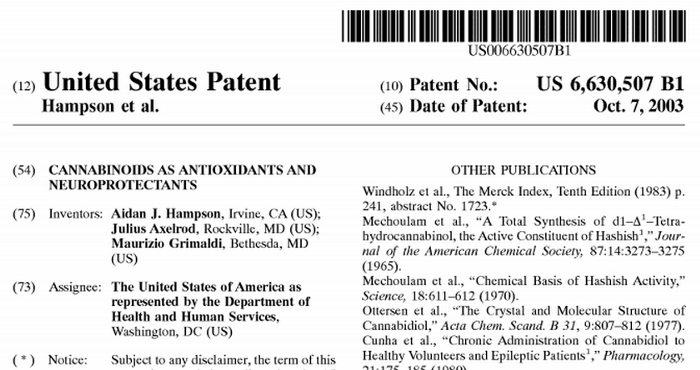
In 2003, patent No. 6630507 was granted to the Department of Health and Human Services. Cannabinoids have been found to have antioxidant properties. Patent No. 6630507 also references 12 other U.S. patents related to cannabis dating back to 1942. U.S. Patent No. 6630507 covers the potential use of non-psychoactive cannabinoids to protect the brain from damage or degeneration caused by certain diseases, such as cirrhosis.
The U.S cannabinoids patent lists the use of certain cannabinoids found in cannabis sativa plants as useful in the treatment of certain neurodegenerative diseases such as Parkinson’s, Alzheimer’s, and HIV dementia. The cannabinoids are found to have particular application as neuroprotectants, which is any substance that helps to shield nerve cells from damage or death. As such, said cannabinoids aid in limiting neurological damage following ischemic insults, such as stroke and trauma, or in the treatment of neurodegenerative diseases Moreover, this newly discovered property makes cannabinoids useful in the treatment and prophylaxis of wide variety of oxidation associated diseases, such as age-related, ischemic, inflammatory, and autoimmune diseases. One particular disclosed class of cannabinoids useful as neuroprotective antioxidants is formula (I) wherein the R group is independently selected from the group consisting of H, CH, and COCH.

Some common personal injury cases include:
There are two types of damages that are recoverable in California personal injury cases, which include special damages and general damages. Special damages are those damages that are financial in nature, such as hospital and medical bills or lost wages. On the other hand, general damages are those that are non-financial losses, including pain and suffering, loss of consortium, and emotional distress.

Judgement or settlement which exceeds policy limits after denying a settlement offer within policy limits and the excess settlement rule. California Court of Appeals ruled that primary insurance companies are responsible for paying all losses in excess of policy limits after denying a within-limits settlement offer, regardless of whether the excess loss arises out of a verdict, judgment or a settlement.
The Second District California Court of Appeal’s August 5, 2016 opinion in Ace American Ins. Co. v. Fireman’s Fund Ins. Co. found that “where the insured or excess insurer has actually contributed to an excess settlement, [the insured or excess insurer] may allege that the primary insurer’s breach of the duty to accept reasonable settlement offers resulted in damages in the form of the excess settlement.” The lack of a final judgment was immaterial, as there was “no persuasive reason to hold that the [policyholder] or its assignee, [the excess insurance company], must suffer that loss with no remedy simply because the case reached an eventual settlement instead of being litigated through trial.”

Not all businesses are made alike. Choosing the right business entity formation is a huge step for any business owner because there are many different entity forms of businesses one can form. A Glendale business entity formation attorney can help you determine which entity form would be the best for your type of business. However, before a business owner considers which entity form h/she wishes, you must determine what name you wish to use for the corporation and check whether or not that name is available to use.
The California Secretary of State website provides a tool for business owners to check for corporation name availability.
In determining name availability, the database checks only against names of like entities registered with the California Secretary of State. Thus, before you are set on a name, check with the California Secretary of State website for corporation name availability.

Effective January 1, 2018, new California marijuana laws to roll out. California will starts accepting online applications for temporary business permits for marijuana business owners. The Bureau of Cannabis Control's online application system will open in December and that the BCC will begin emailing temporary licenses to retailers before the new year. The licenses will become valid on Jan. 1. By New Year’s Day, marijuana/cannabis business owners should be receiving an email from the state regarding the approval of the temporary marijuana business permits. Temporary marijuana business permits will be good for four (4) months. The purpose of giving business owners 4 months, is to give marijuana shop owners time to complete all other additional information needed to receive permanent licenses. Once approved, you will be able to immediately start selling cannabis to adult 21 and over with an valid ID. further opens the door for local governments to permit marijuana consumption at retailers and companies with a micro-business license, which combines a small cultivation site, distribution and retail.
Some of the restrictions associated with growing marijuana pertain to the individual’s age who decides to grow marijuana. As previously mentioned, individuals aged between 18 to 20 years old may be cited with an infraction. Additionally, an individual is not permitted to grow more than six (6) hash plants. This would lead to county jail time of up to six (6) months as well as possibly being fined up to $500. Further, an individual must grow the hash plant indoors or on the premises of their own private property, lock the space efficiently, and grow the plants in an area that is not visible from a public place.
If you or someone you know is interested in growing marijuana for recreational use, contact our KAASS LAW firm at (310) 943-1171. Our attorneys can provide you with a consultation on your case and provide legal assistance to make sure you are in compliance.
There are two types of damages that are recoverable in California personal injury cases, which include special damages and general damages. Special damages are those damages that are financial in nature, such as hospital and medical bills or lost wages. On the other hand, general damages are those that are non-financial losses, including pain and suffering, loss of consortium, and emotional distress.
The statute of limitation for bringing a pedestrian vs car accident is 2 years from the date of the accident. However, claims involving government tort or injury involving a government entity, such as a car accident with a government city vehicle, requires the injured party to first file a claim with the appropriate governmental agency within 6 months from the date of the accident. Finally, depending on the outcome of the claim, the claimant will then have either 6 months or two years to file suit. If you fail to follow the guidelines for the statute of limitations, you may lose your right to file a claim.
California Code of Civil Procedure section 335.1 provides, an injured pedestrian has two years to file a claim against those who may be liable for their accident.
Our personal injury attorneys specialize in various personal injury matters including complex personal injury cases, government torts specifically related to auto accidents, motorcycle accidents, left turn motorcycle accidents, truck accidents, multi-car accidents, which involve a government vehicle such as Metro Bus, fire truck, U.S Postal Service, and Water & Power Truck. If you have been involved in an accident involving a Government vehicle, give our office a call at (310) 943-1171 for a free consultation. [contact-form][contact-field label="Name" type="name" required="true" /][contact-field label="Email" type="email" required="true" /][contact-field label="Website" type="url" /][contact-field label="Message" type="textarea" /][/contact-form]
[video width="1280" height="720" mp4="https://kaass.com/wp-content/uploads/2020/02/California-Pedastrian-Vehicle-Accident.mp4"][/video]
Can you grow marijuana outdoors in California is a frequently asked question. In California you cannot grow marijuana outdoors, nor can it be plainly visible to the naked eye from a public place. In other words, you can’t realistically grow pot in your backyard, because if your neighbors can see it with their unaided vision, then it’s still technically illegal. Due to these restrictions, you will typically want to cultivate your marijuana indoors and somewhere that is not easily visible from the outside. Furthermore, if there is more than one person living in that residence, you are still limited to no more than 6 marijuana plants. In other words, you and your spouse cannot grow twelve plants together, because the 6 plant limit applies per residence, not per person.
You’ll have noticed pretty quickly that all of these official legal definitions and restrictions utilize the word ‘cultivate’ when referring to growing of marijuana plants. This is because it gives a sense of consistency to the semantics that are at play in the law. However, the word ‘cultivate’ in these legal contexts is a bit more encompassing than you might usually expect. Here, to cultivate can mean any or all of the following:
As you can see, the definition of ‘cultivate’ is heavily expanded in these contexts for simplicity’s sake and for the sake of being able to capture more meaning into the word itself. These additional meanings of ‘cultivate’ are significant because the wording of the law is key to understanding what you may be accused of or charged with. Because of the expanded meaning, you do not even have to be physically present to ‘cultivate’ marijuana—even just being indirectly involved with its process is sufficient to be accused. This means that if you were to help your friend remove the leaves, you’d still be ‘cultivating’ marijuana.
This is where things get a bit more murky. Cultivating marijuana for medicinal use is different than for personal use. Even the laws used to denote them are distinct. The one that matters most here is California’s “Compassionate Use Act of 1996”, which came into law through Proposition 215; its provisions are further outlined in California Health and Safety Code 11362.5 and other subsequent sections. In a nutshell, the Compassionate Use Act gives exemptions to the following groups from the usual California laws that govern and regulate the possession and cultivation of marijuana:
Medicinal marijuana patients and their primary caregivers can grow or cultivate 6 mature marijuana plants, 12 immature marijuana plants, or, with a doctor’s recommendation, an even greater number of plants, relative to the patients’ needs for treatment.
Now that marijuana legalization in California has kicked in, most violations of Health and Safety Code 11358 will be considered misdemeanors. The punishments for breaking this statute may include:
You should, however, keep in mind that violating HS 11358 does have more severe consequences if:
In these situation, you would instead be convicted of a felony and you could be sentenced up to 3 years in county jail and be fined a maximum fine of $10,000.
Provided that your arrest was solely for cultivating excessive amounts of marijuana for personal use, you are a non-violent first or second time offender, and/or you are a minor, you can qualify for deferred entry of judgement or a pretrial diversion (enter links to article here). In this case, you will have your sentencing put on hold while you participate and complete a state-approved drug counseling or treatment course. This procedure is due to California Penal Code 1000 and upon successfully completing it, the charges will be dismissed. Crucially, this means that the arrest and the charges will not exist on your record for most purposes, like applying for a job, school, housing, and other applications. However, it does require that you plead guilty first and foremost, as well as meeting the eligibility requirements. Only then will the court consider and accept your case for pretrial diversion. Whether or not your case may qualify for pretrial diversion is something your lawyer will discuss with you.
Proposition 64, now that it is fully in effect, has greatly changed the way that California handles marijuana cases as they pertain to use, possession, and cultivation. As a result of this, the law does work retroactively. In other words, if you were convicted of marijuana cultivation prior to the passing of Prop 64, you may now not be found guilty of convicting a crime at all. In fact, even if you had grown more than the legal limit of 6 marijuana plants, you would still have a reduced punishment since you would have been guilty of a misdemeanor, not a felony. Prop 64, through Health and Safety Code 11361.8 permits those who were convicted under the old version of HS 11358 to appeal for redesignation or resentencing of their violation. For the most part, the court will grant the resentencing without much thought, unless they feel that you would pose some serious risk to public safety. Based on how much of your sentence has already been served, you might even be subject to immediate release. This also holds true for those that were convicted of a marijuana cultivation or use felony under older laws; you can apply to have your crime redesignated from a felony to a misdemeanor, or possibly even get it expunged entirely if you would not been found guilty of any crime under these new laws.
A skilled criminal defense lawyer will get the details of your case and use them to shield you. The following are just some of the possible defenses that may be used in your situation:
f you or a loved one has been accused of violating California Health and Safety Code 11358, or any marijuana law, we invite you to give us a call at (310) 943-1171 to speak to a skilled Los Angeles marijuana defense attorney with confidentiality today.
Location & Directions KAASS LAW Location: 701 North Brand Blvd. Suite 100 Glendale, CA 91203 Telephone: (310) 943-1171 Email: [email protected]
Our lawyers in Glendale, Los Angeles, CA at KAASS LAW are authorized to practice law in California. The above content is intended for California residents only. This content provides only general information which may or may not reflect current legal developments. KAASS LAW expressly disclaims all liability in respect to actions taken or not taken based on any of the contents of this website. The above content DOES NOT create an attorney-client relationship. KAASS LAW does not represent you unless you have expressly retained KAASS LAW in person at the KAASS LAW office. KAASS LAW helps clients in: Los Angeles, Burbank, Hollywood, Glendale, Van Nuys, North Hollywood, Studio City, Highland Park, Eagle Rock, Sunland, Tujunga, Sylmar, San Bernardino, La Crescenta, La Canada, Beverly Hills, Westwood, Santa Monica, Brentwood. Pacoima, Montebello, Commerce, Alhambra, Downey, Bell, Maywood, Walnut Park, Vernon, Lynwood, Echo Park, Silverlake, Mission Hills, Northridge, Woodland Hills, Encino, Canoga Park, North Hills, Porter Ranch, Chatsworth, Reseda.
Drug counseling and community service hours for minors and a fine of $100 for those 18 and older
Owning more than 28.5 grams of marijuana and/or more than 8 grams of concentrated cannabis for minors (under 18 years of age)
Infraction
Drug counseling and community service hours
Having marijuana and/or concentrated cannabis in a K-12 institution while a minor (under 18 years of age)
Infraction
Drug counseling and community service hours
Owning more than 28.5 grams of marijuana and/or more than 8 grams of concentrated cannabis (18 years of age and up)
Misdemeanor
A maximum sentence of 6 months in county jail as well as a $500 fee
Having marijuana and/or concentrated cannabis in a K-12 institution (18 years of age and up)
Misdemeanor
Up to a $250 fee for the first offense, with subsequent offenses incurring additional penalties
Possession of more than 28.5 grams of marijuana or more than 8 grams of concentrated cannabis (hashish) is still illegal under California’s Health and Safety Code 11357. The above chart summarizes the consequences one may face for having excessive amounts of marijuana. Typically, for adults these consequences are deemed misdemeanors and will usually result in a fine of no more than $500 and/or 6 months in county jail, while for minors the crime is merely an infraction and the penalties are to attend drug counseling sessions and community service hours.
Having marijuana on school grounds is also illegal: for adults it is a misdemeanor and for minors it is an infraction. The penalties for minors who commit this crime are identical to the penalties that a minor may face if they possess excessive amounts of marijuana. For adults, it will usually result in a $250 fee for the first offense. Bear in mind that possessing any amount of marijuana at all as a minor is still illegal even in California, and the consequences range from paying a fine to facing drug education or counseling programs and community service.
There are several legal defenses that a skilled Los Angeles marijuana defense attorney can provide in cases that involve charges of illegal marijuana possession in California. These defenses include:
-You didn’t own the marijuana in question
-You were not aware that you had any marijuana
-The marijuana in question was procured in an illegal search or seizure
If you or someone you know is accused of violating California Health and Safety Code 11357 or California Vehicle Code 23222(b) illegal to possess marijuana while driving a vehicle we welcome you to give us a call at (310) 943-1171 to speak to a defense attorney for a free consultation.
KAASS LAW is authorized to practice law in California. The above content is intended for California residents only. This content provides only general information which may or may not reflect current legal developments. KAASS LAW expressly disclaims all liability in respect to actions taken or not taken based on any of the contents of this website. The above content DOES NOT create an attorney-client relationship. Our Los Angeles litigation lawyers do not represent you unless you have expressly retained KAASS LAW in person at our office.
Recently, legal-marijuana pioneers have experienced a rising concern in retaining a marijuana intellectual property lawyer in order to protect their creations from imitators, as well as from multinational corporations in the agriculture, tobacco and pharmaceutical industries that appear to be keeping a close eye on the fast-growing marijuana industry from the sidelines. For instance, in 2013 the first marijuana strain patent containing significant amounts of THC ever granted, patent No. 9,095,554. Accordingly, the patent provides compositions and methods for the breeding, production, processing and use of specialty cannabis.
If you have questions regarding marijuana laws or or are seeking to start a recreational marijuana business in California, we invite you to call our office for a consultation with a Los Angeles recreational marijuana business lawyer today.
Loss of consortium is a claim for damages suffered by the spouse or children of a person who has been injured or killed as a result of the defendant's negligent or wrongful acts. Generally, claims for loss of consortium are not awarded unless the person injured dies or suffers a severe and enduring injury. The suing party must show that the injured or deceased family member cannot provide his or her spouse or family member with the same love, affection, companionship, comfort, society, or sexual relations that were provided before the accident.
Statute of limitations is the period of time you have to file a claim or suit. Personal injury cases have a statute of limitations varies depending on the type of case, but generally, the time limit usually starts on the day the accident or injury occurred and can last anywhere from 1 to 2 years. However, in claims involving government tort or injury involving government entity, such as an car accident with a government city vehicle, requires the injured party to first file a claim with the appropriate governmental agency within 6 months from the date of the accident. Finally, depending on the outcome of the claim, the injured party will then have either 6 months or two years to file suit. If you fail to follow the guidelines for the statute of limitations, you may lose your right to file a claim. Thus, it is vital you speak to a Los Angeles personal injury lawyer immediately to preserve your claim! Our lawyers in Glendale, Los Angeles, California, will be happy to help you through every step of your personal injury case.
Our personal injury attorneys specialize in various personal injury matters including complex personal injury cases, government torts specifically related to auto accidents, motorcycle accidents, left turn motorcycle accidents, truck accident, multi-car accidents, which involve a government vehicle such as Metro Bus, fire truck, U.S Postal Service, and Water & Power Truck. If you have been in an accident involving an Government vehicle, give our office a call at (310) 943-1171 for a free consultation! This content is for educational purposes only. KAASS LAW is authorized to practice law in California. The above content is for California residents only. This content provides only general information, which may or may not reflect current legal developments. KAASS LAW expressly disclaims all liability in respect to actions taken or not taken based on any of the contents of this website. The above content DOES NOT create an attorney-client relationship. KAASS LAW does not represent you unless you have expressly retained KAASS LAW in person at the KAASS LAW office. KAASS LAW helps clients in: Los Angeles, Burbank, Hollywood, Glendale, Van Nuys, North Hollywood, Studio City, Highland Park, Eagle Rock, Sunland, Tujunga, Sylmar, La Crescenta, La Canada, Beverly Hills, Westwood, Santa Monica, Brentwood. Pacoima, Montebello, Commerce, Alhambra, Downey, Bell, Maywood, Walnut Park, Vernon, Lynwood, Echo Park, Silverlake, Mission Hills, Northridge, North Hills, Porter Ranch, Chatsworth, Reseda, San Diego, La Jolla, El Cajon, Chula Visa, Del Mar
In order words, in the event that a policyholder(s) do not have excess insurance, policyholders should argue that their first party insurance company or primary insurer who rejected a within-limits settlement offer is obligated to pay the full amount of any subsequent settlement which exceeds that insured's policy limits. There is no reason why the first party insured should be forced to contribute or pay a settlement of which first party insured could recover by filing at first party bad faith action against their primary insurance company.
California insurance bad faith actions arise when insurance company breaches the implied obligation of good faith and fair dealing. Insurance companies must, unreasonably or without proper cause, act or fail to act in a manner that deprives the insured of the benefits of the policy. It is not a mere failure to exercise reasonable care. However, it is not necessary for the insurer to intend to deprive the insured of the benefits of the policy. Generally, the term bad faith for insurance purposes means an insurance company:
The court found that when an insurer's failure to reasonably settle a claim within policy limits, after primary or "first party" insurance rejected a within-limits settlement offer and there is a judgement against their insured/policyholder, whether by settlement or verdict, the first party insurance company must pay any excess monies, whether through jury verdict, settlement, or judgment. Policy limits demands can be a powerful tool for plaintiffs' insurance lawyers and can cause headaches for claims adjusters. While, it all depends on the circumstances surrounding the claim or issue, an insurer that misses an opportunity for a reasonable settlement of a claim against its insured can now be liable for the full amount of a later judgment, regardless of the policy limits. If you believe that your primary insurance company rejected a within-limits settlement offer and an later there was a subsequent settlement or judgement which exceeds your policy limits or you believe that your insurance company may be acting in bad faith, speak to one of our Los Angeles insurance lawyers for a free consultation and case review. Call our office at (310) 943-1171, our attorneys speak English, French, Spanish, Russian, Armenian, and Italian.
There are many corporation entity types and each type have different forms that must be completed with the California Secretary of State. The following are corporation entity types a business owner can choose from:
Often times, many business owners are unable to finalize their corporate filings due to name issues, errors, missing forms, or misstatements in the proposed filings. The following filing tips are designed to help you meet the minimum filing requirements of the California Corporations Code. If you have specific legal questions or concerns regarding to corporate filing we invite you contact a Glendale corporate filing lawyer for a consult. Our business lawyer at KAASS LAW is experienced with many cases involving business law.
As mentioned above, the preliminary task is to check of the availability of a name with the California Secretary of State’s office.
Under California law, a corporation must have at least three directors, unless there are less than three shareholders. In that case, the number of directors may be equal to or greater than the number of shareholders. California does not set forth a minimum age or residency requirement for directors. Either the articles of incorporation or the corporation’s bylaws must state the number of directors that will constitute the corporation’s board of directors. Finally, prepare and file articles of incorporation with the Secretary of the State.
If you will be paying at least $100 to an employee or employees in a quarter (this includes corporate officers), you are subject to California employment taxes and must register for a California employer account number within 15 days of paying that $100. You can register for employment taxes and get your account number online using the Employment Development Department’s website. These taxes must be paid quarterly.
When preparing and filing articles of incorporation with the Secretary of the State, ensure that you have correctly completed the Articles of Incorporation form. A Statement of Information Form SI-550 must also be filed with the California Secretary of State within 90 days after filing the Articles of Incorporation. The Statement of Information must be filed each year thereafter during the applicable filing period. Furthermore, most corporations are required to pay a minimum tax of $800 to the California Franchise Tax Board each year. This content is intended for educational purposes only. KAASS LAW is authorized to practice law in California. The above content is intended for California residents only. This content provides only general information, which may or may not reflect current legal developments. KAASS LAW expressly disclaims all liability in respect to actions taken or not taken based on any of the contents of this website. The above content DOES NOT create an attorney-client relationship. KAASS LAW does not represent you unless you have expressly retained KAASS LAW in person at the KAASS LAW office. KAASS LAW helps clients in: Los Angeles, Burbank, Hollywood, Glendale, Van Nuys, North Hollywood, Studio City, Highland Park, Eagle Rock, Sunland, Tujunga, Sylmar, La Crescenta, La Canada, Beverly Hills, Westwood, Santa Monica, Brentwood. Pacoima, Montebello, Commerce, Alhambra, Downey, Bell, Maywood, Walnut Park, Vernon, Lynwood, Echo Park, Silverlake, Mission Hills, Northridge, North Hills, Porter Ranch, Chatsworth, Reseda, San Diego, La Jolla, El Cajon, Chula Vista, Del Mar
California law imposes quality control regulations for pot, which requires new testing procedures. For instance, prior to distributing marijuana products, cannabis distributors will be required to test samples for possible pesticides residue, and bacteria. Products must also be labeled with the weight, THC, and CBD content.
California cannabis sales tax taking effect January 2018. A 15% levy on all cannabis sales will be added on cannabis and medical marijuana products. Local governments are also adding taxes for sellers and growers which potentially could result in a 70% increase in the price of a small bag of good quality marijuana.
Some specific California marijuana regulations to go into effect January 1, 2018 including the following:
Some restriction under California Prop 64 effective January 1, 2018 include:
If you have questions regarding marijuana laws or or are seeking to start a recreational marijuana business in California, or how to obtain a marijuana license, KAASS LAW invites you to contact our Los Angeles marijuana business attorneys for a consultation.
KAASS LAW is authorized to practice law in California. The above content is intended for California residents only. This content provides only general information which may or may not reflect current legal developments. KAASS LAW expressly disclaims all liability in respect to actions taken or not taken based on any of the contents of this website. The above content DOES NOT create an attorney-client relationship. KAASS LAW does not represent you unless you have expressly retained KAASS LAW in person at the KAASS LAW office. KAASS LAW criminal defense attorneys helps represent clients in Los Angeles, Burbank, Hollywood, Glendale, Van Nuys, North Hollywood, Studio City, Highland Park, Eagle Rock, Sunland, Tujunga, Sylmar, San Bernardino, La Crescenta, La Canada, Beverly Hills, Westwood, Santa Monica, Brentwood. Pacoima, Montebello, Commerce, Alhambra, Downey, Bell, Maywood, Walnut Park, Vernon, Lynwood, Echo Park, Silverlake, Mission Hills, Northridge, Woodland Hills, Encino, Canoga Park, North Hills, Porter Ranch, Chatsworth, Reseda.
[contact-form][contact-field label='Name' type='name' required='1'/][contact-field label='Phone' type='text' required='1'/][contact-field label='Email' type='email' required='1'/][contact-field label='Comment' type='textarea' required='1'/][/contact-form]