U.S Government Cannabinoids Patent No. 6630507
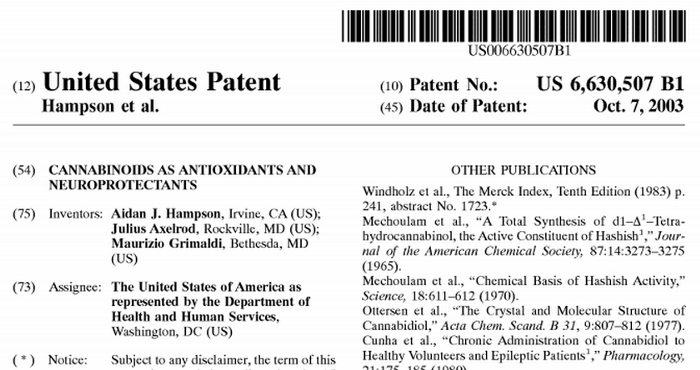
U.S Government Cannabinoids Patent No. 6630507
In 2003, patent No. 6630507 was granted to the Department of Health and Human Services. Cannabinoids have been found to have antioxidant properties. Patent No. 6630507 also references 12 other U.S. patents related to cannabis dating back to 1942. U.S. Patent No. 6630507 covers the potential use of non-psychoactive cannabinoids to protect the brain from damage or degeneration caused by certain diseases, such as cirrhosis.
Marijuana Patents U.S. Patent No. 6,630,507
The U.S cannabinoids patent lists the use of certain cannabinoids found in cannabis sativa plants as useful in the treatment of certain neurodegenerative diseases such as Parkinson’s, Alzheimer’s, and HIV dementia. The cannabinoids are found to have particular application as neuroprotectants, which is any substance that helps to shield nerve cells from damage or death. As such, said cannabinoids aid in limiting neurological damage following ischemic insults, such as stroke and trauma, or in the treatment of neurodegenerative diseases Moreover, this newly discovered property makes cannabinoids useful in the treatment and prophylaxis of wide variety of oxidation associated diseases, such as age-related, ischemic, inflammatory, and autoimmune diseases. One particular disclosed class of cannabinoids useful as neuroprotective antioxidants is formula (I) wherein the R group is independently selected from the group consisting of H, CH3, and COCH3.
First U.S. Marijuana Strain Patent Granted: Patent No. 9,095,554
Recently, legal-marijuana pioneers have experienced a rising concern in retaining a marijuana intellectual property lawyer in order to protect their creations from imitators, as well as from multinational corporations in the agriculture, tobacco and pharmaceutical industries that appear to be keeping a close eye on the fast-growing marijuana industry from the sidelines. For instance, in 2013 the first marijuana strain patent containing significant amounts of THC ever granted, patent No. 9,095,554. Accordingly, the patent provides compositions and methods for the breeding, production, processing and use of specialty cannabis.
Los Angeles Recreational Marijuana Business Lawyers
If you have questions regarding marijuana laws or or are seeking to start a recreational marijuana business in California, we invite you to call our office for a consultation with a Los Angeles recreational marijuana business lawyer today.
Related Articles
View All Posts
Purchasing a business is a complex procedure. The current business landscape is ever-changing, and success in this type of environment requires entrepreneurs to stay ahead of the curve. Purchasing an existing business is a great way to jump-start your entrepreneurial journey. However, success often hinges on ensuring that the purchased business can be transformed and adapted to fit a changing market. Here are four suggestions on how you can ensure this during the process of acquiring a new business.
Research Thoroughly
Before committing to any purchase, do your research! It's important that you understand the potential opportunities and threats associated with the specific business you're considering buying and its market. Evaluate industry trends, target customer demographics, competitive landscape, revenue streams, and more so that you can really gauge whether or not you can transform the purchased business effectively.
Conduct Experiments
After purchasing a business, don't be afraid to experiment with different approaches to see what works best for your desired market transformation. This could include launching pilot programs from time to time based on customer feedback. Also, testing out various marketing strategies depends on what type of product or service you offer. Additionally, refining pricing models and evaluating distribution channels are also great ways to experiment. This will help to increase customer satisfaction while shifting towards specific markets.
Redesign Branding Materials
Consider altering existing branding materials if they don't quite match up with the changing market shift you attempting to create within your acquired business. This could include small tweaks like updating slogans or logos. As well as, revamping entire campaigns involving promotional materials such as advertisements or social media posts. All of these subtle changes will help create an effective transformation process. This can happen by reinforcing the desired message with customers over time.
Leverage Technology
Technology can be leveraged in numerous ways when transforming a purchased business towards a shifting market. Incorporating technological advancements into accounting systems may help reduce costs and improve efficiency while investing in software solutions like CRMs could bolster customer relationship management efforts significantly. Moreover, using cutting-edge tools for website development or mobile app creation could open up even more avenues. Given their effectiveness in engaging different audiences across multiple platforms simultaneously.
In conclusion, it's possible to acquire an existing business and use it as a springboard to success by transforming it into something new that fits modern markets today. However, this requires careful planning beforehand coupled with ongoing experimentation afterward. This will afford durable results over time. By strictly adhering to the suggestions outlined above, entrepreneurs are sure to put themselves in great positions to develop successful enterprises!
Contact Attorney Today
We welcome you to contact Kaass Law's knowledgeable attorneys for a consultation. Call us at (310) 943-1171 now or visit the website for other practices!

Copyright laws are in place to safeguard people's intellectual property and prevent unauthorized use of their works. Under the authority of the Constitution's copyright clause, the federal government in the United States is responsible for enforcing copyright laws. The US Copyright Act of 1976, which grants creators exclusive rights over their works, controls copyright protection in the US. However, copyright rules range from one nation to the next. Therefore, it's crucial to comprehend the parallels and distinctions between US and foreign regulations.
Similarities Between US and Foreign Copyright Laws
Universally recognized fundamental rights for creators exist in several states. The creator does not need to register the work or do any additional actions to acquire protection in the majority of nations, including the United States. Instead, the result is covered by copyright as soon as it is produced and fixed in a tangible form. The owner of the copyright may impose limitations on the use of their work. This includes the rights to copy, distribute, perform, and show it. One similarity between US and foreign copyright rules is the concept of fair use. For particular purposes, such as criticism, commentary, news reporting, teaching, scholarship, or research, copyrighted content may be used without a license under this exception to the copyright law. Although the acceptable range of fair use varies from country to country. However, it is an essential part of copyright law in many jurisdictions.
Differences Between US and Foreign Copyright Laws
Although US and foreign copyright rules are similar, there are still important variations that creators should be aware of. The duration of copyright protection is one of the most important variances. In the US, copyright protection is valid for the lifetime of the creator plus an additional 70 years. The Copyright protection in some foreign countries is valid for the creator's lifetime plus an additional 100 years. Other nations have varied protection periods that range from 50 to 95 years following the creator's passing. The treatment of moral rights is another important distinction between copyright laws in the US and those of other countries. The creator's moral rights are their legal entitlement to credit for their creations and the right to forbid any alterations that would harm their reputation. Moral rights are an important part of copyright law in many other countries, especially in Europe, despite the fact that US copyright law doesn't recognize them. For instance, in France, authors must maintain the integrity of their works. Furthermore, no modifications or changes may be made without the author's permission. Along with variations in the length of copyright protection and the recognition of moral rights, there are several approaches to fair use. Even if fair use exists in the US, it is not in many other countries. Instead, the idea of "fair dealing," which exists in many nations, permits the unlawful use of intellectual property in certain situations. However, the definition of fair dealing varies from country to country. Therefore, it's important for creators to be familiar with the legal framework of the nations where they are doing business.
Contact an Attorney for a Consultation
In summary, copyright laws play a significant role in safeguarding intellectual property all around the world. Despite the similarities between US and international copyright laws, there are still significant differences that creators need to be aware of. Artists working worldwide or considering distributing their works abroad must be aware of these variances. Creators may protect their intellectual property and make sure that others don't use their works without permission by being aware of the legal framework for copyright protection in various jurisdictions. Feel free to give us a call for a consultation at 310.943.1171. If your business is located outside of the US visit the website for more information.
How Was Cultivating Marijuana Treated Before Proposition 64?
Cultivating marijuana in California was treated as a felony offense under Health and Safety Code Section 11358 before Proposition 64. A felony is a criminal offense punishable by serving one year or longer in prison.
How Does Proposition 64 Change Laws Relating to Cultivating Marijuana?
Proposition 64 went into effect on January 1, 2018, making it legal for individuals 21 years or older to grow marijuana for recreational purposes. Additionally, the sale of marijuana has also been legalized for those business entities that have been licensed to do so.
What Are the Changes Made as a Result of Passing Proposition 64?
The following is a list of crimes related to marijuana that has been affected by Prop 64 Adult Use of Marijuana Act:
Possession of up to 28.5 grams of marijuana (Health and Safety Code Section 11357)
- Before Proposition 64: Considered an infraction with a $100 fine
- After Proposition 64: Legal
Possession of up to 8 grams of concentrated cannabis (Health and Safety Code Section 11357)
- Before Proposition 64: Considered a misdemeanor
- After Proposition 64: Legal
Cultivating up to 6 marijuana plants (Health and Safety Code Section 11358)
- Before Proposition 64: Felony
- After Proposition 64: Legal for ages 21 years and older
Cultivating more than 6 marijuana plans (Health and Safety Code Section 11358)
- Before Proposition 64: Felony
- After Proposition 64: Misdemeanor
Possession of marijuana for sale without a license (Health and Safety Code Section 11359)
- Before Proposition 64: Felony
- After Proposition 64: Misdemeanor if 1st and 2nd offense
Sale and transportation of marijuana without a license (Health and Safety Code Section 11360)
- Before Proposition 64: Felony
- After Proposition 64: misdemeanor if 1st or 2nd offense
Can You Apply for Resentencing After Passing Proposition 64?
Individuals convicted prior to the passing of Proposition 64 may apply for resentencing. Resentencing under Proposition 64 may lead to an immediate release from jail. However, this may be contigent on how much time you have served.
How Do You Apply for Proposition 64 Resentencing?
An individual can make an application to the court to have their sentence reduced. This is true for individuals who are currently serving time related to marijuana crimes they were convicted of before the passing of Proposition 64. Typically, judges presume that individuals applying for such a request have met the criteria for Proposition 64 resentencing. However, this may not be the case should the prosecutor oppose the petition by proving clear and convincing evidence that the individual does not meet the criteria for resentencing. However, judges are supposed to resent individuals so long as the individual does not pose an unreasonable risk of danger to public safety.
Los Angeles Criminal Defense Attorney
Are you in need of legal advice or services from an attorney? We invite you to contact our Los Angeles criminal defense attorney at (310) 943-1171 for assistance. KAASS Law is always standing by and ready to provide legal assistance.