

Yes, California has discrimination laws. Employers who discriminate against a protected class of employees or job candidates are breaking the law, according to the California Fair Employment and Housing Act. Victims of workplace discrimination have the right to sue their employer for monetary damages.
Evidence of discrimination in the workplace could include demonstrating that particular groups of employees are treated differently than others. It could also involve abrupt shifts in an employer's attitude toward an employee after learning that the individual belongs to a protected group. If you think you are being discriminated against, please look for the following examples:
Employers that are members of the same protected class as the employee are nonetheless permitted to discriminate. An African-American manager, for example, could prejudice against an African-American employee or candidate. A female employer can treat a female applicant unfairly because of her gender.
Before an individual is ever hired, employment discrimination rules apply to job applications, job seekers, and interview circumstances. Improper job application forms or interview questions could be a symptom of probable employment discrimination. When an employer asks a person these questions, they may be breaking the law.
Employers may not force a candidate to take a medical or psychological assessment if no other prospective workers are required to do so, or if the examination is not job-related and in line with business requirements. An employer, on the other hand, may ask job applicants if they are capable of performing the job's essential functions and how they would carry out the duties. After an applicant has been granted a position, the employer can condition it on the applicant passing a medical exam or answering medical questions if all new workers in a similar job function must also answer these questions or undergo a medical exam.
It is a civil right under California law to be able to seek and keep work without being discriminated against on the basis of race, religion, sexual orientation, or other forms of unlawful discrimination. Employees who are discriminated against might launch a discrimination lawsuit against their employers. You only have a limited amount of time to initiate a lawsuit against your employer for discrimination in the workplace. The time restriction is determined in part by the manner in which your complaint was handled. However, depending on the circumstances, these dates may be extended or shortened. The time limits to file a lawsuit vary depending on if its a federal discrimination lawsuit or a California discrimination law suit. See below for details.
In general, you must file a complaint with the DFEH within three years of the latest act of discrimination or retaliation in the workplace. Before you can bring a case in civil court, you must first get a Right-to-Sue notice. You have one year from the date the state sends you a notice of your right to sue or does not pursue your claim to file a lawsuit in state court.
You have 180 days to file a federal employment discrimination complaint. However, if a state or local agency enforces employment discrimination statutes on the same premise as the EEOC, the period can be extended to 300 days. Employees in California would have 300 days to submit an EEOC complaint for the majority of employment discrimination claims. You must first get a notice of right to sue in order to file a federal employment discrimination claim. After receiving a notification of right to sue from the EEOC, the employee usually has 90 days to bring a civil case.
Aside from employment discrimination, there are other types of discrimination as well. Some of the other types of discrimination are related to housing, education, and finances such as loans or sales.
If you or someone you know has been discriminated against at the workplace, feel free to contact KAASS Law today at 310.943.1171. Our specialized employment attorneys will be able to assist you with this matter.

California is known for its strong laws that protect employee. When it comes to their rights, this is extremely important for workers, especially when they need to take rest and or meal breaks. Having compliance with these regulations is not just a legal obligation for employers. As a result, it is crucial for fostering a productive, healthy and legally sound work environment. Here at KAASS LAW, we are dedicated to providing an informative to all our readers and or clients so they may prosper efficiently at their work place. The following will shine a light on meal breaks and rest periods during your ideal work environment.
According to the Department of Industrial Relations and CA Labor Code 512, non-exempt employees in California must have a thirty (30) minute lunch or meal break if they work more than five (5) hours in a day, according to wage and hour law. The meal break must be within the first five hours of the workday. Employees who work more than ten (10) hours a day have the right to a second 30-minute meal break.

In today's interconnected world, businesses rely heavily on their employees to deliver services, create products, and represent the company's brand. While most employment relationships are mutually beneficial, there are instances where an employee's actions can cause significant harm to others. When this harm stems from an employer's failure to properly vet, manage, or dismiss a problematic employee, it can give rise to a legal claim for negligent hiring, supervision, or retention. At KAASS LAW, we understand the complexities of these cases and dedicate in helping those who with injuries due to an employer's negligence in these critical areas.
Usually, injuries take place in a place of business, or the accident occurs due to the negligence of an employee in any other place. California law gives the injured person the right to sue and recover damages from the employer who is liable for the negligent hiring or supervision of the employee. California Civil Jury Instruction (CACI) 426 clearly explains the elements that must be proven for convicting the employer in negligent hiring and/or supervising the employee:
The American workforce is the backbone of our nation's economy. With countless individuals contributing their skills and labor across various industries. While workplaces strive to maintain safe environments, accidents and injuries can still occur, sometimes due to employer negligence. For workers engaged in interstate commerce, a unique set of legal protections exists under the Federal Employers Liability Act (FELA). FELA provides a crucial legal avenue for workers who got an injury on the job due to their employer's negligence. At KAASS LAW, we champion the rights of workers and dedicate to ensuring they receive the compensation. The following will explore the key aspects of FELA, its purpose, scope, and how it can help injured workers seek recovery.
Federal Employers Liability Act (FELA) is a U.S. federal law which has the aim to protect and compensate workers injured on the job, in case the worker is able to establish that it was at least partially negligent in causing him and injury.
According to CACI 2900, in case the plaintiff claims that while he was employed by the defendant, he was harmed by his negligence he must be able to prove all the following elements to establish the claim:

The Fair Employment and Housing Act provides protection to employees from illegal employment practices. Employers are subject to the Fair Employment and Housing Act in case they have five or more employees. Under FEHA, an employer is prohibited from taking adverse action against his employee based on discrimination or retaliation. The Fair Employment and Housing Act also provides protection to employees from harassment, failing to take necessary steps to prevent harassment and discrimination, and failing to provide reasonable accommodations for pregnancy or mental or physical disability.
Workplace harassment and discrimination can be in different forms, including cases of:
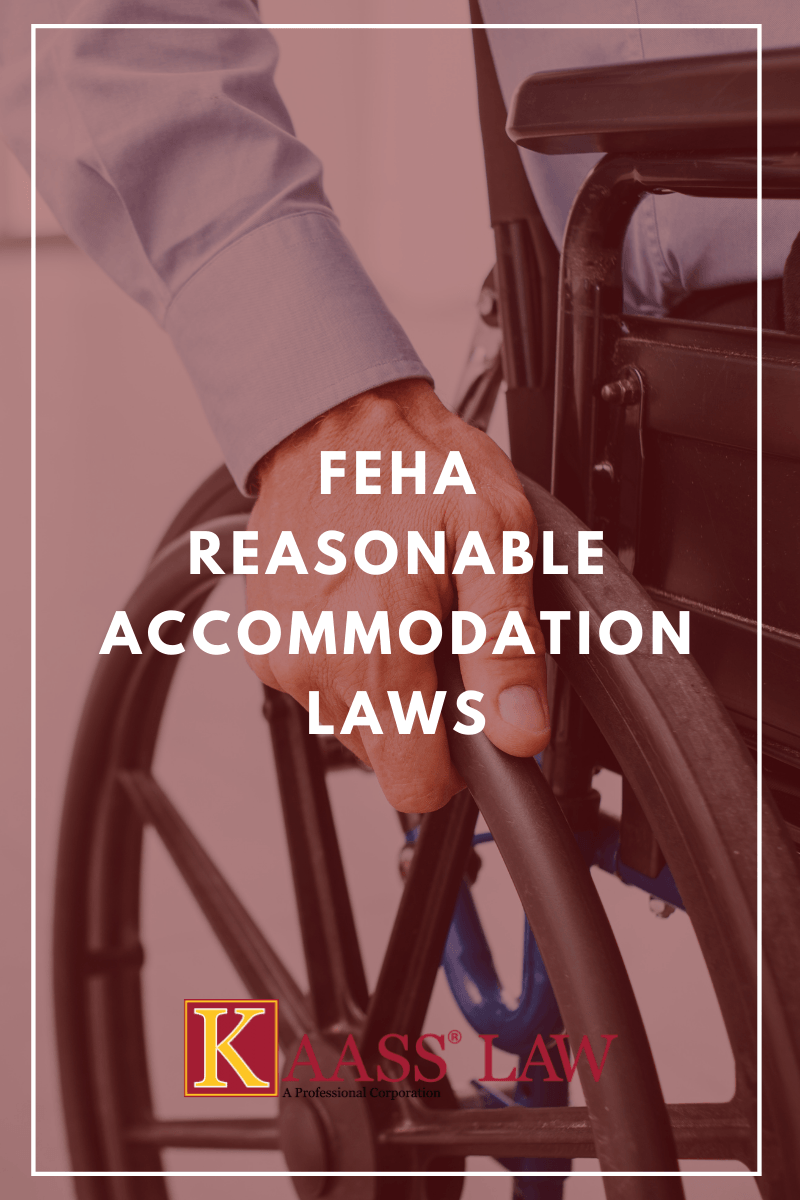
California law recognizes the importance of providing equal opportunities for individuals with disabilities in the workplace. The Fair Employment and Housing Act (FEHA) mandates that employers provide reasonable accommodations to employees and job applicants with disabilities, enabling them to perform their job duties and participate fully in the workplace. At KAASS Law, we are dedicated to upholding the rights of individuals with disabilities and ensuring that employers fulfill their legal obligations. The following will explore the intricacies of reasonable accommodation under FEHA and how we can help if your rights have been violated.
The Fair Employment and House Act provides protection to employees from illegal employment practices. Employers are subject to the Fair Employment and Housing Act in case they have five or more employees. According to the Fair Employment and Housing Act, employers who have five or more employees are required to provide reasonable accommodation in California for individuals with a mental or physical disability to perform essential functions of their jobs.
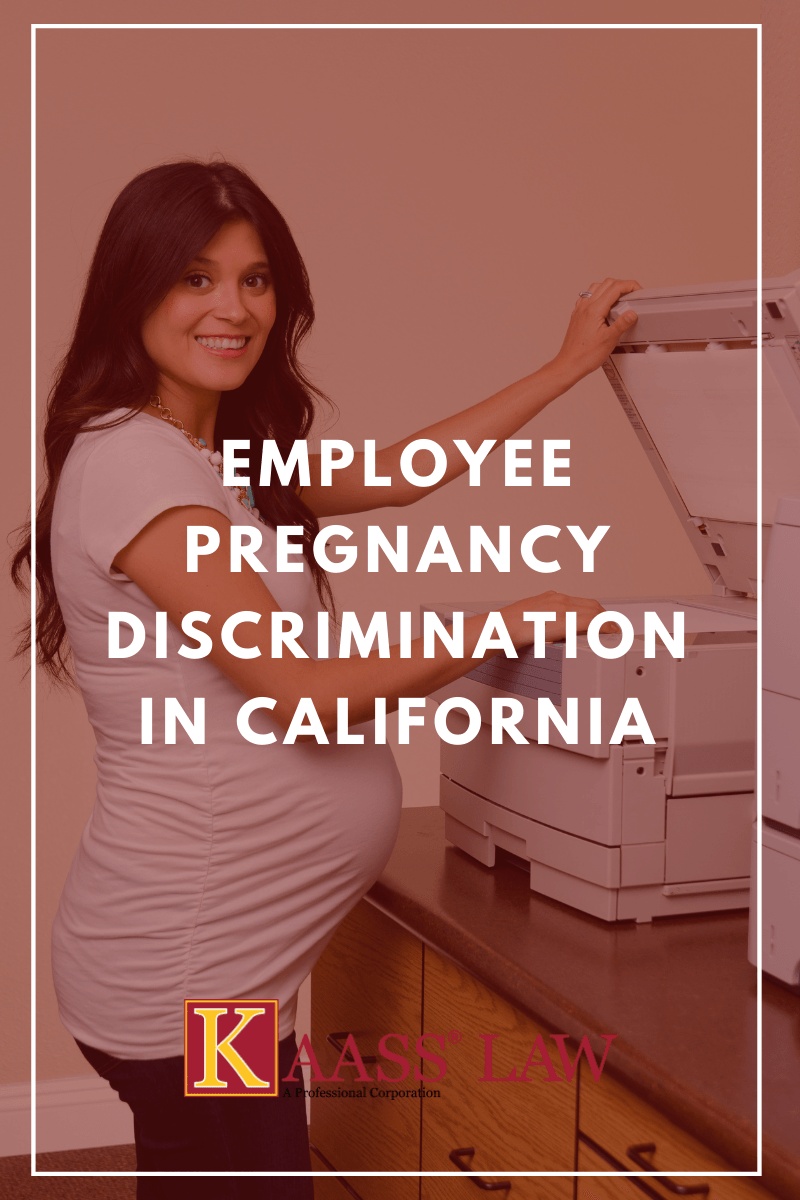
Employment pregnancy discrimination occurs when an employee or job applicant receives less favorable treatment because due to her pregnancy or on the basis that she may someday become pregnant.
Examples of employment pregnancy discrimination include:
An employee or job applicant will have to prove the following elements to establish that the employer engaged in unlawful discrimination:
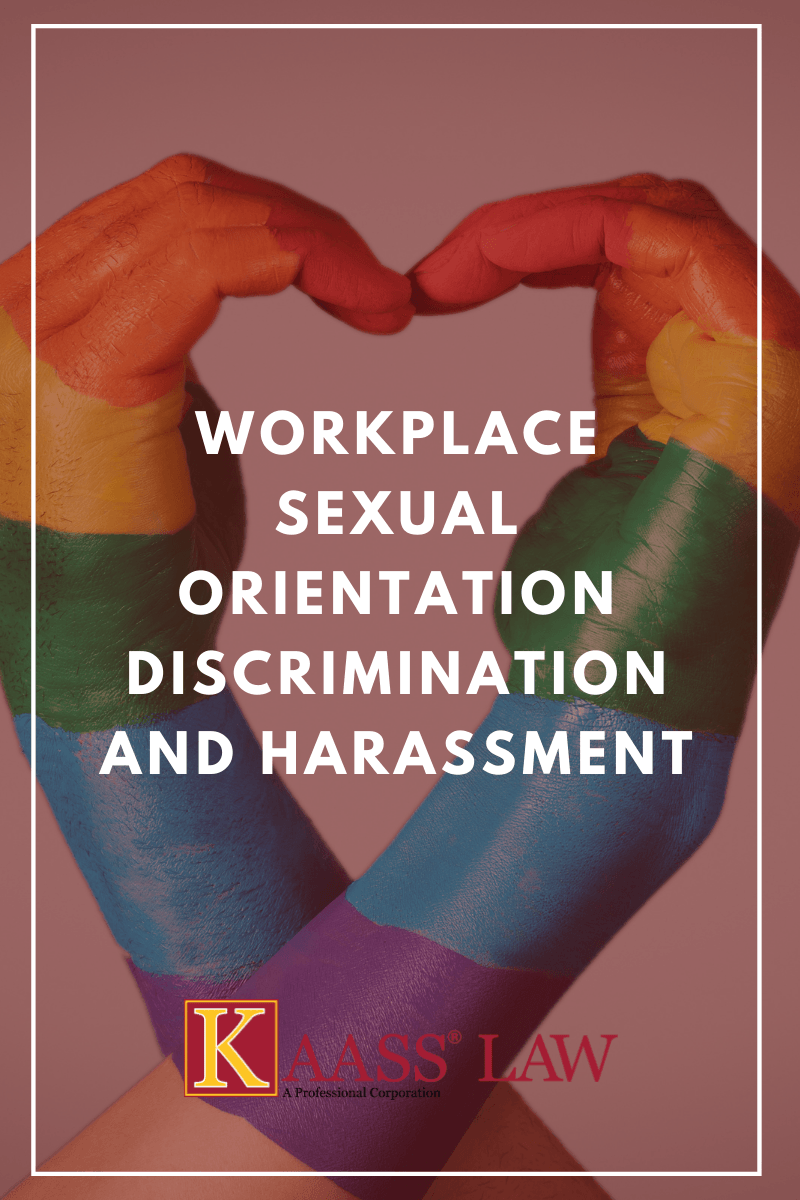
California has long been at the forefront of protecting the rights of LGBTQ+ individuals, and the workplace is no exception. The Fair Employment and Housing Act (FEHA) prohibits discrimination and harassment based on sexual orientation and gender identity. This is guaranteeing that all employees have the right to a safe and inclusive work environment. At KAASS Law, we are dedicated to upholding these rights and fighting for justice when they are violated. The following will explore the issue of workplace discrimination and harassment based on sexual orientation and gender identity in California. As a result, we are attempting to explain your rights and how we can help.
The Fair Employment and Housing Act apply to employers with five or more employees. The exception is the cases of harassment, where there is no minimum employer size. The FEHA also applies to labor unions, employment agencies, state licensing boards, and state and local governments. Though, the FEHA doesn’t provide protection for federal employees. According to the California Fair Employment and Housing Act, (), it is illegal for an employer to fire, fail to hire, or discriminate in any way against a person on the basis of their sexual orientation. Sexual orientation can mean homosexuality, bisexuality, and heterosexuality. Furthermore, includes the perception that a person has some characteristics or in case a person actually has the characteristics of a type of sexual orientation.
The California Family Rights Act (CFRA) provides eligible employees with crucial job-protected leave. This is so that someone can care for themselves or their families during times of need. However, many employees are unaware of their rights under CFRA. Employers sometimes violate these rights, leading to stressful and unlawful situations. The following is helping to shed light on CFRA violations and how KAASS Law can help protect your rights.
The California Family Rights Act (CRFA) has aimed to ensure employees with a right to a temporary leave from employment. The CFRA allows eligible employees to take up to 12 weeks of unpaid, job-protected leave during a 12-month period for the following reasons:
On July 1, 2018, California’s Fair Employment and Housing Commission regulations expand its protections against “national origin discrimination" under the FEHA. Fair Employment and Housing Act apply to public employers in California. National origin discrimination is serious, and we must actively enforce zero tolerance everywhere, at all times. California takes pride in its diversity, and the law reflects this commitment to inclusivity. The Fair Employment and Housing Act (FEHA) provides robust protections against workplace discrimination, including discrimination based on national origin. At KAASS Law, we champion the rights of employees and strive to create workplaces free from prejudice and bias. The following will explore national origin discrimination under FEHA and how we can help if your rights have been violated.
Enacted in September 18, 1959, FEHA was a big step on improving equality and fairness amongst all types of people in California. The Fair Employment and Housing Act (California Government Code Section 12900-12951 & 12927-12928 & 12955 - 12956.1 & 12960-12976) provides protection from harassment or discrimination in employment because of: age (40 and over), ancestry, color, creed, denial of family and medical care leave, disability (mental and physical) including HIV and AIDS, marital status, medical condition (cancer and genetic characteristics),, religion, sex, and sexual orientation. The Fair Employment and Housing Act (FEHA) also prohibits discrimination in all aspects of housing (rental, lease, terms and conditions, etc.) because of a person's disability. The definition of disability used in California exceeds the Federal definition and can be found in the housing section of the Act.
Non-exempt employees who work three and a half (3 1/2) hours or more in a day are required by California labor law to take rest breaks. Employees are entitled to ten (10) minutes of relaxation for every four (4) hours, or a significant fraction worked in a day. These breaks should be during each 4-hour period as much as practicable.
Rest break must be ten minutes long and uninterrupted. During the break, an employee must release of all obligations, and the employer must provide "appropriate resting facilities" in a location apart from the restrooms. Rest breaks, unlike meal breaks, are compensated. Employers are not permitted to ask employees to remain on-site or on-call during rest periods.
Rest periods may choose to skip by employees. Employees cannot pressure or encourage to skip rest periods by their employers.
A meal break is an unpaid and uninterrupted period that an employee has to do what they wish during their 30 minutes provided break. Further, during the meal break the employer must:
Employers are cannot do from the following:
Employers must provide meal/lunch breaks but are not, upon requirement, to ensure that their employees take them.
An employee who works a shift of six hours or less may give up their right to a meal break. Meal break waivers do not need to be in writing, but both parties must agree to them. If the employee's shift is more than ten hours but not more than twelve, they can renounce their right to a second meal break as long as they take the first one—they cannot waive both breaks on the same day. Employees who work through a meal break do not have the right to depart early.
Yes, and yes, you should. If your employer refuses to give you a meal or rest breaks, you have the right to a penalty of one hour's earnings for each day you were denied any rest breaks, as well as a penalty of one hour's wages for each day you were denied any meal breaks (for a maximum penalty of up to 2 hours' wages per day). Due to a recent California Supreme Court decision, the filing date for meal and rest breaks violations is normally three years. Still, in some situations, a one-year filing deadline may apply.
At KAASS LAW, we are committed to protecting the rights of employees throughout California. If you are an employee who has been legally denying required rest or meal breaks, or if you are an employer seeking guidance on ensuring compliance with these complex laws, our experienced labor law attorneys can help. We provide:
Ensuring compliance with California's employee rest and meal break laws is not just about avoiding penalties; it's about fostering a fair and productive workplace. Whether you are an employer seeking to do right by your employees or an employee whose rights have been violated, KAASS LAW is here to provide the legal support you need. Contact us today for a consultation to discuss your specific situation. We also offer help if with employment contract violation.
The key element in a negligent hiring claim is foreseeability. Did the employer know, or should they have reasonably known, about the employee's unfitness? A thorough background check, careful review of credentials, and robust interview process are essential to mitigating the risk of negligent hiring.
According to California law, employee is any person subject to the direct control of an employer. Such people consist not only of salaried employees also of temporary workers, per diem overflow workers, independent contractors, agents, and third parties such as security guards.
For being liable for negligent hiring, supervision, or retention the employer should have known or been on notice that the employee was incompetent or unable to perform the work. According to California Civil Code Section 1714, every person is responsible for injuries caused by their want of ordinary care or skill in the management of their person or property. But this rule applies only in case the employee was acting within the scope of employment. So the employer is liable in case the employee was doing his job, carrying out company business, or otherwise acting on the employer's behalf when the accident happened.
An employer cannot be liable in case the employee committed intentionally wrongful acts. But if the employer knew or reasonably should have known about the employee's intention to engage in an illegal act, the employer can still be liable for negligent hiring or supervision.
Employers can’t be liable for the negligent or intentional actions of the employee which fall outside of the scope and course of the employment, because the consequences are unrelated to the employer.
Here are a few actions the employer can undertake to avoid claims of negligent hiring or retention
At KAASS LAW, we have extensive experience in handling cases involving negligent hiring, supervision, and retention. We understand the intricacies of these claims. As a result, we dedicate to fighting for the rights of those of sustain injuries due to an employer's negligence. If you or a loved one has suffered harm as a result of an employee's misconduct, contact us today. Our skilled legal team can investigate your case, gather evidence, and help you pursue the compensation you deserve. We commit to holding employers accountable for their negligent actions and ensuring justice for our clients. Additionally, we are familiar with representing clients in employment discrimination.
Don't face these challenges alone. Let KAASS LAW be your advocate.
To prove that a breached its duty the plaintiff must prove the circumstances which a reasonable person would foresee as creating a potential for harm and that this breach played any part, even the slightest, in producing the injury or harm to the plaintiff.
FELA's protection extends to a wide range of workers who are in interstate commerce. This includes employees who:
Workers must file a claim under FELA within a three-year period. In case the worker fails to initiate the claim before the mentioned deadline, there will be a case dismissal under federal law.
FELA allows injured workers to get full compensation for caused damages. This is one of the main differences between standard workers’ compensation claims and FELA claims. Workers are not at limit to seeking compensation for a part of lost wages and medical benefits. Workers with an injury have the right to compensate for their noneconomic losses, including pain and suffering. Federal Employers Liability Act covers injuries due to asbestos exposure, as well as cumulative trauma injuries and repetitive stress.
FELA cases can be complex and challenging, often involving intricate legal arguments and extensive evidence. At KAASS LAW, our attorneys have a deep understanding of FELA.
We can help you:
If you're a worker with an injured on the job and believe your employer's negligence, give us a call. We'll listen to your story, answer your questions, and explain your legal options under FELA. We dedicate in helping workers to get the justice and compensation they deserve.
Additionally, FELA cases have played an important role in establishing the precedent for many tort law issues. For instance, such as damages allocation and standards for employee safety and working conditions. Are you in need of additional information? Our employme nt law attorney at KAASS LAW would be happy to help. Get in touch with us now at (310) 943-1171 now!
In case there is proof that the employer failed to take the required steps to protect his employee from discrimination or harassment at the workplace, the employee may have been eligible to take legal action against his employer.
To bring a claim against the employer a plaintiff must establish the following elements:
Protected activity can include the following:
It is illegal for an employer to terminate his employee who threatened to file a charge of employment discrimination against him.
Adverse employment action according to the Fair Employment and Housing Act is an action that materially affects the conditions, terms, or privileges of employment.
An employee must file the discrimination claims within the Department of Fair Employment and Housing within 1 year from the date of the discrimination.
Filing a complaint with the DFEH is required before the employee can file a lawsuit pursuant to the Fair Employment and Housing Act. An online form to file a complaint against an employer can be found on the DFEH website.
When a plaintiff files a complaint with the Department of Fair Employment and Housing, he/she can either:
Thus, an employee is only eligible to file a lawsuit over the Fair Employment and Housing Act retaliation or discrimination after getting a "right to sue" notice from the Department of Fair Employment and Housing.
Are you in need of legal assistance from an attorney who specializes in employment law? Contact our Los Angeles employment law attorney at (310) 943-1171 for a free consultation. [contact-form][contact-field label="Name" type="name" required="true" /][contact-field label="Email" type="email" required="true" /][contact-field label="Website" type="url" /][contact-field label="Message" type="textarea" /][/contact-form]
Reasonable accommodation in the workplace can include, but is not limited to:
An employer is not required to provide reasonable accommodation if the employer would suffer an undue hardship.
California Government Code Section 12926 (u) defines an undue hardship as, "an action requiring significant difficulty or expense."
To determine whether an undue hardship exists the courts look at the following factors:
When the applicant or employee requests reasonable accommodations the employer is required to initiate an interactive process. Under California law, it is illegal for an employer to fail to involve in a timely and good-faith interactive process. The main aim of this process is to remove barriers that keep people with disabilities from performing jobs that they could perform with some form of accommodation.
To prove the claim of failure to accommodate a disability a plaintiff must establish the following:
For purposes of this claim, a person doesn’t have to establish that he/she suffered an adverse employment action as a consequence of his/her disability. According to the California FEHA, an employer’s failure to reasonably accommodate a person is a violation of the statute.
Damages depend on the level of the discrimination and the type of harm to the employee and can include monetary damages, equitable remedies, and punitive damages Money damages include:
If you believe your employer has failed to provide reasonable accommodation or has engaged in discriminatory practices related to your disability, it's crucial to seek legal counsel. At KAASS Law, we have extensive experience representing employees in disability discrimination and reasonable accommodation cases. We can help you:
If you believe you have been denied a reasonable accommodation by your employer we invite you to contact our Los Angeles disability discrimination attorneys at (310) 943-1171 for a free consultation.
You have the right to a workplace that supports your abilities and provides the necessary accommodations for you to thrive. If you're facing challenges related to reasonable accommodation, contact KAASS Law today for a free consultation. We're here to help you navigate the complexities of FEHA and ensure that your rights and its protection.
The five main laws which provide leave rights to pregnant employees and new mothers:
Each of the above-mentioned laws has its own eligibility requirements, each of them provides leave under different circumstances and for different lengths of time,
In addition to requiring 4 months of pregnancy leave employers are also required to:
If you believe that your employer has discriminated against you on the basis of your pregnancy, we invite you to contact our employment law attorney at (310) 943-1171, for a free consultation.
Sexual orientation discrimination occurs when an employer treats an employee or applicant unfairly because of their actual or perceived sexual orientation. This includes discrimination against individuals who are lesbian, gay, bisexual, heterosexual, or asexual.
Gender identity discrimination occurs when an employer treats an employee or applicant unfairly because of their gender identity, including transgender individuals, those who identify as non-binary, or those who do not conform to traditional gender norms.
Examples of sexual orientation discrimination in the workplace include the following:
A discriminated employee can file a complaint with the Department of Fair Employment and Housing (DFEH). DFEH will either investigate the complaint or issue a "right-to-sue notice. In case the DFEH finds evidence of discrimination based on sexual orientation and is not able to reach a settlement between the employer and employee, the agency can “prosecute” the case by holding a formal hearing or filing a lawsuit on behalf of the employee. In case the agency decides not to prosecute the case, the employee will receive a “right to sue” notice from the Department of Fair Employment and Housing.
A person will have one year from the date of the sexual orientation discriminatory act to get a right-to-sue notice from the Department of Fair Employment and Housing.
In case a person wins a discrimination lawsuit he may be eligible to recover the income that was lost as a result of the discrimination. The person can particularly recover:
At KAASS Law, we commit to protecting the rights of LGBTQ+ employees and creating workplaces free from discrimination and harassment. If you have experienced discrimination or harassment based on your sexual orientation or gender identity, contact us today for a free consultation. We can help you understand your legal options, navigate the legal process, and fight for the justice you deserve
If you believe that your employer has discriminated against you on the basis of sexual orientation, we invite you to contact our employment law attorney at (310) 943-1171, for a free consultation.
To be eligible for CFRA leave, you must meet the following criteria:
According to CACI 2600 to establish this claim of refusing to grant family care or medical leave, or refusing to return to the same or a comparable job when the family care or medical leave ended the plaintiff must prove all of the following elements:
The plaintiff must also prove the following to show the eligibility for family care or medical leave:
The employee must provide reasonable notice to the defendant of the need for medical leave or family care including its expected timing and length. An employee is required to give their employer 30 days advanced notice of taking family leave.
California Family Rights Act leave is generally unpaid leave unless the employee chooses to use sick leave, vacation time, or other paid leave time. In case CFRA leave is for the employee’s own serious health condition, the employer can require the employee to use accrued leave. Full-time employees can take leave for up to twelve workweeks in a twelve-month period and part-time employees can take leave on a proportional basis. An employee doesn't need to take leave in one continuous period of time.
Unfortunately, CFRA violations are not uncommon. Some of the most frequent violations include:
If you believe you have been denied a family leave by your employer we invite you to contact our Los Angeles employment lawyer at (310) 943-1171 for a free consultation. KAASS Law is here to help! https://www.youtube.com/watch?v=UdeL6JZjQ50
The regulations clarify the definition of "national origin” and includes “the individual’s or an ancestor’s actual or perceived characteristics including:
The regulations also provide protections to “national origin groups” including geographic places of origin, ethnic groups, and countries that are not presently in existence. Under this definition, an employee’s protected national origin status includes:
The regulations also state that “undocumented employee or applicant employee” is the appropriate reference to someone who lacks authorization under federal law to be or work in the USA.
Since 2001, the State of California has prohibited employers from adopting a policy that prohibits or limits the use of any particular language in the workplace, unless the employer met certain notice requirements and a business necessity justified the restriction. The regulations also state additional restrictions on employers who limit or prohibit employees from using any language in the workplace. Workplace language restrictions are prohibited unless:
The regulations place some restrictions on immigration-related practices also. The employer cannot inquire into an employee's immigration status unless he can present clear and convincing evidence. Such an inquiry is necessary to comply with federal immigration law. It is also illegal for an employer to retaliate against or discriminate against the employee because of the employee's immigration status unless he can present clear and convincing evidence that such inquiry is necessary to comply with federal immigration law. The employer can’t take adverse action against an employee who updates or attempts to update his personal information because of a change in the name, government-issued employment documents, or social security number.
Discrimination isn't something we take for granted. These types of behaviors can put a toll on victims' livelihood and their finances. We can help and fight for any claims of potential financial compensation! At KAASS Law, we commit to fighting for workplace equality and protecting employees from all forms of discrimination. If you have experienced national origin discrimination, contact us today for a free consultation. We can help you understand your rights, navigate the legal process, and seek justice for the discrimination you have suffered.
If you believe there has been discrimination against due to your national origin, we invite you to contact our Los Angeles employment lawyer at (310) 943-1171 for a free consultation and case review.