Employee Pregnancy Discrimination in California
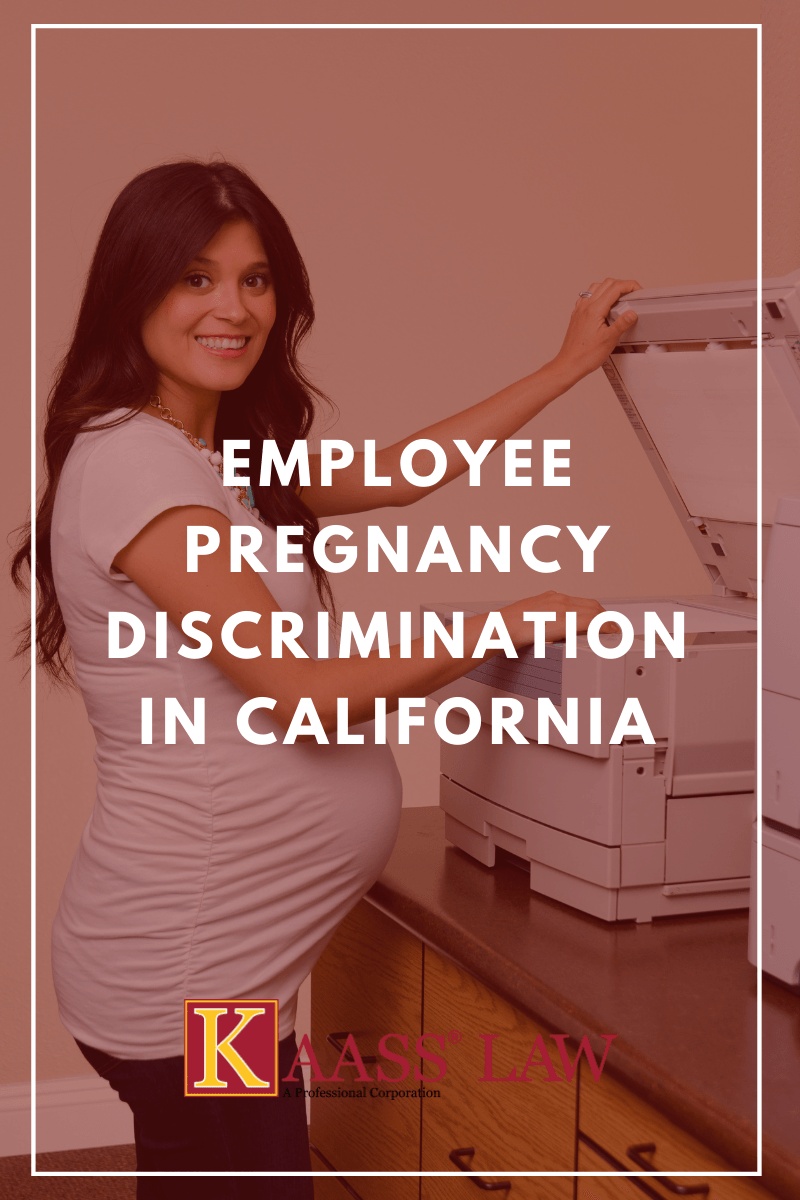
Employment pregnancy discrimination occurs when an employee or job applicant receives less favorable treatment because due to her pregnancy or on the basis that she may someday become pregnant.
Examples of Employment Pregnancy Discrimination
Examples of employment pregnancy discrimination include:
- demotion;
- termination;
- failure to promote;
- failing to provide a reasonable accommodation;
- failing to provide leave for pregnancy-related medical conditions;
- refusing to hire;
- refusal in education and training; and or
- refusing bonus and benefit opportunities
What Must the Employee Establish to Prove Pregnancy Discrimination?
An employee or job applicant will have to prove the following elements to establish that the employer engaged in unlawful discrimination:
- The employer is an entity covered by applicable pregnancy discrimination laws;
- Employer undertook a negative employment action against the employee;
- Employee’s or job applicant’s pregnancy, ability to become pregnant, pregnancy-related disability was the main reason for the employer’s action; and
- Employer’s negative employment action caused harm to the employee
Laws Protecting Pregnancy-Related Leave in California
The five main laws which provide leave rights to pregnant employees and new mothers:
- The federal Family and Medical Leave Act
- The California Fair Employment and Housing Act
- California’s Pregnancy Disability Leave Law
- The California Family Rights Act
- The New Parent Leave Act
Each of the above-mentioned laws has its own eligibility requirements, each of them provides leave under different circumstances and for different lengths of time,
California's Employment Pregnancy Leave
In addition to requiring 4 months of pregnancy leave employers are also required to:
- Extend the pregnancy leave beyond 4 months using accrued sick leave and vacation time;
- Hold the employee’s job for at least 4 months (in addition to the twelve weeks required by the California Family Rights Act); and
- Continue to pay the employer premiums for health insurance that were paid before the pregnancy leave
Los Angeles Pregnancy Discrimination Attorney
If you believe that your employer has discriminated against you on the basis of your pregnancy, we invite you to contact our employment law attorney at (310) 943-1171, for a free consultation.
Related Articles
View All Posts
Anxiety can be crippling and have a bad effect on a person's capacity for both domestic and professional performance. However, anxiety at work is a frequent occurrence and, in extreme instances, can result in wrongful mortality. To learn more about the reasons, symptoms, and remedies for wrongful death brought on by workplace worry, read on.
What Causes Anxiety at Work?
There are many reasons why anxiety can occur in the workplace. For example, some common causes of anxiety at work include:
- Excessive workloads
- Lack of support from management
- Unrealistic expectations
- Fear of job loss
- Harassment or discrimination
- High-pressure work environments
- Traumatic incidents or events
These elements may combine to create a poisonous workplace that is detrimental to an employee's emotional health and well-being.
Signs of Workplace Anxiety
Recognizing the early symptoms of workplace anxiety is crucial to preventing it from developing into a serious condition that could result in accidental death. Examples of typical indications of worry at the workplace include:
- Excessive worry or fear
- Difficulty concentrating or making decisions
- Irritability or anger
- Physical symptoms such as headaches or stomach aches
- Difficulty sleeping such as insomnia
- Avoidance of work or social situations
- Substance abuse
It is crucial to obtain assistance right away if you or someone you know is going through these signs.
Preventing Workplace Anxiety-Related Wrongful Death
Employers are required by law and morality to give their workers a secure and wholesome working atmosphere. Therefore, managers should take the following actions to avoid wrongful death brought on by worry at work:
- Establish a welcoming workplace culture, which includes an open-door policy where staff members can voice their worries and feel acknowledged.
- Additionally, employers ought to offer assistance tools like therapy or mental health services.
- Manage workloads - In order to avoid workers from feeling overburdened, employers should make sure that workloads are fair and doable.
- Address harassment and discrimination - As a result, companies need to put rules in place to guard against and deal with workplace harassment and discrimination.
- Provide instruction - Employers should instruct staff members and supervisors on how to spot anxious symptoms and how to offer support.
- Offer flexible work arrangements - To lessen tension and anxiety, employers should think about offering flexible work arrangements like online work or variable hours.
Legal Options for Wrongful Death Caused by Anxiety at Work
The victim's family may have legal options if a company fails to provide a secure and healthy workplace and an employee passes away from anxiety brought on by work-related stress. For negligence or failure to maintain a secure workplace, the employer may be responsible for wrongful death claims. It is crucial in these situations to seek the counsel of a qualified attorney who can help you navigate the court system and secure the recompense you are entitled to. If ignored, workplace anxiety can be a serious disease that results in wrongful mortality. Employers are required by law and morality to give their workers a secure and wholesome working atmosphere. For example, by creating a supportive work environment, managing workloads, addressing harassment and discrimination, providing training, and offering flexible work arrangements, employers can prevent wrongful death caused by anxiety at work.
Contact Us Today
Further, keep in mind that assistance is accessible and that you are not alone. Seek the counsel of seasoned lawyers who concentrate on these types of cases if you or a loved one has experienced the untimely death of a family member brought on by workplace worry. As a result, at Kaass Law, our lawyers have the knowledge and experience to help you navigate the legal system and secure the settlement you are due. So call us at 310-943-1171 right away to arrange a meeting and find out how we can help you with your situation. One of our many areas of expertise is wrongful death. All things considered, we are devoted to the pursuit of justice and to making bosses liable for their deeds.
California law now allows workers and job seekers to refuse to accept their employer's arbitration agreement as of 2020. Your employer cannot fire you or take any other adverse action against you if you decline. Employees must, however, normally abide by any prior arbitration agreements. Employers and employees that have signed an arbitration agreement agree to settle any disputes through private arbitration rather than through a civil court case. Usually, when a new employee is entering the company, their documentation includes an arbitration agreement. The majority of the time, your business won't ever tell the employee that they must arbitrate any conflicts, and even fewer will explain what it implies.
What Exactly is an Arbitration Contract?
A contract stating that any disputes between an employee and employer must be resolved by private arbitration, not a California court, is known as an employment arbitration agreement. Such agreements are rarely found on their own documents and are usually included in a bigger agreement. Arbitration agreements can be brief and tucked away in a longer document. Alternative dispute resolution includes arbitration. In comparison to civil court litigation, it is a simpler, more efficient process. The fact that it is typically less expensive is another factor that appeals to employers. In the following aspects, arbitration and lawsuit are comparable:
- Both the employer and the employee may have legal representation
- The parties share information with one another
- It is possible to call and interrogate witnesses
- A decision-maker is the subject of a hearing
Why do Employers Insist That Workers Sign Arbitration Contracts?
Employers favor arbitration over civil action for a variety of reasons. Most importantly, arbitration is less expensive than civil litigation. They typically move forward considerably more rapidly and are consequently less expensive because they save so much on legal bills. Additionally, the parties share information considerably more swiftly during the discovery phase. Since there are typically fewer documents to analyze and consider, the process can move along more swiftly. Selecting the arbiter is a crucial component of the arbitration procedure' flexibility. In contrast to civil court proceedings where it is mandatory for them to comply with the judge, arbitration allows the parties to select an arbitrator who is knowledgeable in the subject area of the dispute. This has the downside that employers frequently attempt to select arbitrators who they believe will be helpful to their case.
Which Laws Apply to Arbitration Contracts?
Two significant laws, one produced by the California legislature and the other by the federal government, control arbitration:
- The California Arbitration Act (CAA)
- Act Federal Arbitration Act (FAA)
Each statute's particular criteria might vary, and disagreements between federal and California law are common. State laws are superseded by federal law, and any contradictions will be resolved in favor of the federal law.
What Kinds of Disputes are Eligible for Arbitration?
Any legal dispute that results from the employment connection between an employer and employee may be subject to arbitration agreements. The following claims are examples of those that could be arbitrated:
- Back pay issues in the workplace
- Charges of harassment
- Retaliation, discrimination
- Wrongful termination
- Litigation based on failure to promote
- Personal injury lawsuits connected to the workplace are all common
This is merely a representative list; a legal arbitration agreement should be addressing a resolution for many other types of conflict between an employee and an employer.
When is a Clause Requiring Arbitration Enforceable?
Arbitration agreements must follow specific guidelines in order to have support by federal and California law. These conditions must be met for an arbitration agreement to be enforceable. This means that an employee will not be able to file a lawsuit; rather, they must arbitrate problems in accordance with the contract. In California, all agreements must:
- Be reasonable
- Have support by a thought
- Written and signed without fraud, coercion, error, or incapacity
Conscionability is a legal term that describes fairness in contract discussions. An agreement's terms are deemed unconscionable if they unjustly favor one party over another, particularly if that party is regarded as the more powerful one, such an employer.
Glendale Attorneys
Do not hesitate to contact us if you have any questions concerning California's arbitration agreement rules or if you would want to privately discuss your case with one of our knowledgeable California employment attorneys. You can reach us at 310.943.1171

Employees occasionally have the right to sue their employers under the California Fair Employment and Housing Act for workplace harassment committed by a non-supervisor. Employees have a right under the FEHA to be free from all forms of harassment including:
- an overseer
- a coworker who is not a supervisor
- certain unpaid individuals (such as clients or independent contractors)
What is the Law Regarding Supervisory Harassment in the Workplace?
Most individuals first consider supervisory harassment when they hear of workplace harassment. The FEHA prohibits the following types of supervisory harassment:
- Sexual harassment, when a supervisor asks for sexual favors or inappropriate behavior in exchange for employee advantages
- Non-sexual harassment, when a supervisor's severe or pervasive abusive behavior
The fact that the employer is strictly accountable for any harassment, regardless of the manner, is the most crucial concept to comprehend. If the victim's supervisor or a person with ever higher authority (for instance, the supervisor's supervisor) was responsible. This indicates that it did not matter if it took appropriate action to stop the harassment from occurring. If an employee sues, claiming that their supervisor harassed them, the employer may still be liable for damages.
Can Employees File Lawsuits for Non-Supervisory Employee Harassment at Work?
If an employee is experiencing harassment by non a supervisor, they may still take their employers to court under the Fair Employment and Housing Act. (This refers to hostile workplace harassment rather than sexual harassment for financial gain.) The employer is only liable in a workplace harassment lawsuit if the company was negligent. The following two conditions therefore need to be met:
- The employer was aware of the harassment or should have been aware of it
- The employer did not implement a prompt and suitable corrective action
This kind of litigation will center on whether the employer took action to stop harassment in the workplace. Another issue is how the company handled reports of harassment or other warning indicators. To the extent that the harassing behavior may have been clear to anybody in authority, the employer shall know about it. If this is the case, harassment is still illegal even if the victim does not disclose it. The employer must act quickly to halt it or they run the danger of being found negligent.
Can Employees File a Lawsuit for Harassment by a Client or Customer?
When an employee is experiencing harassment by a customer or client of the firm, particularly a significant one, whether it be sexual or otherwise, a difficult scenario occurs. The employer's natural impulse is to appease and appease the client or customer in order to keep their business. But it would be foolish to act on this instinct in light of California harassment law and the FEHA. Similar to how it would be for sexual harassment committed by a coworker, an employer is liable for third-party harassment if its conduct contributed to the harassment. Negligence is when an employer fails to take the necessary corrective action while knowing or having a duty to know about the harassment. All employers who are aware that their employees are experiencing harassment by clients, customers, or independent contractors must address the hostile work environment this produces. This is true even in circumstances when sexual harassment would appear to be almost certain (such as when a woman works in a jail for men).
Glendale Attorneys
Do not hesitate to contact us if you have any questions about workplace harassment by supervisors and non-supervisors. Please feel free to give our office a call at 310.943.1171.