

Law enforcement and criminal justice agencies use CLETS, a computer network, to access a person’s criminal history, record, and driving information. Additionally, it helps track and verify vital details during investigations. Moreover, the FBI, DMV, and other government agencies maintain and update this database. California Law Enforcement Telecommunications System information is highly sensitive; therefore, only authorized personnel have access to it. Additionally, the database connects law enforcement agencies to:
These networks allow for all law enforcement agencies to have a way to communicate. Most police vehicles are equipped with a mobile data terminal that connects them to the CLETS network from the car.
If you have heard of a CLETS Order, you might be referring to different types of restraining orders. They have this name because the CLETS database enters them. A California Law Enforcement Telecommunications System Order can include anything from:
Given the amount of data stored in CLETS, it is necessary to set limitations on when you can access certain information. Instances of misusing CLETS can include:
Abuse of CLETS violates Penal Codes 11141-11143 and 13302-13304, making it a crime to misuse state and local summary criminal history. Felony penalties may apply under Government Code 6200. The DOJ will investigate misuse, and the California Attorney General will review the case.
Violations involving access to the CLETS system are taken very seriously at both the state and federal level. Any attempt to illegally access or use the data may result in criminal penalties. If a law enforcement officer uses the system to obtain information about someone without a legitimate reason, it could be considered a dereliction of duty. Even one-time personal use of CLETS may result in:
However, if you are accused of illegally accessing the CLETS system or the CORI database, there are a number of defenses available. One common line of defense is to claim that the access was made in error. Or that it was part of a legitimate investigation. An attorney may be able to prove a lack of malice if the employee obtained the information as part of a job assignment. It is also possible to challenge the legality of the investigation itself. Especially if there were procedural violations. Such as:
In such cases, the lawyer will help develop a defense strategy based on the facts and the admissibility of the evidence. In addition, CLETS and CORI training is recommended for all law enforcement officers to prevent such allegations. This helps ensure compliance with the law. It also protects employees from potential legal consequences. If you are confronted with allegations of illegal use of CLETS or CORI, it is important to seek legal advice quickly.
Misuse of CLETS or CORI can have serious professional and personal consequences. For example, a conviction may remain on your record. This can negatively affect future employment opportunities. Especially in law enforcement or other government agencies. It may also result in:
This is especially true for employees with security clearances. The employer may consider even the suspicion of a violation as grounds for termination. Therefore, at the first sign of an investigation, it is necessary to contact an attorney immediately.
A qualified attorney will not only help you build the right defense strategy, but will also help ensure that all of your rights are respected. KAASS LAW has extensive experience and is ready to fight for your reputation and your freedom. Do not underestimate the seriousness of these charges. Timely legal assistance can dramatically change the course of a case.
CORI information can also be found through CLETS. CORI is defined in Penal Code 11075 as a database of compiled records and data that allow law enforcement officers to identify criminal offenders. Contains CORI information like:
The same penalties apply to the misuse of CORI; individuals cannot use it for personal reasons. The DOJ and California Attorney General will also investigate misuse. Moreover, they will pursue appropriate legal action if needed. KAASS LAW can assist you if you face charges related to the misuse of CLETS or CORI.

California statute Penal Code 29800 makes it a felony offense for a convicted felon, or wanted felon, to be in possession of a firearm. 29800 PC states that “Any person who has been convicted of, or has an outstanding warrant for, a felony under the laws of the United States, the State of California, or any other state, government, or country…or who is addicted to the use of any narcotic drug, and who owns, purchases, receives, or has in possession or under custody or control any firearm is guilty of a felony.” Under this statute, any person convicted or wanted for a felony offense, may not possess a firearm, or they will be in violation of Penal Code 29800.This statute also applies to individuals addicted to narcotic drugs and those with previous firearm offenses.
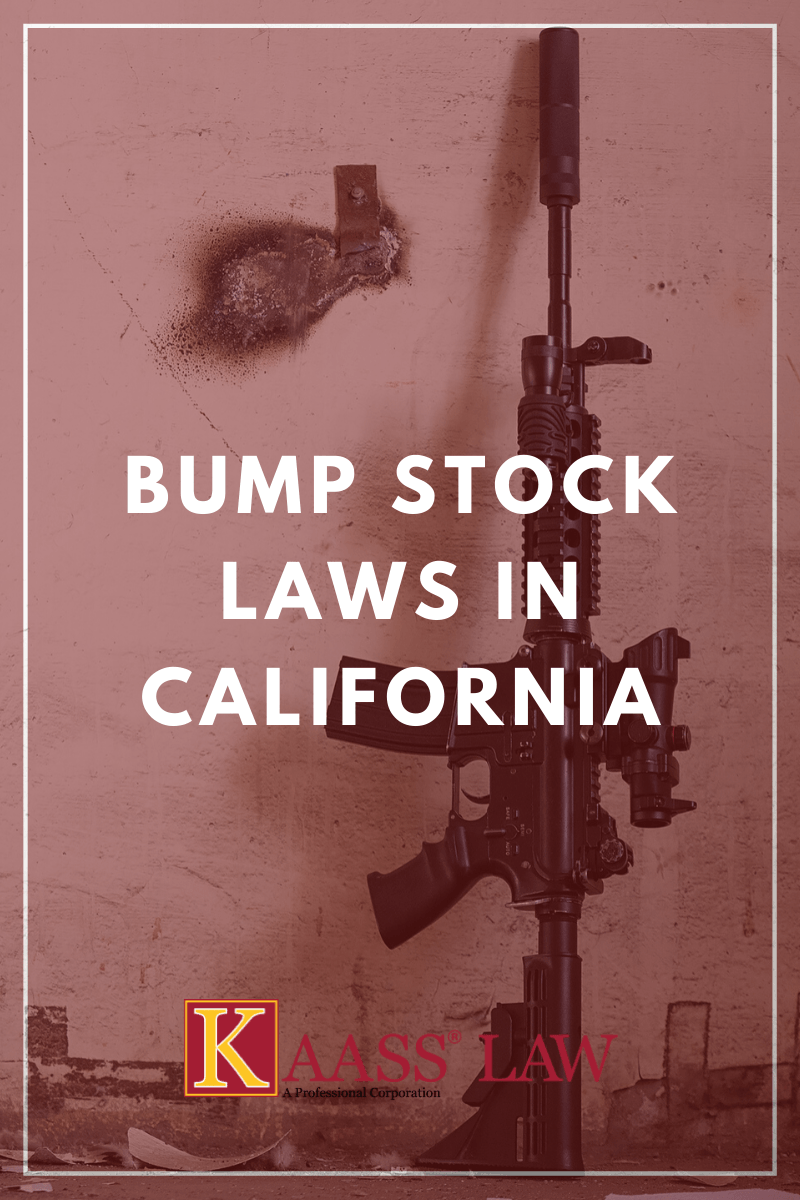
A bump stock is a modification to a firearm that manipulates the stock, trigger and grip on a semi-automatic rifle, using recoil to manipulate the trigger to fire at an accelerated rate of speed when held.
Bump stocks legally define as a “multiburst trigger activator” and can be one of two things:
This device replaces the stock on the firearm with a “reciprocating stock” that stays planted against your shoulder and firmly holding the barrel, the recoil of the firearm moves the trigger back and forth against the weight of your finger, mimicking the automatic rate of fire. Bump stocks were the famous modification used during the Las Vegas strip shooting in 2017. Penal Code 32900 forbids the use of “multiburst trigger activators” in California. California can prosecute possession of any accessory that increases the rate of fire for semi-automatic rifles as a misdemeanor or felony. What happens if you get caught with a bump stock in California? Despite the fact that bump stocks are banned by California state law, there are still detections of such devices in the possession of citizens. It is important to understand how the law works in these situations. Also important to know the consequences of possessing a bump stock. It is not uncommon for law enforcement to find such devices during a search. Or during an inspection related to other violations. However, even if a bump stock is found accidentally, the charges can be extremely serious.
In California, firework laws divide fireworks into two categories and an exempt category. The categories are “dangerous fireworks” and “safe and sane” fireworks. Specifically, a 'dangerous' firework includes items like rockets and sparklers longer than ten inches or wider than one-quarter inch in diameter. Conversely, a 'safe and sane' firework includes ones like fountains, spinners, noise makers, etc...
Under Health and Safety Code 12505, dangerous fireworks must be used by someone with a license to do so. Dangerous fireworks contain: arsenic sulfide, chlorates, magnesium, phosphorus, zirconium and many other chemicals. Similarly, exempt fireworks also require a special license to use in California. To clarify, exempt fireworks are those used for industrial, commercial, agricultural, or religious purposes. Under Health and Safety Code 12529 these are fireworks that comply with California law and local fire department restrictions. These types of fireworks must be sold at a designated place of business by a person with a retail sales license between the dates of June 28th Noon until Noon of July 6th each year. In contrast, the only items that can be sold year round are 'party poppers' and 'snap caps.

Under California Health and Safety Code 120290, it is violation of the law to purposefully transmit an infectious disease to another person. We can define this in the following scenarios:
Offenses can include knowingly passing a sexually transmitted disease to a partner or even sharing needles infected with HIV.
Street racing of any kind is forbidden on California public roadways. Offenses include street racing, drag racing and speed contests. Violation of these rules allows for the offenses to be punished under Vehicle Code 23109, Vehicle Code 23103 and Penal Code 187.
California Vehicle Code 23109: Speed Contest
Violation of California Vehicle Code 23109 will result in a misdemeanor charge. This will then lead to a jail time of 24 hours to 90 days; then fines ranging between $350 and $1000. The penalties will increase as the number of repeated convictions increases. If a violation of VC 23109 results in serious bodily injury, it may be charged as a felony. A prosecutor must prove that the accused motorist was operating a motor vehicle on a public roadway while willfully engaging in a contest of speed.

California Penal Code section 347 (a)(1) states. “Every person who willfully mingles any poison or harmful substance with any food, drink, medicine, or pharmaceutical product or who willfully places any poison or harmful substance in any spring, well, reservoir, or public water supply, where the person knows or should have known that the same would be taken by any human being to his or her injury, is guilty of a felony punishable by imprisonment in the state prison for two, four, or five years.”
There are 2 elements that make up the crime of poisoning in California. They require that the defendant:

California Penal Code section 148.5 PC states, “Every person who reports to any peace officer listed in Section 830.1 or 830.2, or subdivision (a) of Section 830.33, the Attorney General, or a deputy attorney general, or a district attorney, or a deputy district attorney that a felony or misdemeanor has been committed, knowing the report to be false, is guilty of a misdemeanor.”
In order to be criminally charged with making a false report of a crime, you must have satisfied the three elements. These elements constitute a violation of Penal Code 148.5 PC. The three elements are the following:

CA PC 206, California's state torture statute, is a huge reminder of the law's commitment to protecting individuals from the most wicked form aggression and violence. The word, "torture" can be defined and interpreted in many ways, which often conjures images of international conflicts and human rights abuses. This type of crime, unfortunately as it is, does occur within our own community often than not. Understanding PC 206 is important for both those under the accusation and those who were the victims of such crime. At KAASS LAW, we believe in providing clear and comprehensive information regarding California's criminal laws. The following will aim at that and shed light on how complex PC 206 can be, in the simplest terms.
According to California Penal Code Section 206, torture is the infliction of great bodily harm with the intention to cause extreme pain and suffering for extortion, revenge, persuasion, or a sadistic purpose. Torture is similar to mayhem under PC Section 203 and other violent crime offenses, but the main difference is the critical element of motivation. Without motivation, intention to cause suffering and pain and inflicting great bodily harm is not enough for a conviction under PC Section 206. Prosecutor must establish the following elements to prove that defendant has committed an act of torture pursuant to California PC Section 206.

The business world thrives on trust, integrity, and fair competition. However, the pursuit of profit and advantage can sometimes lead individuals astray, tempting them to engage in unethical or even illegal practices. One such practice is commercial bribery, a serious offense that undermines fair business dealings and can have severe legal consequences. In California, Penal Code 641.3 PC specifically addresses commercial bribery, outlining the prohibited conduct and the penalties for those who violate the law. At KAASS LAW, we commit to upholding ethical business practices and protecting our clients from the legal ramifications of commercial bribery. The following provides a comprehensive overview of Penal Code 641.3 PC, explaining the elements of the offense, potential defenses, and the importance of seeking legal counsel if you are facing accusations or are concerned about potential violations.
According to California Penal Code Section 641.3 (a), an employee who solicits, accepts or agrees to accept money or anything of value from a person other than his employer, corruptly and without the knowledge or consent of the employer, in return for using his position for the benefit of that other person, is guilty of commercial bribery.
Penalties for a conviction under Penal Code 29800 may result in:
Defendants can argue against a charge for violation of this statute by proving momentary possession, justifiable possession and illegal search and seizure.
Expungement for a violation of California Penal Code 29800 can be provided given that the defendant completed the jail term and/or probation period. Expungement cannot apply to serious sex offenders or former inmates of a California State Prison.
A defendant can reclaim gun rights by reducing their felony charges to a misdemeanor. This can happen with a wobbler offense. A defendant can petition the court to reduce a felony wobbler to a misdemeanor.
Federal law prohibits the following people from owning a gun:
KAASS LAW can assist if you face charges under California Penal Code 29800 for possessing a firearm as a felon.
In addition to the basic criminal penalties, a conviction under PC 29800 can have other serious consequences. For example, a conviction for weapons possession can seriously affect:
This is especially true for non-residents of the United States - they may face deportation or denial of naturalization. It is also important to understand that a conviction under this article may be used as an aggravating factor in future offenses. This may result in harsher penalties for repeat arrests. Especially if the case involves violence or illegal weapons.
If you are facing charges under PC 29800, it is important to contact an attorney as soon as possible. He or she can evaluate:
For example, evidence may be excluded if the police searched without a warrant or probable cause. Another line of defense is lack of knowing possession of a gun. If the gun was in a shared residence but did not belong to the defendant, the defense attorney may be able to prove that the client did not intend to possess the gun. A strategy to reduce the charges is also possible. If the court finds that the crime falls into the wobbler category, the attorney can move to reclassify it as a misdemeanor. This opens the door to probation and subsequent expungement. The attorneys at KAASS LAW are highly experienced. They are prepared to defend your rights in court. Do not delay a consultation - timely action can change the outcome of the case.
There are many ways to fight against a Bump Stock charge. One defense is proving the defendant was in lawful possession of the bump stock. A defense could argue the defendant possessed the bump stock while taking it to law enforcement for disposal. Ignorance of possession or not being the owner of the bump stock also leaves room for charges to be dropped. One of the best defenses is through police misconduct. If law enforcement obtained the bump stock through illegal search, coerced confession, or planted evidence, the court may dismiss charges.
Bump Stocks do not convert semi-automatic rifles into automatic ones, although they allow a semi-automatic rifle to fire like an automatic one. Under federal law, Attorney General Mathew Whitaker signed a bill defining weapons with bump stocks as machine guns. You may however legally own a bump stock in California if:
If a person is charged with possession of a bump stock, the punishment will depend on the circumstances of the case. In some cases, the charge may qualify as a misdemeanor. This can result in a fine and up to one year in county jail. However, if there are aggravating circumstances such as:
the charge may escalate to a felony. In this case, the possible punishment ranges from 18 months to 3 years in prison. In addition, under federal law, possession of a bump stock can result in a penalty of up to 10 years in prison and a fine of up to $250,000. The penalties for selling or distributing such devices are particularly severe. However, there are several defenses. For example, if a person self-reported the device to the police or was unaware of its existence. The defense may be able to obtain a reduced sentence or dismissal of the charges altogether. A defense based on unlawful police action is also common. Such as:
You can contact KAASS LAW for advice and defense in bump stock cases.
For more information about bump stock laws and to schedule your free consultation, contact Los Angeles Criminal Defense Attorney at KAASS LAW at (310) 943-1171. We are located at 815 E. Colorado Street Unit 220, Glendale, CA 91205 with additional offices in Los Angeles located at 633 West 5th St., 26th Floor, Los Angeles, CA 90071.
Any and all “safe and sane” fireworks in the state of California must display a “State of California, State Fire Marshall Registered Fireworks” seal. If the seal is not present, the fireworks are not legal to possess or use in the state of California.
In California, specifically, being in possession of an illegal firework violates Health and Safety Code 12677. Therefore, this can apply to California 'safe and sane' fireworks as well, if they violate local fire codes. To illustrate, in Burbank and Glendale, 'safe and sane' fireworks are not permitted. Most offenses result in a misdemeanor punishable by:
The sale and distribution of 'dangerous' fireworks violates California Health and Safety Code 12767 and therefore results in other charges. Furthermore, the punishment for this offense is dependent on the amount of fireworks in possession of the defendant upon arrest.
An attorney may be able to help you fight against a California Firework charge. In particular, known defenses include:
Important: If you have been accused of possessing or selling illegal fireworks, seek legal counsel right away. This will allow you to obtain a defense and possibly lessen the consequences of the charges. KAASS LAW can help you build a defense strategy. Possible defenses include:
If you have a permit to use the fireworks, this can also be an important factor in your defense. Furthermore, if the charges are related to a miscommunication in the transaction, this could also be grounds for dismissing the charges. Don't risk - KAASS LAW is here to help you protect your rights and interests. It is also worth remembering that even possession of fireworks without the intent to use them can result in charges. For this reason, having an experienced attorney become a key factor. One who can carefully review the details of your case and help minimize or completely dismiss the charges. [contact-form-7 id="5673" title="KAASS LAW Contact Form"]
Violating this Health and Safety code may result in a misdemeanor punishable by a maximum of 6 months in county jail and a fine of up to $1000. A defendant can fight against charges under 120290 HS by having no knowledge of the infectious disease, proving no intent to transmit that disease, or simply even if no transmission occurs at all. Actual disease transmission proves guilt for this crime. So if there is a way to prove that the disease was not transmitted, or at least not transmitted by the defendant, there is grounds for dismissal.
There are three other charges that can be related to Health and Safety Code 120290. Health and Safety Code 1621.5, Penal Code 12022.85, and Penal Code 243.4.
This code criminalizes donating blood, organs, semen, or breast milk when knowingly infected with HIV or AIDS. This law pertains to the donation of infectious diseases, rather than transmission.
Violating Health and Safety Code 120290, and causing HIV/AIDS during those acts with a minor, adds three years. The three year enhancement of charges goes on top of the time served for the underlying charges.
Violation of this penal code and Health and Safety Code 120290 would be that a person knowingly transmitting an infectious disease while also committing sexual battery. A person commits sexual battery when they touch another's genitalia for their own gratification. In this case, touching would be the form of conduct that spreads the infectious disease. A prosecutor can charge this as a misdemeanor or a felony. Misdemeanor offense can lead up to one year in prison and up to $3000 fine. A felony offense can have up to a 4 year prison sentence and fines up to $10,000.
It is important to realize that HSC Section 120290 charges can seriously affect a defendant's future. Even a misdemeanor charge can lead to a criminal record that affects every part of your life. Especially related to communicable diseases. It can affect employment, immigration status, and personal reputation. Therefore, it is crucial to have your case handled by an experienced attorney who can assess all the nuances and build a defense strategy. In addition, prosecutors must prove not only the fact of infection, but also that the defendant knew about the disease. That he or she intentionally attempted to transmit the infection, and that the infection actually occurred or there was a high risk of transmission. If even one of these elements is missing, the charge can be dismissed. For example, if a person participated in risky behavior but was unaware that he or she was infected, this does not fall under HSC 120290. The defense can argue that protected contact and a low likelihood of transmission meant there was no risk of infection. The lawyers at KAASS LAW are prepared to act quickly and decisively. We will provide comprehensive legal support. We will also analyze medical documents, involve experts if necessary and achieve justice in court. Under no circumstances should you wait if you are faced with such a charge.
If If you or a loved one is charged with intentionally transmitting an Infectious disease or its related offenses, we invite you to contact our Glendale criminal defense attorney at KAASS LAW at (310) 943-1171 for a free consultation and case review. Our staff speaks Spanish, Armenian, Russian, and French.
California Vehicle Code 23103: Reckless Driving Law
Punishments for violating VC 23103 include a 5 to 90 day stay in the county jail and a fine between $145 and $1000. Like VC 23109, if bodily injury is involved due to the violation, it may result in more serious consequences. Repeated offenses also result in more severe punishments. The details of the case may lead to a street racing charge as reckless driving. The prosecutor must be able to show that the operator of the motor vehicle was driving with a “wanton disregard” for the wellbeing of people or property. This means that the operator of the vehicle was in full awareness of the risk of harm, and then proceeded to disregard that risk.
A death during a street racing incident is referred to People v. Watson, or in other words a “Watson Murder” case. Penal Code 187, Watson Murder, is a second degree murder charge. This usually is the result of a DUI. On the other hand, it can be applied to street racing if:
Watson Murder can result in a 15 years to life in a California state prison, fines up to $10,000 and a strike under California’s “Three Strikes Laws.” A repeated “strike” offense may result in a doubled prison sentence.
When a person is arrested for any of the above offenses, the arresting officer has the authority to call in a tow truck to send the car to impound for a period of up to 30 days. The circumstances to receive the vehicle before the end of the 30 period period are as follows:
Attorneys can defend against these charges by being able to prove that the defendant’s actions were not willful, there is not enough evidence to support that the defendant was contesting speed, the defendant was not driving the vehicle or the attorney can prove a necessity defense. A necessity defense means you are “guilty with an explanation.” For example, rushing to the hospital. Glendale Reckless Driving/Street Racing Attorney If you or a loved one is charged with reckless driving or street racing we invite you to contact our Glendale criminal defense attorney at KAASS LAW at (310) 943-1171 for a free consultation and case review. Our staff speaks Spanish, Armenian, Russian, and French.
The law applies to both large-scale public goods, such as:
One must act purposefully when poisoning a substance, meaning accidental contamination does not count. Also necessary that the defendant knew that what was poisoned would be consumed by someone. A crime can occur even if no one consumes it, as long as someone intended the substance for human consumption. Moreover, even if one doesn’t certainly know that the poisoned item was meant for consumption, as long as the defendant reasonably should have known that it would be consumed, then this will constitute a violation of PC 347 (a)(1). EX: A frustrated employee decides to take some rat poison and stick it in a pill bottle that he found in his boss’s desk. The boss consumes the rat poison and becomes very ill, but the employee claims that he should not be guilty of violating PC 347 (a)(1) because he had never seen his boss take the medication before. Although he may not have seen anyone take the pills before, he can reasonably assume that someone meant the pill bottle in the desk for consumption.
Poisoning is a severe crime and qualifies as a felony offense in California. It is punishable by up to 5 years in a state prison. If your poisoning causes great bodily injury or death to another, the court can extend your sentence by 3 years, and you will likely face additional charges.
In addition to a charge under California Penal Code section 347(a)(1), a defendant may face other charges depending on the circumstances of the case. For example, if a person died as a result of poisoning, the prosecutor may file a charge of attempted murder or premeditated murder. If there are victims or premeditated actions, the prosecution may request increased penalties. This is also how other sections of the California Penal Code can be used. In addition, if the poisoning occurred in a public place, such as:
1. at a school 2. at work 3. public institution This can be considered a particularly dangerous crime with a high risk to a large number of people. Such circumstances often result in a harsher sentence. If the poisoning incident involved: 1. domestic violence 2. act of revenge 3. workplace conflict Additional counts may be added to the main charge. For example, in the case of proven intent, the prosecutor may insist on life imprisonment or a long term of imprisonment.
The Law Offices of KAASS LAW provides skilled defense in cases involving poisoning charges. Our firm carefully analyzes all the details of each case to obtain the best possible outcome for our clients.
You can use several legitimate defenses if authorities wrongfully charge you with poisoning in California. Some of them are:
You can defend yourself if you didn’t know someone would consume the poisoned item and if it was unreasonable to expect anyone to know it was for human consumption. Also, it is required that you poisoned the item willfully. This means that you knew that the substance would be harmful to others and that you purposefully mixed it with an item for human consumption. EX: A mother makes cookies for her son and friends who are visiting, and the cookies include nuts, which one of her son’s friends is allergic to. The friend has an allergic reaction, and the mother faces charges under PC 347(a)(1). She would be guilty if she knew the friend was allergic and purposefully included the nuts, but she would be innocent if she had no knowledge of his allergy. Lastly, the substance you introduced must actually be poisonous or harmful. This is a legal grey area, but sometimes people may face poisoning charges even when the substance deemed a "poison" is not actually harmful. KAASS LAW focuses on defending clients accused of poisoning under California Penal Code 347(a)(1).
Penal Code section 148.5 PC only encompasses misdemeanors and felonies, meaning that making a report of these offenses is illegal. However, reporting an infraction would not violate this law. You must know that the misdemeanor or felony was based on false information, meaning that merely making a mistake and reporting a crime you truly thought occurred would not violate PC 148.5. The law defines a 'figure of authority' as anyone delegated by the state to accept criminal reports. This includes police officers, emergency line operators, prosecutors, a grand jury, etc. Keep in mind that the law can charge you with the crime even if you didn’t make the false report yourself. If a third party makes a criminal report, whether it actually happened or not, you could face charges for violating PC 148.5 if you made a false statement at any point during the investigation. EX: Your neighbor’s car is not at their house one day so they report it as stolen. When the police investigate, they ask you if you saw who stole it. Because you really dislike the landlord of your building, you falsely tell the police that you witnessed the landlord steal the car. You would be guilty of violating PC 148.5 because your statements are inherently reporting your landlord as the culprit even if you didn’t make the initial report.
California considers making a false report of a crime a misdemeanor offense. This means that you can spend up to 6 months in county jail, and/or pay a maximum fine of $1,000. You can expunge this crime from your criminal record upon completion of probation or a jail sentence. However, it is important to realize that being charged under PC 148.5 can have other consequences. For example, having a criminal history of false reporting can have a negative impact on a person's reputation. Moreover, such charges can make it more difficult to obtain certain licenses or participate in government assistance programs. In addition, in some cases, the court may impose additional punishment in the form of community service or special courses. This is especially true for young people facing the criminal justice system for the first time. It should be noted that even if you gave false testimony out of fear, the court can still qualify your actions as willful provision of false information. Therefore, it is important to contact an attorney as soon as possible who can assess the situation and suggest the most effective defense strategy. Finally, although many people believe that false reporting, is a "frivolous" crime, law enforcement takes such charges quite seriously. The reason is that false reports divert police resources and can lead to the unfair prosecution of innocent individuals. This is why having qualified legal support is crucial to protecting your rights. The lawyers at KAASS LAW are here to help you if you find yourself in a similar situation.
There are several common defenses to a violation of PC 148.5. They include:
Even if you gave false information in a criminal report, you must have known that your statements were false. Mistakenly giving a false statement is not a crime. The statute also specifies that you must make the false report to someone delegated by the state to accept reports of crimes. For instance, if say you made a false report to a security guard at a night club, not to an actual police officer. You would not consider this a violation of PC 148.5. Lastly, you must ensure that the crime in question was a misdemeanor or felony, meaning that minor infractions do not count. Falsely reporting a nearby car of failing to signal when changing lanes would not constitute breaking this law. This is because the traffic violation was not a misdemeanor or felony. If you are facing charges for making a false report under PC 148.5, KAASS LAW can provide legal support.
Under California law, the crime of torture doesn’t require any proof that the victim suffered pain. The only thing that must be shown is that the defendant inflicted great bodily injury and that when he did so he intended to cause extreme pain and suffering while. For purposes of California PC Section 206, great bodily injury means a substantial or significant physical injury. It must something more than just a minor or moderate harm. Examples of “great bodily injury” include:
To be found guilty of torture under California PC Section 206, defendant should have caused cruel or extreme pain and suffering to the victim. The intent to hurt another one is not the same as intent to inflict extreme or cruel or pain and suffering.
To be found guilty of torture, defendant’s motivation for causing extreme or cruel pain and inflicting great bodily injury must be for revenge, extortion, persuasion, or sadistic purposes.
In case the defendant caused extreme pain or inflicted great bodily harm for reasonably defending himself or another person, he can’t be convicted of torture.
In case the defendant is convicted of the crime of torture under California PC Section 206, he will be punished with:
A strike will be added to defendant’s record under California’s Three Strikes Law since torture is considered as a violent felony crime. The defendant will be eligible to seek parole at a parole board hearing not earlier than seven years into his sentence.
Facing torture charges under PC 206 is a serious matter with potentially life-altering consequences. It is crucial to secure experienced legal representation as soon as possible. A skilled criminal defense attorney can: Conduct a Thorough Investigation: Investigate the facts of the case, gather evidence, and interview witnesses. Challenge the Prosecution's Evidence: Identify weaknesses in the prosecution's case and challenge the admissibility of evidence. Negotiate with the Prosecution: Attempt to negotiate a favorable plea agreement, potentially reducing the charges or penalties. Represent You in Court: Provide aggressive and effective representation at trial, presenting a strong defense and protecting your rights. Understand the Nuances of Intent: A good lawyer understands that the "intent" portion of this crime must be proven.
At KAASS LAW, we understand the complexities of California's criminal laws, including PC 206. We are committed to providing our clients with the highest quality legal representation. If you are facing torture charges, contact us today for a confidential consultation. We will review your case, explain your options, and develop a personalized defense strategy to protect your rights. More importantly, we are trying to secure your future. Don't face these serious charges alone. Let the experienced attorneys at KAASS LAW fight for you. Additionally, we offer consultation to anyone that was a victims of criminal injuries and compensation.
The prosecutor must establish the following elements to prove a charge of Penal Code 641.3 PC commercial bribery:
Penal Code Section 641.3 PC applies similarly to employees receiving or soliciting bribes and to the person offering bribes. The commercial bribery statute is based on the concept of fiduciary duty between an employer and his employees. The purpose of PC Section 641.3 is to punish individuals who conduct actions to undermine the employer's interests for receiving money or anything else of value that personally benefits them.
The main defense to commercial bribery charges is that there is no evidence that the employee or the person who pays the bribe had corrupt intent.
Commercial bribery can be charged as either a felony or a misdemeanor, depending on the amount of the bribe.
If the value of the bribe is less than $1,000, the defendant will be charged with a misdemeanor, and the following penalties include:
If the value of the bribe is $1,000 or more, the defendant will be charged with a felony, and the following penalties include:
If the victim suffered monetary losses, a court can also order restitution pursuant to California PC Sections 1202.4(a) and (f). Civil damages can also be recovered under California Civil Code Section 3281 if the employer suffered a loss.
If you're facing accusations of commercial bribery, there may be legal defenses available to you. Some potential defenses include:
If you're facing accusations of commercial bribery or are concerned about potential violations, it's crucial to seek legal counsel from an experienced criminal defense attorney. An attorney can:
At KAASS LAW, we understand the complexities of commercial bribery laws and the potential impact these charges can have on your business and reputation. Our firm has a fair understanding of these types of bribery laws, especially Federal Bribery Laws. Our attorneys dedicate to providing skilled legal representation and protecting your interests. If you're facing allegations of commercial bribery or need guidance on compliance with Penal Code 641.3 PC, contact us today for a free consultation.