
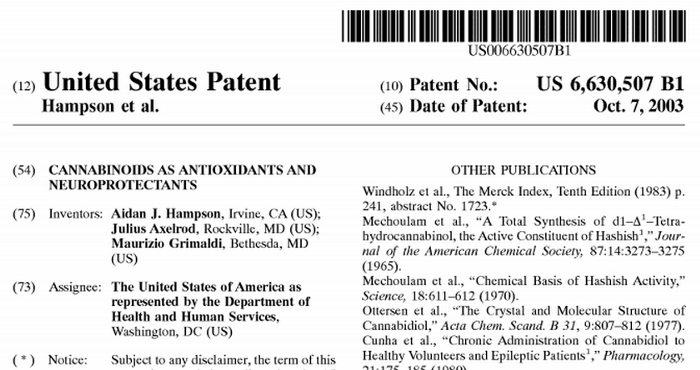
In 2003, patent No. 6630507 was granted to the Department of Health and Human Services. Cannabinoids have been found to have antioxidant properties. Patent No. 6630507 also references 12 other U.S. patents related to cannabis dating back to 1942. U.S. Patent No. 6630507 covers the potential use of non-psychoactive cannabinoids to protect the brain from damage or degeneration caused by certain diseases, such as cirrhosis.
The U.S cannabinoids patent lists the use of certain cannabinoids found in cannabis sativa plants as useful in the treatment of certain neurodegenerative diseases such as Parkinson’s, Alzheimer’s, and HIV dementia. The cannabinoids are found to have particular application as neuroprotectants, which is any substance that helps to shield nerve cells from damage or death. As such, said cannabinoids aid in limiting neurological damage following ischemic insults, such as stroke and trauma, or in the treatment of neurodegenerative diseases Moreover, this newly discovered property makes cannabinoids useful in the treatment and prophylaxis of wide variety of oxidation associated diseases, such as age-related, ischemic, inflammatory, and autoimmune diseases. One particular disclosed class of cannabinoids useful as neuroprotective antioxidants is formula (I) wherein the R group is independently selected from the group consisting of H, CH3, and COCH3.
Recently, legal-marijuana pioneers have experienced a rising concern in retaining a marijuana intellectual property lawyer in order to protect their creations from imitators, as well as from multinational corporations in the agriculture, tobacco and pharmaceutical industries that appear to be keeping a close eye on the fast-growing marijuana industry from the sidelines. For instance, in 2013 the first marijuana strain patent containing significant amounts of THC ever granted, patent No. 9,095,554. Accordingly, the patent provides compositions and methods for the breeding, production, processing and use of specialty cannabis.
If you have questions regarding marijuana laws or or are seeking to start a recreational marijuana business in California, we invite you to call our office for a consultation with a Los Angeles recreational marijuana business lawyer today.

If one cannot duplicate a phone number or street address, then why should one have the power to duplicate a domain name? Domain names, similar to words and symbols, can be used to identify a seller’s products and distinguish them from the products of another, and are thus viewed as trademarks. The Ninth Circuit U.S. Court of Appeals recently ruled that a business must use its domain name to sell goods or services in order to protect the name — even if a competitor starts to use the name after you registered the domain. In other words, merely reserving a domain name isn't enough. Thus, its important to register your domain name, because if your domain name has a trademark, the URL has protection under the USPTO.
The Trademark Act of 1946 (“Lanham Act”) prohibits uses of trademarks that are likely to cause confusion about the source of a product or service. 15 U.S.C. §§ 1114, 1125(a). Moreover, to establish a trademark infringement claim under the Lanham Act, a plaintiff must establish that defendant’s use of a mark is confusing similar to plaintiff’s. Id. The main area of inquiry in trademark infringement cases is whether the similarity of the marks is likely to confuse customers about the source of a product or service. ., 174 F.3d 1036, 1062 (1999).

A contract is an agreement to do or not to do a certain thing. Recovering damages for breach of contract, the plaintiff must prove all of the following:
If you entered into a contract and you fail to abide by the terms of the agreement. Consequently, you may face the likelihood of having a lawsuit against you. If a party contracts with you and does not fulfill the terms of the agreement. In return you may also have the right to seek legal remedy and likewise file suit against the breaching party.

Regardless of whether you own an business with a family member, a friend, or hold a position on the board of a large corporation, you know that business and contract disputes can often times cause major problems. Specifically, business owners that face contract disputes with other companies and even more so, between their own ownership structure. For instance, a business contract dispute may arise between two or more partners, when one partner fails to fulfill his responsibilities. Often times business owners do not anticipate disputes until they arise. As a result, income might be lost due to contract breaches; ownership might be in the limbo due to outside lawsuits and claims; and tensions amongst business owners may rise. Lastly, a California business that is facing a lawsuit must be represented by an attorney. As such, a business owner cannot represent themselves in pro per.
As a matter of course, each general partner has an equal right to take part in the . Disputes in the ordinary course of business are decided by a of the . While, disputes or disagreements of or any to the . Be that as it may, in an partnership of any size the will provide for certain electees to manage the partnership along the lines of a company board. Generally, unless otherwise provided in the , no one can become a partner of the However, an existing partner may transfer partnership interests and assign his share of the profits and losses and right to receive distributions.

Not all businesses are made alike. Choosing the right business entity formation is a huge step for any business owner because there are many different entity forms of businesses one can form. A Glendale business entity formation attorney can help you determine which entity form would be the best for your type of business. However, before a business owner considers which entity form h/she wishes, you must determine what name you wish to use for the corporation and check whether or not that name is available to use.
The California Secretary of State website provides a tool for business owners to check for corporation name availability.
In determining name availability, the database checks only against names of like entities registered with the California Secretary of State. Thus, before you are set on a name, check with the California Secretary of State website for corporation name availability.

Effective January 1, 2018, new California marijuana laws to roll out. California will starts accepting online applications for temporary business permits for marijuana business owners. The Bureau of Cannabis Control's online application system will open in December and that the BCC will begin emailing temporary licenses to retailers before the new year. The licenses will become valid on Jan. 1. By New Year’s Day, marijuana/cannabis business owners should be receiving an email from the state regarding the approval of the temporary marijuana business permits. Temporary marijuana business permits will be good for four (4) months. The purpose of giving business owners 4 months, is to give marijuana shop owners time to complete all other additional information needed to receive permanent licenses. Once approved, you will be able to immediately start selling cannabis to adult 21 and over with an valid ID. further opens the door for local governments to permit marijuana consumption at retailers and companies with a micro-business license, which combines a small cultivation site, distribution and retail.

Before you decide to buy an existing business, rather than starting your own business there are a few facts you may want to consider. While, buying an existing business may provide many advantage, its important to do your research and consider consulting with a Glendale business attorney prior to signing any agreements to ensure you have covered all areas to decrease the probability of any issues presenting itself in the future. In determining whether or not to buy an existing or established business consider some important factors such as valuation of the business, negotiating the business purchase, purchase agreement, and do your due diligence.
Its important to first determine the value of the business you wish to buy so that you don't end up over paying for it. There are a handful of methods for evaluating businesses, thus it important to understand which method the business owner used when it computed its business value. It is important that you determine or receive information regarding the actual, taxable “profits” or “losses” for the business. If you are unsure how business valuation works, it is recommend you speak to a experienced business attorney before entering into a purchase agreement. Our are who have vast experience in determining valuation of businesses and can review and consult you on your business purchase as well as, business valuation. We invite you to contact our office at (310) 943-1171 and schedule a consultation.

Commercial Lease Agreements vs. Residential Lease Agreements California commercial lease agreements and residential lease agreement have a few major differences between them. In California, there are a few legal protections available for commercial leases in comparison to residential lease agreements. For instance:

Before you file a lawsuit for breach of contract in Los Angeles Court there are a few requirements to prove. In order to be successful in a breach of contract lawsuit, the Plaintiff must prove the basic elements for breach of contract, including: Whether or not a valid contract existed.
The four basic requirements of a valid contract include the following:

There are many advantages of incorporating a business in California, each business form hold different advantages and disadvantages.
While, there are many benefits of incorporating a business, choosing to register your business under the form of a Limited Liability Company, or "LLC" is one of the more common and better choices. Here are four (4) reasons why forming an LLC in California is the best decision:
An LLC can be organized in various ways. The beauty of an LLC is that the structure of the firm is virtually entirely up to founders' imagination! This is in stark contrast to the rigid, formal structure of a corporation.
Unlike a corporation, which mandates board meetings and shareholder votes along with other burdensome default rules, an LLC has virtually no mandatory rules. Rather, the statutes in your jurisdiction will provide default rules which can be contracted around in the Operating Agreement.
To protect your business or brand from infringement, you may want to trademark your domain name in addition to a logo, slogan, or design. Merely, registering a domain name does not give you trademark rights, rather it identifies your website and generally will not prevent others from using the name. If you trademark your domain name, you have legal protection if a third party uses your trademarked name. You can file a trademark infringement action against the infringing party and recover money damages, financial losses, and other damages you might have incurred.
The domain should function as a "source indicator." It must convey to whoever sees the URL what products or services are behind the name. A domain qualifies as a trademark when it is a "source indicator." Your domain must convey the products or services associated with the name to whoever sees the URL. Not all domain names can be registered as trademarks. The PTO is particular about what can be registered as a domain name.
Consumer confusion occurs when another company has a domain name close in spelling to your domain. The other company's name might different by one letter. Generally, consumer confusion matters only if a domain name that's similar to the one you want to use is a protected trademark. To be protected, a trademark must be distinctive. If the trademark owner has been able to register a name with the U.S. Patent and Trademark Office, it is probably distinctive. The dispositive question in trademark infringement cases is whether the similarity of the marks is likely to confuse customers about the source of a product or service. Interstellar Starship Services, Ltd. V. Epix, Inc., 304 F. 3d 936, 941 (2002).
Initial interest confusion occurs when the defendant’s use of plaintiff’s trademark sways consumers towards their own product or service by capturing “initial consumer attention.” Brookfield at 1045. In the context of website domain, the defendant’s unauthorized use of the trademark confuses consumers who expect to find the plaintiff’s product or service at that web address. Interstellar at 942. Although actual confusion is not required, plaintiff must prove a probability of confusion, as the mere possibility is not enough. Perfumebay.com Inc. v. eBay, Inc., 506 F.3d 1165, 1176.
To evaluate the likelihood of confusion, including initial interest confusion, the Sleekcraft factors considered are:
(1) the similarity of the marks;
(2) the relatedness or proximity of the two companies' products or services;
(3) the strength of the registered mark;
(4) the marketing channels used;
(5) the degree of care likely to be exercised by the purchaser in selecting goods;
(6) the accused infringers' intent in selecting its mark;
(7) evidence of actual confusion; and
(8) the likelihood of expansion in product lines.
Courts consider these factors within the totality of the circumstances through the eyes of the “reasonably prudent consumer” in the marketplace, not a person with a legally trained mind. Dreamwerks Production Group, Inc. v. SKG Studio, 142 F.3d 1127, 1129 (1998).
In the context of website domain, courts have held that the three most important Sleekcraft factors in evaluating a likelihood of confusion are (1) the similarity of the marks, (2) the relatedness of the goods or services, and (3) the parties’ simultaneous use of the Web as a marketing channel. Interstellar at 942.
No one factor is to be considered conclusive and the relative importance of each individual factor will be case-specific. Compare Brookfield, 174 F.3d at 1061 (holding that use of the domain name “moviebuff.com” violated plaintiff’s trademark rights in the mark “MovieBuff,” as consumer confusion is likely to result from the relatedness of the products and the companies’ simultaneous use of the Web as a marketing and advertising tool) with Interstellar at 943 (finding that domain name “epix.com” for website showcasing creator’s electronic pictures did not infringe the trademark “EPIX,” used in connection with printed circuit boards and computer programs, because there was a lack of relation between the products and both parties marketed to a different consumer base through the web).
The Federal Trademark Dilution Act (FDTA) allows a trademark owner to obtain an injunction against another’s “commercial use in commerce” of a mark or trade name” 15 U.S.C. § 1125(c)(1). “Commercial use in commerce” has been generally interpreted to mean use of mark in relation to any goods or services. Mattel, Inc. v. MCA Records, Inc., 296 F.3d 894, 903 (2002).
If you believe someone is infringing on your trademark or have questions regarding trademark registration, copyright, or any other intellectual property related question, we invite you to contact our office and speak to an experienced Los Angeles trademark lawyer at (310) 943-1171.
It is important to remember that a California business owner cannot represent themselves in a lawsuit as pro per, this is because in California, a California business that is facing a suit or wish to file a lawsuit against another must be represented by an attorney. Please review all the provisions in the contract to ensure you don't file a frivolous lawsuit against the other party. Often times contracts can be confusing and thus require the assistance of a business law or contract attorney. Breach of contract can occur in many different ways, such in business service contracts, employment contracts, or business partnership contracts. If you believe that another party did a breach in their terms or didn't fulfill the terms under a contract it is important to speak to a experienced business lawyer, to ensure you rights and remedies are protected.
Businesses can dissolve the entire or part of a company by engaging in the "winding up" or "dissolution" process. The winding up process is subject to a strict legal rights of its partners, as well as creditors and claimants. Terminating a California business, often times involves a "liquidation process", where the company begins to wind-up affairs, pay debts, and dissolve. Furthermore, there are special procedures for dissolving corporations that are undergoing Chapter 7 bankruptcy, or have disposed of all assets, and not conducted any business for the last five years.
During the winding-up process is subject to strict legal rights of the shareholders, thus must be both "just and equitable" Thus, to ensure that all issues are considered and addressed appropriately, its is recommend to that you consult with California corporate attorney prior to submitting termination documents to the California Secretary of State. If you wish to dissolve or terminate your corporation, we invite you to contact our Glendale business corporate lawyers and discuss the proper legal steps you must take in order to property terminate your California corporation. Under California’s General Corporation law (“GCL”) shareholders holding shares with at least 50 percent of the voting power can voluntary elect to dissolve the corporation. It is important that you review your articles of incorporation and bylaws, and speak to a experienced Glendale business lawyer, to ensure that you are following the proper dissolution procedures specifically for your corporation. If a all members have approved that dissolution, your corporation continues to exist only for the purpose of taking care of final matters. As such, all board members have full power to wind up and settle the affairs of the corporation, including paying all known corporation debts and liabilities, and then distributing remaining assets, if any, to persons entitled to those assets.
There are many corporation entity types and each type have different forms that must be completed with the California Secretary of State. The following are corporation entity types a business owner can choose from:
Often times, many business owners are unable to finalize their corporate filings due to name issues, errors, missing forms, or misstatements in the proposed filings. The following filing tips are designed to help you meet the minimum filing requirements of the California Corporations Code. If you have specific legal questions or concerns regarding to corporate filing we invite you contact a Glendale corporate filing lawyer for a consult. Our business lawyer at KAASS LAW is experienced with many cases involving business law.
As mentioned above, the preliminary task is to check of the availability of a name with the California Secretary of State’s office.
Under California law, a corporation must have at least three directors, unless there are less than three shareholders. In that case, the number of directors may be equal to or greater than the number of shareholders. California does not set forth a minimum age or residency requirement for directors. Either the articles of incorporation or the corporation’s bylaws must state the number of directors that will constitute the corporation’s board of directors. Finally, prepare and file articles of incorporation with the Secretary of the State.
If you will be paying at least $100 to an employee or employees in a quarter (this includes corporate officers), you are subject to California employment taxes and must register for a California employer account number within 15 days of paying that $100. You can register for employment taxes and get your account number online using the Employment Development Department’s website. These taxes must be paid quarterly.
When preparing and filing articles of incorporation with the Secretary of the State, ensure that you have correctly completed the Articles of Incorporation form. A Statement of Information Form SI-550 must also be filed with the California Secretary of State within 90 days after filing the Articles of Incorporation. The Statement of Information must be filed each year thereafter during the applicable filing period. Furthermore, most corporations are required to pay a minimum tax of $800 to the California Franchise Tax Board each year. This content is intended for educational purposes only. KAASS LAW is authorized to practice law in California. The above content is intended for California residents only. This content provides only general information, which may or may not reflect current legal developments. KAASS LAW expressly disclaims all liability in respect to actions taken or not taken based on any of the contents of this website. The above content DOES NOT create an attorney-client relationship. KAASS LAW does not represent you unless you have expressly retained KAASS LAW in person at the KAASS LAW office. KAASS LAW helps clients in: Los Angeles, Burbank, Hollywood, Glendale, Van Nuys, North Hollywood, Studio City, Highland Park, Eagle Rock, Sunland, Tujunga, Sylmar, La Crescenta, La Canada, Beverly Hills, Westwood, Santa Monica, Brentwood. Pacoima, Montebello, Commerce, Alhambra, Downey, Bell, Maywood, Walnut Park, Vernon, Lynwood, Echo Park, Silverlake, Mission Hills, Northridge, North Hills, Porter Ranch, Chatsworth, Reseda, San Diego, La Jolla, El Cajon, Chula Vista, Del Mar
California law imposes quality control regulations for pot, which requires new testing procedures. For instance, prior to distributing marijuana products, cannabis distributors will be required to test samples for possible pesticides residue, and bacteria. Products must also be labeled with the weight, THC, and CBD content.
California cannabis sales tax taking effect January 2018. A 15% levy on all cannabis sales will be added on cannabis and medical marijuana products. Local governments are also adding taxes for sellers and growers which potentially could result in a 70% increase in the price of a small bag of good quality marijuana.
Some specific California marijuana regulations to go into effect January 1, 2018 including the following:
Some restriction under California Prop 64 effective January 1, 2018 include:
If you have questions regarding marijuana laws or or are seeking to start a recreational marijuana business in California, or how to obtain a marijuana license, KAASS LAW invites you to contact our Los Angeles marijuana business attorneys for a consultation.
KAASS LAW is authorized to practice law in California. The above content is intended for California residents only. This content provides only general information which may or may not reflect current legal developments. KAASS LAW expressly disclaims all liability in respect to actions taken or not taken based on any of the contents of this website. The above content DOES NOT create an attorney-client relationship. KAASS LAW does not represent you unless you have expressly retained KAASS LAW in person at the KAASS LAW office. KAASS LAW criminal defense attorneys helps represent clients in Los Angeles, Burbank, Hollywood, Glendale, Van Nuys, North Hollywood, Studio City, Highland Park, Eagle Rock, Sunland, Tujunga, Sylmar, San Bernardino, La Crescenta, La Canada, Beverly Hills, Westwood, Santa Monica, Brentwood. Pacoima, Montebello, Commerce, Alhambra, Downey, Bell, Maywood, Walnut Park, Vernon, Lynwood, Echo Park, Silverlake, Mission Hills, Northridge, Woodland Hills, Encino, Canoga Park, North Hills, Porter Ranch, Chatsworth, Reseda.
[contact-form][contact-field label='Name' type='name' required='1'/][contact-field label='Phone' type='text' required='1'/][contact-field label='Email' type='email' required='1'/][contact-field label='Comment' type='textarea' required='1'/][/contact-form]
There are five (5) common business valuation methods, which include the following:
Upon finalizing the sale of a California business, generally the seller will have his or her business attorney prepare a Purchase Agreement, which will sets forth the terms and conditions for the purchasing of the business in a binding contract. It is highly recommend that you retain a business attorney to review all the details of the purchase agreement to ensure you didn't miss anything throughout the process. Otherwise, you may end up with the shorten end of the stick, which is something you want to avoid, of course. KAASS Law would be happy to assist you with these matters. For the most part a purchase agreement includes details about what you are purchasing with the sale of the business, such as, inventory, customer list, equipment, and any other property.
Conducting your due diligence prior to purchasing an existing business is critical! Before you commit to anything make sure you do your research on the company from top to bottom, not leaving any loose ends. Often times, business owners quickly jump the gun and fail to investigate and ask questions and find themselves in agony a few months down the line. For instance, a business owner purchase an existing business and is in violation of zoning laws, has judgements against them, or has a pending lawsuit. Other times, a business owner may purchase a business and the office space that was leased with the purchase has reoccurring pipping issues which cause flooding. In cases like these, business owners will find them filing business insurance claims because their unit was damaged due to the flooding, which results in temporary stopping business operations. In such cases, if an owner had conducted their due diligence, they may have discovered that the reoccurring pipping issues.
[contact-form][contact-field label='Name' type='name' required='1'/][contact-field label='Phone' type='text' required='1'/][contact-field label='Email' type='email' required='1'/][contact-field label='Comment' type='textarea' required='1'/][/contact-form]
Before signing a commercial lease agreement, it is vital that you review all the terms and ensure that the terms included in the lease agreement will meet the needs of your business. Failure to review the terms thoroughly prior to committing to and signing a lease can lead to unfortunate consequences in the future. Thus, if you are a business owner and wish to enter into a commercial lease agreement it is vital that you have a experienced Glendale business attorney review your commercial lease agreement prior to signing in order to avoid adverse consequences in the future.
These are only a few things a business owner should consider when entering into a commercial lease agreement. Our experienced business law in Los Angeles, CA are available to review for your commercial lease agreement and consult with you on which provisions need changes to ensure you rights are protected. Call (310) 943-1171 and speak with a Los Angeles business law attorney. We are available 24-hours a day.
KAASS LAW is authorized to practice law in California. The above content is intended for California residents only. This content provides only general information which may or may not reflect current legal developments. KAASS LAW expressly disclaims all liability in respect to actions taken or not taken based on any of the contents of this website. The above content DOES NOT create an attorney-client relationship. KAASS LAW does not represent you unless you have expressly retained KAASS LAW in person at the KAASS LAW office. KAASS LAW helps clients in Los Angeles, Burbank, Hollywood, Glendale, Van Nuys, North Hollywood, Studio City, Highland Park, Eagle Rock, Sunland, Tujunga, Sylmar, San Bernardino, La Crescenta, La Canada, Beverly Hills, Westwood, Santa Monica, Brentwood. Pacoima, Montebello, Commerce, Alhambra, Downey, Bell, Maywood, Walnut Park, Vernon, Lynwood, Echo Park, Silverlake, Mission Hills, Northridge, Woodland Hills, Encino, Canoga Park, North Hills, Porter Ranch, Chatsworth, Reseda.
[contact-form to='[email protected]' subject='Contract KAASS LAW '][contact-field label='Name' type='name' required='1'/][contact-field label='Email' type='email' required='1'/][contact-field label='Phone ' type='text'/][contact-field label='Message' type='textarea' required='1'/][/contact-form]
A contract is a binding agreement between two or more parties. Section 1 of the Restatement defines a contract as ‘‘a promise or a set of promises for the breach of which the law gives a remedy, or the performance of which the law in some way recognizes as a duty.’’
An "offer" is a manifestation of present contractual intent, communicated to an identified offeree, containing definite and certain terms. The offer element is further analyzed objectively, rather than subjectively. In order other words, for Plaintiff to prove breach of contract, s/he must also prove that the parties intended to enter into a contract.
Two laws govern contract law and depending on the type of transaction or agreement parties have entered into the Courts will determine under which law governs the contracts. The two laws which govern contracts law is common law contracts and the Uniform Commercial Code.
Most contracts are governed by state common law, such as employment contracts, service contracts, or the sale of real property.
The uniform commercial code "UCC" governs contracts which involve merchants engaging in the sales of goods. UCC applies to:
When a party has breached the terms of a contract or interfered with their contractual duties they can be held liable for tort or damages caused to the other party.
The statute of limitation to bring suit for breach of contract in California depends on the type of contract the parties entered to. Breach of written contract differs from oral contracts.
If you are involved in a business dispute or breach of contract matter we invite you to speak to our Glendale business attorney at KAASS Law today! Give us a call or get in touch with us at (310) 943-1171 using the form below; our attorneys speak English, French, Spanish, Russian, and Armenian. [contact-form to='[email protected]' subject='Contract'][contact-field label='Name' type='name' required='1'/][contact-field label='Email' type='email' required='1'/][contact-field label='Phone Number' type='text' required='1'/][contact-field label='Message' type='textarea' required='1'/][/contact-form]
An LLC has even more limited liability than a corporation or limited liability partnership! The founders can execute an Operating Agreement that vacates most of their fiduciary responsibility. This is extremely important as it shields owners from being personally financially responsible for the liabilities of the LLC should things go wrong. This means that creditors cannot go after the personal assets of the owners to pay business debts.
Unlike a corporation which is subject to "double taxation" (i.e. a corporation pays taxes on its annual earnings while shareholders must also make tax payments on dividend payments), an LLC is eligible for flow-through (aka pass-through) taxation under IRS rules. A Flow-Through entity, such as an LLC, is not subject to taxation. Rather, taxes are only paid once the income passes to the owners. Ultimately, the beauty of an LLC is that it offers the limited liability of a corporation with the freedom and tax advantages of a partnership. Owners of an LLC are shielded from personal liability, avoid double-taxation, and have the flexibility to organize the LLC management structure in any way they see fit. Our Glendale business attorneys will help you make the right decision as each entity has its own significant consequences in matters pertaining to issues of liability, management, ownership, and control; business succession matters such as transfer, assignment, and dissolution; as well as business taxation.
For further question regarding incorporating your business, feel free to contact our office at (310) 943-1172. Our attorneys speak English, French, Spanish, Russian, Armenian, and Italian.
KAASS LAW is authorized to practice law in California. The above content is intended for California residents only. This content provides only general information which may or may not reflect current legal developments. KAASS LAW expressly disclaims all liability in respect to actions taken or not taken based on any of the contents of this website. The above content DOES NOT create an attorney-client relationship. KAASS LAW does not represent you unless you have expressly retained KAASS LAW in person at the KAASS LAW office.
KAASS LAW immigration attorneys helps clients in: Los Angeles, Burbank, Hollywood, Glendale, Van Nuys, North Hollywood, Studio City, Highland Park, Eagle Rock, Sunland, Tujunga, Sylmar, La Crescenta, La Canada, Beverly Hills, Westwood, Santa Monica, Brentwood. Pacoima, Montebello, Commerce, Alhambra, Downey, Bell, Maywood, Walnut Park, Vernon, Lynwood, Echo Park, Silverlake, Mission Hills, Northridge, Woodland Hills, Encino, Canoga Park, North Hills, Porter Ranch, Chatsworth, Reseda.