
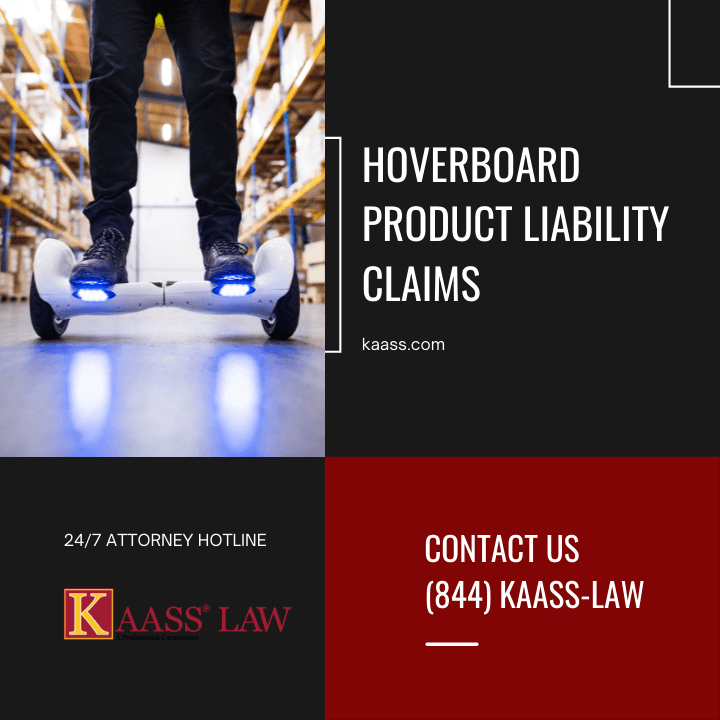
Started back in 2013, hoverboards have been in public for some time now . They began to quickly gain fame as most teenagers started purchasing the product. However, many problems arose during that time. Let's discuss Hoverboard Product Liability Claims.
A hoverboard is a way of portable transport, made to ride with only feet. There is a common term for them, which is "self-riding scooters." Hoverboards came to be the "next big thing" at the time of their release. With it being technologically so active, there came along a variety of issues with the product.
With the hoverboard being the new portable way of transit, technological reliability is highly dependent on during the use of this product. An example of a defect in technology included the hoverboard coming to an immediate stop. Now, this may not sound so bad, however, the damages it led to have been far more serious. With further elaboration, let's discuss how the hoverboard is driven. Riding a hoverboard, you must place your two feet in the two given spots. Being able to move the hoverboard forward or backward, you must lean forward and backwards, respectfully. To turn in direction, the body weight must transfer to one leg while the other maneuvers the opposite leg to start turning. This applies to both sides while you are turning. So, if someone were to be riding the hoverboard and going in a forward motion and suddenly the hoverboard comes to an immediate stop, there are a countless number of physical damages that may arise in the midst of this accident. Technology crashing may also lead to a loss of control.
Some issues with the hoverboard include:
There are several possible hoverboard product defects that can exist causing injury. There are 3 theories that a product liability lawsuit can be brought under. The 3 product liability theories include:
California hoverboard or electrically motorized board riders should be aware that there are California laws that govern its use. Some of these California hoverboard laws include but are not limited to:
If you or someone you know has been injured and think this can potentially be a Hoverboard Product Liability Claim, don’t hesitate to contact our Los Angeles personal injury attorney today at (310) 943-1171 for a free consultation and case review.

Yes, under Health and Safety Code 11351, it is considered a felony in the state of California to possess controlled substances with the intent to sell them.
For purposes of Health and Safety Code 11351, a controlled substance is any drug or chemical whose manufacturing, possession, and use are regulated by the government under the Controlled Substances Act.
The Controlled Substance Act is a federal statute that enables the federal government to regulate the manufacturing, importation, possession, use, and distribution of certain substances. Additionally, controlled substances are placed under one of five schedules under this act. The placement is based on the following:

Making a false report of fire is governed under Penal Code 148.4. Under this penal code, it is illegal to do any of the following willfully and maliciously:
The penalties involved in violating the penal code for making a false report of a fire can either be prosecuted as a felony or a misdemeanor.
Violation of the penal code is considered a felony when an individual willfully and maliciously does the following:
The penalties that an individual would face here are listed under . Additionally, an individual can also pay fines of up to $10,000.
A 995 motion is another name for a Motion to Set Aside Information. This is a motion that the defendant in a criminal matter may make. In other words, this motion asks the judge to dismiss all or part of the criminal charges that are pending before an individual in a criminal matter. The argument here is that the judge in the preliminary hearing ruled incorrectly finding that there was enough evidence for the matter to go to trial. A motion to set aside information is governed by Penal Code 995.
If a 995 motion is improperly denied, the following options can be taken by the defendant:
It is important to note that an improperly denied 995 motion cannot be directly appealed.
A petition for writ of prohibition is governed by Penal Code 999a, which states that the defendant has 15 days after their 995 motion was denied to file a petition if their 995 motion was made because the defendant had been indicted without reasonable or probable cause or that the defendant had been committed on information without reasonable or probable cause. A copy also needs to be served to the District Attorney.

The Homeowners Protection Act (HPA), also known as the PMI Cancellation Act, is a 1998 federal law that affords homeowners certain protections when canceling private mortgage insurance (PMI). It also creates other regulations related to the lending process. The HPA only covers private loans and does not regulate government-backed loans, such as VA loans. For people who take private loans, many of them are required or opt to purchase PMI, only to find out that they no longer need it later on. The HPA provides regulation in the process of purchasing and canceling PMI so that homeowners can avoid paying these unnecessary costs.
PMI is typically only required when a home buyer plans to pay less than the standard 20% upfront. This makes lending to those who cannot afford the high initial costs a lot less risky and more worthwhile to do. Paying for PMI can come in many forms, including paying an extra monthly premium on the mortgage, paying a 1-time sum at the beginning of the mortgage, or raising interest rates on the loan. No matter how the buyer chooses to pay, all forms of PMI are subject to HPA regulation.

Construction site accidents are fairly common. An injured victim may either file an insurance claim with the at-fault party's insurance carrier and/or a personal injury lawsuit against the at-fault party.
The plaintiff must be able to prove the following elements to establish negligence in a construction accident case:
In some cases, property owners are liable for the occurred accident on their property. According to CACI 1000 in a premises liability lawsuit, the plaintiff must be able to establish the following elements:

Yes, under Health and Safety Code 11162.5, it is a crime to make or possess counterfeit prescription blanks for a controlled substance.
Controlled substance for purposes of Health and Safety Code 11162.5 is defined as those drugs or chemicals whose manufacture, possession, and use are regulated by the government under the United States “Controlled Substances Act.”
Under the code, counterfeit is defined as making an exact imitation of the prescription blank, pad, or form with the specific intent to use that prescription blank to defraud or deceive. These prescription blanks, pads, or forms are those that a physician or other medical practitioner who has the authority to prescribe medication typically uses when ordering or otherwise authorizing a prescription for a controlled substance.

Under Penal Code 246, it is a crime in California to shoot at a house, apartment, building, camper, or any other dwelling or vehicle where there are individuals inside.
No, in order to violate Penal Code 246, the individual has to willfully and maliciously shoot the firearm.
For purposes of Penal Code 246, an individual must have the intent to do a wrongful act with the intent to injure, disturb, or otherwise harm another individual.
For purposes of Penal Code 246, an inhabited dwelling is considered any house or building if an individual lives inside the house or building. It is important to note that for purposes of Penal Code 246, it is not necessary that an individual was in fact inside the house or building at the time of the shooting. Thus, it is only necessary that an individual uses the house or building as a dwelling for purposes of Penal Code 246.

Yes, under Penal Code 171(b), it is a crime in California for an individual to bring or possess weapons into a public building and meetings that are open to the public.
Under the PC 171(b), it is a crime to carry the following into a public building or meetings that are open to the public:

According to California Penal Code Section 466, it is prohibited to possess certain tools that experience by law enforcement has shown to be instruments frequently used by thieves for breaking into a home, car, or another structure. It is not unlawful to possess these tools as long as there is no evidence to show criminal intent.
Penal Code 466 lists over 15 kinds of tools that are frequently used to break into any railroad car, building, trailer coach, aircraft, vessel, or vehicle.
Controlled substances for purposes of Health and Safety Code 11351 include the following:
Keep in mind that possession of controlled substances such as marijuana and methamphetamine for purposes of sale are considered separate offenses not covered under Health and Safety Code 11351.
For purposes of Health and Safety Code 11351, possession is established when an individual has direct and/or immediate control over the controlled substance. Typically, this is established when the individual possesses the controlled substance if they are carrying it on them. Possession can also be established if an individual has personal control over the substance such that the controlled substance was found near or around an area that the individual exercises control over, such as in the individual’s car or garage.
Under Health and Safety Code 11351, intent to sell can be established by showing the following:
As mentioned above, violating Health and Safety Code 11351 is considered a felony. Penalties include the following:
If you or someone you know has been charged with Health and Safety Code 11351, we invite you contact KAASS LAW today at (310) 943-1171 to speak to our criminal defense attorney for a free consultation.
Essentially, violation of the penal code is considered a misdemeanor when an individual does the same acts as listed above. However, the difference here is that there are no deaths or great bodily injury that results from the individual’s acts. The penalties that an individual can face include up to one year in county jail and/or paying fines of up to $1,000.
To do something willfully means that the individual intended to do the illegal act on purpose. Additionally, to do something maliciously means that the individual’s purposeful conduct was intended to either injure, annoy, or otherwise do something wrong.
A Penal Code 148.4 PC conviction can be expunged if it was charged as a misdemeanor. On the other hand, a felony conviction that resulted in serving time in state prison would not qualify for an expunged.
If you or someone you know has been charged with violating Penal Code Section 148.4, contact our Los Angeles criminal defense attorney at (310)943.1171 for a free consultation.
An arraignment is part of a criminal matter where the defendant enters a plea, whether guilty or not guilty or no contest.
A writ of habeas corpus petition works similarly to the way a petition for writ of prohibition does. However here, Penal Code 1508 states, the Supreme Court or Court of Appeals can return the matter before the issuing judge/court or to the court below it. Thus, if the trial court denies the petition, the defendant can then file a new petition in the court of appeal. However, if the court of appeal denies the petition, the defendant can then can have the Supreme Court review the petition by filing a petition for review. The defendant may also file another petition that would invoke California Supreme Court’s habeas jurisdiction.
Plea bargaining allows the defendant to negotiate and use leverage. In other words, the defendant can further poke holes in the prosecuting agency’s legal theory and further highlight how the issues found at the preliminary hearing may become an issue for the jury to return a guilty verdict.
If you or someone you know has been denied of their 995 motion, we invite you to contact our Los Angeles Criminal Defense Attorney at (310) 943-1171 for a free consultation.
Before the passage of the HPA, many lenders would make their customers aware that PMI is not required for the entire duration of the loan, yet there were difficulties for homeowners when trying to cancel it, many of whom were ignorant to the fact that they could do so. The HPA made it so lenders must do the following regarding PMI:
The HPA makes it so nearly all homeowners can cancel their PMI once the loan-to-value (LTV) reaches 80%, meaning that their equity must reach 20%. You can send a written request to your lender once you reach this number, and they are legally required to cancel your PMI barring other extenuating circumstances. Once the LTV reaches 78% your lender is legally required to cancel your PMI automatically, even if you have not requested it. It is generally a good idea to keep track of the equity you have accrued and cancel PMI at 80%, not just because you are losing out on money, but because there are circumstances where the lender may be able to charge PMI past 78% LTV. For example, liens on your property may allow a lender to keep charging PMI. https://youtu.be/wpuQaj4rdg8
Under California products liability laws, whoever sells designs, or manufactures a defective product is liable for caused injuries. According to CACI 1200, the following types of defects can be involved in product defect claims involve:
A product liability lawyer near you should be able to provide you with additional information.
There are a handful of parties that can be held responsible for construction accidents, which include:
Even if the injured person is partially liable for the accident, he can still file a lawsuit against others who were also at fault. According to CACI 405 an injured victim can still recover damages regardless of his percentage of fault, however, the plaintiff’s damages award will be reduced by the proportion of negligence.
People injured at construction sites can suffer different types of injuries, including:
Under California law, a plaintiff must file a lawsuit within a two–year period from the date of sustaining a construction accident injury.
In a successful claim, the plaintiff is entitled to compensatory damages, including economic and non-economic damages.
Recoverable economic damages in a construction accident include:
Recoverable non-economic damages in a construction accident include:
In case the defendant’s acted with malice, extreme recklessness, intentional or fraud, or oppression the plaintiff can also be entitled to punitive damages.
If you or a loved one has suffered an injury in a construction accident we invite you to contact our Glendale Personal injury attorney KAASS LAW at (310) 943-1171 for a free consultation and case review.
The penalties associated with violating this code can be prosecuted as either a misdemeanor or felony and is therefore considered a wobbler offense. Potential penalties for a misdemeanor Health and Safety Code 11162.5 conviction including up to one year in county jail as well as paying fines of up to $1,000. Potential penalties for a felony Health and Safety Code 11162.5 conviction include sixteen (16) months, two years, or three years in county jail.
The number of counterfeit prescription blanks is typically what determines whether the violation will be charged as a misdemeanor or felony. For example, if the individual has three or fewer counterfeit prescription blanks, the violation would likely be charged as a misdemeanor. On the other hand, should the individual possess more than three, the violation will likely be charged as a felony.
If you or someone you know has been charged with violation of Health and Safety Code 11162.5, please contact KAASS LAW today at (310) 943-1171 to speak to our criminal defense attorneys for a free consultation.
Similarly, as to an inhabited dwelling, an occupied vehicle is considered any vehicle such as a car or camper where an individual lives inside of the vehicle. Again, the individual does not necessarily have to have been home at the time of the shooting, just that the individual uses the vehicle as a place to dwell in.
Penal Code 246 is prosecuted as a felony, where an individual can face penalties including:
However, an individual can face harsher penalties if the victim suffers great bodily injury or in fact dies. Great bodily injury is defined as a significant or substantial physical injury such as breaking a bone or suffering from a gunshot wound.
If you or someone you know is facing charges of Penal Code 246, please contact KAASS LAW at (310)943.1171 to speak to an experienced criminal defense attorney for a free consultation.
This penal code can be prosecuted as either a felony or misdemeanor and is therefore considered a wobbler. If charged as a misdemeanor, the misconduct is punishable by up to one year in county jail. If charged as a felony, an individual can face imprisonment of either 16 months, 2 years, or 3 years.
A building owned or leased by the state or local government where public employees regularly are present to perform their official duties is considered a public building. An example of a public building is a courthouse.
Yes, there are several exceptions under Penal Code 171(b), which are as follows:
If you or someone you know is being charged with Penal Code 171(b), call KAASS LAW today and speak to an experienced criminal defense attorney today at (310) 943.1171.
The prosecutor must establish the following elements to convict the defendant of possession of burglary tools:
For being charged with possession of burglary tools there must be evidence showing that the defendant not only possessed them, but he also had criminal intent to use them to carry out a burglary. When considering all factors, everything that has been gathered gets taken into account, including physical evidence, witness testimony, and what happened when the defendant was arrested. The intent may be established in case all steps were taken to possibly complete the crime. Intent can be established through what the defendant was wearing at that time, what type of structure he was in when arrested, the hour of the day, types of tools he possessed, and statements he made before the crime.
For being convicted under PC Section 466 it is not enough to have the mentioned above tools in possession or even to alter or make the listed tools. The crime happens when a defendant possesses one or more tools and intends to unlawfully break into a rail car, structure, vessel, or vehicle. In case the defendant didn’t intend to unlawfully enter a vehicle or structure to commit a crime, he can’t be convicted of this crime.
The defendant should not be convicted of possessing burglary tools in case he wasn’t aware that the tools were used or were to be used in a crime of burglary.
All search and seizure operations must be carried out within the boundaries of the law. In case the tools were found during an unlawful search, the defendant may be able to have evidence obtained during the search kept out of court. That can lead to acquittal or dismissal. There are various factors involved that can determine whether a search was lawful or unlawful.
In California possession of burglary tools is a misdemeanor offense with the following penalties:
If you or a loved one has been charged with possession of burglary tools, you should immediately contact an experienced criminal defense attorney today at (310) 943-1171 for a free consultation and case review.