The business world thrives on trust, integrity, and fair competition. However, the pursuit of profit and advantage can sometimes lead individuals astray, tempting them to engage in unethical or even illegal practices. One such practice is commercial bribery, a serious offense that undermines fair business dealings and can have severe legal consequences. In California, Penal Code 641.3 PC specifically addresses commercial bribery, outlining the prohibited conduct and the penalties for those who violate the law. At KAASS LAW, we commit to upholding ethical business practices and protecting our clients from the legal ramifications of commercial bribery. The following provides a comprehensive overview of Penal Code 641.3 PC, explaining the elements of the offense, potential defenses, and the importance of seeking legal counsel if you are facing accusations or are concerned about potential violations.
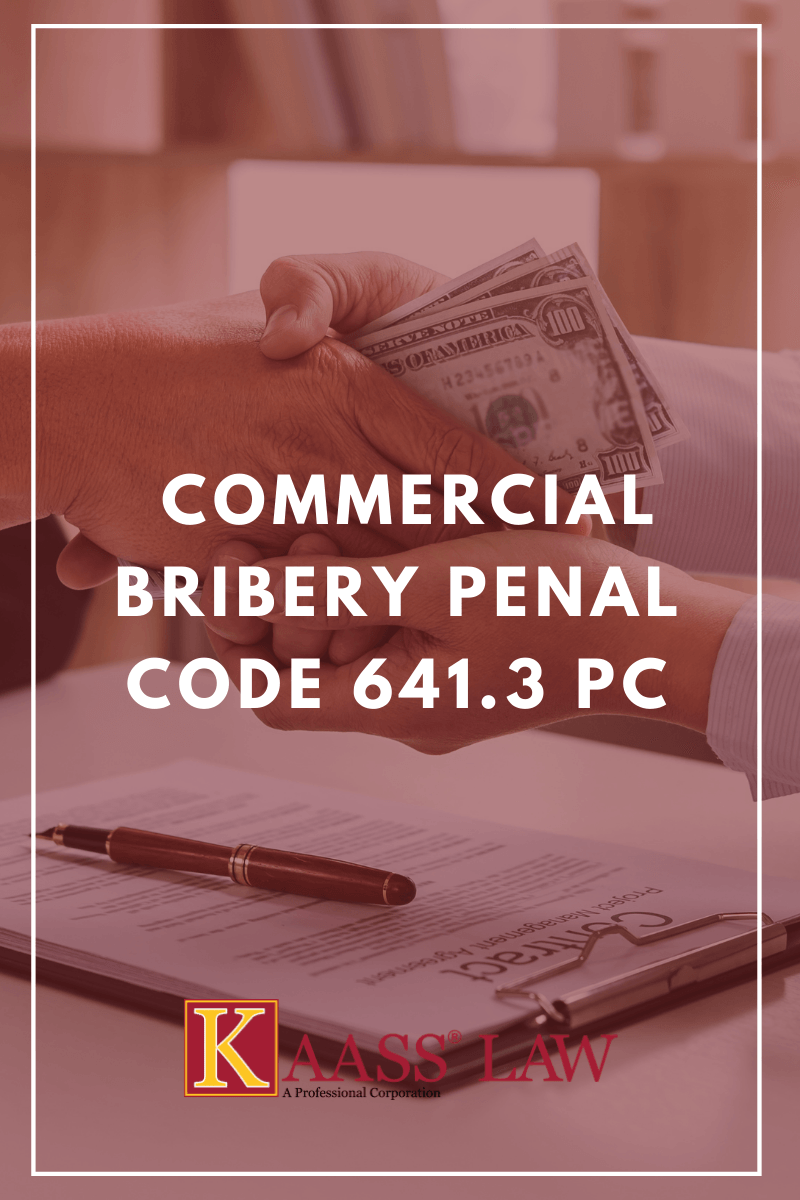
Commercial Bribery Penal Code 641.3 PC
According to California Penal Code Section 641.3 (a), an employee who solicits, accepts or agrees to accept money or anything of value from a person other than his employer, corruptly and without the knowledge or consent of the employer, in return for using his position for the benefit of that other person, is guilty of commercial bribery.
What Must The Prosecutor Prove to Be Found Guilty of Penal Code Section 641.3 Commercial Bribery?
The prosecutor must establish the following elements to prove a charge of Penal Code 641.3 PC commercial bribery:
The defendant is an employee who, with the intent to defraud or injure, solicits, accepts, or agrees to accept;
Money or anything else greater than $250;
From a person who is not an employer;
Without the consent and knowledge of the employer; and
In return for using his position to convey a benefit for that person.
Penal Code Section 641.3 PC applies similarly to employees receiving or soliciting bribes and to the person offering bribes. The commercial bribery statute is based on the concept of fiduciary duty between an employer and his employees. The purpose of PC Section 641.3 is to punish individuals who conduct actions to undermine the employer's interests for receiving money or anything else of value that personally benefits them.
Legal Defenses to California PC Section 641.3 (A) Charges
The main defense to commercial bribery charges is that there is no evidence that the employee or the person who pays the bribe had corrupt intent.
Penalties for a Commercial Bribery Penal Code Section 641.3
Commercial bribery can be charged as either a felony or a misdemeanor, depending on the amount of the bribe.
Penalties for Misdemeanor Commercial Bribery Conviction
If the value of the bribe is less than $1,000, the defendant will be charged with a misdemeanor, and the following penalties include:
up to 1 year in a county jail
Penalties for Felony Commercial Bribery Conviction
If the value of the bribe is $1,000 or more, the defendant will be charged with a felony, and the following penalties include:
16 months, two or three either in a county jail or California state prison
If the victim suffered monetary losses, a court can also order restitution pursuant to California PC Sections 1202.4(a) and (f). Civil damages can also be recovered under California Civil Code Section 3281 if the employer suffered a loss.
Defenses to Commercial Bribery Charges
If you're facing accusations of commercial bribery, there may be legal defenses available to you. Some potential defenses include:
Lack of Intent: You may be able to argue that you did not have the requisite corrupt intent to defraud or harm your employer or a competitor.
Lack of Knowledge: You may be able to argue that you were unaware that the payment or gift you received constituted a bribe.
Entrapment: If law enforcement or another party induced you to commit the offense, you may be able to argue entrapment as a defense.
Insufficient Evidence: The prosecution must prove every element of the offense beyond a reasonable doubt. If there is insufficient evidence to support the charges, you may be able to get the case dismissed.
Seeking Legal Counsel: A Critical Step
If you're facing accusations of commercial bribery or are concerned about potential violations, it's crucial to seek legal counsel from an experienced criminal defense attorney. An attorney can:
Investigate the allegations: Thoroughly investigate the circumstances of the alleged offense and gather evidence to support your defense.
Advise you on your rights and options: Explain the potential charges and penalties you may be facing and advise you on the best course of action.
Negotiate with the prosecution: Negotiate with the prosecution to seek a reduction or dismissal of the charges.
Represent you in court: Provide a strong defense in court and protect your rights throughout the legal process.
KAASS LAW: Protecting Your Business Interests
At KAASS LAW, we understand the complexities of commercial bribery laws and the potential impact these charges can have on your business and reputation. Our firm has a fair understanding of these types of bribery laws, especially Federal Bribery Laws. Our attorneys dedicate to providing skilled legal representation and protecting your interests. If you're facing allegations of commercial bribery or need guidance on compliance with Penal Code 641.3 PC, contact us today for a free consultation.
California, with its diverse terrain and scenic highways, is a haven for motorcycle enthusiasts. However, the freedom of the open road comes with responsibilities. California law mandates specific equipment requirements for motorcycles to ensure rider safety and promote responsible riding practices. Furthermore, certain modifications are illegal so we may prevent unsafe conditions and excessive noise pollution. At KAASS LAW, we commit to promoting motorcycle safety and helping riders understand their legal obligations. The following will provide a comprehensive guide to the required and prohibited motorcycle features in California, empowering you to ride legally and safely.
Required Motorcycle Equipment: Gearing Up for Safety
California law mandates several essential pieces of equipment for all motorcycles operating within the state:
Helmets: A U.S. Department of Transportation (DOT) compliant motorcycle safety helmet is mandatory for both riders and passengers.
Handlebars: Motorcycles must have handlebars, and they cannot be installed in a position that places the rider's hands more than six inches above their shoulder height when seated.
In today's competitive business landscape, trade secrets are often a company's most valuable assets. These confidential pieces of information, ranging from formulas and designs to customer lists and marketing strategies, provide a critical edge in the marketplace. California law recognizes the importance of protecting trade secrets. Additionally, they offer robust legal recourse for businesses that fall victim to misappropriation. At KAASS LAW, we dedicate on safeguarding the intellectual property of businesses and helping them defend their trade secrets from unfair competition. The following will explore the complexities of trade secret misappropriation in California, outlining the legal framework, the elements of a claim, and the available remedies. These types of secrets you want to hold close to your chest!
Understanding the Terms
According to Civil Code Section 3426.1(b)(1) under California law, "misappropriation" refers to the acquisition of a trade secret by а person who knows or has reason to know that the trade secret was acquired by improper means, such as bribery, theft, misrepresentation, breach or inducement of a breach of duty to maintain secrecy. According to Civil Code Section 3426.1(b)(2), misappropriation also includes the disclosure or use of a trade secret without consent by a person who used improper means to acquire knowledge of the trade secret.
An individual's injuries as a result of a defective product are the focus of a product liability action. A medication, a toy, an electronic device, or anything else could be the product. The most important thing is that the product is defective or malfunctioning in some way, and that the flaw or malfunction injures someone. Every year, thousands of people in the United States are wounded as a result of defective or harmful products. As a result, there are laws in place to provide legal recourse. According to California Product Liability Laws, any person who designs, produces, or sells a defective product is strictly liable for the product's damages, even in case the person or company was not negligent.
Elements the Plaintiff Must Prove During a Product Liability Lawsuit
Generally, a plaintiff must be able to establish the following elements, to prevail on a claim for products liability in California,
Defendant designed, distributed, manufactured, or sold a defective product
The product contained the defect when it left the defendant's possession
Plaintiff used the product in a reasonably foreseeable manner
In the realm of legal responsibility, there's a concept called "vicarious liability" that can hold you accountable for the actions of another person, even if you weren't directly involved. This legal doctrine, while complex, plays a crucial role in ensuring fairness and protecting victims in various situations. At KAASS LAW, we understand the intricacies of vicarious liability and dedicate to providing clear legal guidance and representation. The following will explore the concept of vicarious liability in California. Furthermore, this will be explaining its applications, implications, and how it might affect you.
What is Vicarious Liability in California?
Vicarious liability is a legal doctrine that holds one person or entity liable for the wrongful actions of another person. Even if the first person or entity did not directly cause the harm. This liability arises from a specific relationship between the parties, such as employer-employee, principal-agent, or parent-child. The rationale behind vicarious liability is that the person or entity in a position of control or authority should bear some responsibility for the actions of those under their supervision or influence.
Relationships That Involve Vicarious Liability
Employer-Employee Relationships
The employer can be accountable for an employee's negligent actions. This is referred to as respondent superior law. According to :
When we purchase a product, we expect it to be safe and function as intended. Unfortunately, defective products can cause serious injuries, property damage, and even death. California law provides a framework for holding manufacturers, distributors, and retailers accountable for the harm caused by defective products. At KAASS LAW, we are dedicated to protecting consumers and ensuring they receive the compensation they deserve for injuries caused by defective products. The following explores the intricacies of product liability lawsuits in California. Furthermore, this will be explaining the types of defects, the legal theories involved, and the steps you can take! KAASS LAW, we dedicate in protecting consumers and ensuring they receive the compensation they deserve for injuries caused by defective products. This blog post explores the intricacies of product liability lawsuits in California, explaining the types of defects, the legal theories involved, and the steps you can take to seek justice. The harms a person sustains as a result of a defective product are the focus of a product liability case. A medication, toy, electronic gadget, or anything else could be the product. The crucial factor is that the product must be faulty or malfunction in some way, causing harm to someone. There are regulations in place to give people legal remedies because unsafe and defective items injure thousands of people every year.
Contracts are the foundation of countless transactions and relationships in our society, from buying a cup of coffee to complex business agreements. While the written terms of a contract define the explicit obligations of each party, California law goes further by recognizing an implied covenant of good faith and fair dealing in every contract. This covenant, though not explicitly written, requires parties to act honestly and fairly in their contractual dealings, ensuring that neither party unfairly interferes with the other's right to receive the benefits of the agreement. At KAASS LAW, we understand the nuances of contract law and commit to protecting your rights and interests. The following will explore the covenant of good faith and fair dealing in California, explaining its significance, potential breaches, and how we can help if your contractual rights have been in violation. Every contract and agreement in California contains an implied promise of good faith and fair dealing. This means that each party shouldn't do anything to unfairly interfere with the right of any other party for receiving benefits of the contract. Though, the implied promise of fair dealing and good faith can't create obligations that are inconsistent with the terms of the contract.
Elements the Plaintiff Must Prove for Breach of Covenant of Good Faith in California
Conservatorship is a legal process where a court appoints a responsible person or entity to care for an adult who is deemed unable to care for themselves or manage their own finances. It's a significant undertaking with far-reaching implications for the individual under conservatorship, their family, and the appointed conservator. In California, conservatorship laws are there to strike a delicate balance between protecting vulnerable individuals and preserving their autonomy. At KAASS LAW, we understand the complexities and sensitivities surrounding conservatorships. The following will provide a comprehensive overview of conservatorship in California, exploring the different types, the process involved, and the rights and responsibilities of all parties. Conservatorship is a court proceeding when a judge assigns an entity or individual to manage the financial affairs and exercise the legal rights of a mentally ill person. The court refers to the person managing the legal rights and finances of the disordered person as the "conservator." The disabled person is the "conservatee."
Who Can Become a Conservator in California?
Usually, a conservator is a spouse, child, domestic partner, relative, friend, or neighbor of a disabled person. Although conservatorship law prefers a family member of the conservatee, in some cases the court can appoint professional conservators, government, or non-profits agencies.
Prescription drugs play a vital role in managing health conditions, but they can also be misused and abused. California law takes a strong stance against prescription fraud, including forging or altering prescriptions. These actions not only endanger public health but also carry severe legal consequences. At KAASS LAW, we understand the complexities of prescription drug laws and are committed to providing accurate legal information and representation. The following will explore the legal ramifications of forging or altering a prescription in California, outlining the potential charges, penalties, and defenses.
Forging or Altering a Prescription in California
Under California Business and Professions Code Section 4324 it is illegal to forge or alter a prescription, or possess drugs acquired through a false prescription. It is a crime in California to forge a prescription or make an attempt to gain possession of prescription drugs. However, in case a person actually got medication as a result of forging a prescription, he will be also liable under Business & Professions Code Section 4324(b). A person can be convicted of both offenses i.e. forging the prescription and obtaining the medication through false prescription.
California is an "at-will" employment state, meaning that employers generally have the right to terminate employees for any legal reason or even for no reason at all. However, there are important exceptions to this rule, and one of the most significant is the principle of "wrongful termination in violation of public policy." At KAASS LAW, we are dedicated to protecting the rights of employees and ensuring that they are not unjustly dismissed from their jobs. The following will explore the concept of wrongful termination in violation of public policy in California. Furthermore, we will be explaining the legal basis for such claims, common scenarios, and how we can help.
What is Wrongful Termination in Violation of a Public Policy?
Wrongful termination in violation of public policy happens when an employer fires an employee for performing a legal obligation or exercising a legal right, and the obligation or right is related to important public policy. California law prohibits employers from firing their employees in case that discharge would be in violation of public policy. This is true even though California is an at-will employment state. To add, employers have the right to terminate employment relationships at any time without reason. Specifically, the employee can sue the employer for wrongful termination in case the employer has fired him for:
Turn Signals: All motorcycles manufactured after 1972 must be equipped with functioning front and rear turn signals. This allows riders to clearly signal their intentions to other motorists, enhancing safety on the road.
Mirrors: Motorcycles must have at least one mirror, providing the rider with a clear view of the roadway behind them.
Horn: A functioning horn is required to alert other motorists or pedestrians of the motorcycle's presence, especially in situations where visibility may be limited.
Exhaust System: Motorcycles manufactured in 2013 or later must have exhaust systems that comply with state regulations. Modifying the exhaust system to increase noise levels is prohibited.
Lights: Motorcycles must have functioning headlights, taillights, and brake lights.
Tires: Tires must have adequate tread depth and be properly inflated to ensure safe handling and traction.
Brakes: Motorcycles must have functioning front and rear brakes that meet performance standards.
Prohibited Motorcycle Modifications: Staying Within the Lines
California law also prohibits certain motorcycle modifications that can compromise safety or create excessive noise:
Handlebar Height: As mentioned earlier, handlebars cannot be raised more than six inches above the rider's shoulder height when seated.
Loud Exhaust Systems: Modifying the exhaust system to amplify noise levels is illegal. This helps reduce noise pollution and ensures that motorcycles do not create excessive noise that can startle other motorists or pedestrians.
Unsafe Lighting: Modifying headlights or taillights to be excessively bright or distracting can cause serious accidents on the streets.
Radar Detectors/Jammers: Using devices that detect or interfere with police radar is illegal in California.
Nitrous Oxide Systems: Installing nitrous oxide systems, which can significantly increase a motorcycle's speed and acceleration, is not street legal.
Unsafe Tires: Using excessively worn or improperly sized tires is illegal and can compromise the motorcycle's handling and stability.
The Importance of Compliance
Adhering to California's motorcycle equipment requirements and modification restrictions is not only a legal obligation but also a crucial safety practice. Properly maintained and legally compliant motorcycles contribute to a safer riding environment for everyone on the road.
Safety Equipment Features
According to California Vehicle Code Section 27803, all motorcyclists need to wear helmets upon requirment.
According to California Vehicle Code Section 26709, all riders must be equipped with right and left mirrors.
According to California Vehicle Code Section 27801, handlebars cannot fit in a position that puts the rider's hands more than 6 inches above his shoulder height. While the motorcycle is in motion.
Cannabis Use
Riding under the influence of cannabis in the state of California can result in a DUI charge. As a result, a rider can get penalties and fees, including suspension of a motorcycle rider's license and driving privileges. In case the motorcyclist caused an accident while under the influence of cannabis, he can be financially liable for injuries and other damages.
Lane Splitting Laws
Lane splitting is when a motorcycle rider drives between two lanes of traffic to get around other vehicles. In the state of California, it is legal to practice lane splitting on the state's roadways. Here are regulations related to lane splitting:
According to California Vehicle Code Section 22517, riders are not allowed to open or leave vehicle doors unless it is reasonably safe to do so.
According to California Vehicle Code Section, 22400 riders cannot drive at a speed that blocks the normal traffic movement unless it is necessary for safety.
KAASS LAW: Your Partner in Motorcycle Safety and Legal Compliance
At KAASS LAW, we dedicate to promoting motorcycle safety and helping riders understand their legal features or help them understand CA Motorcycle Insurance. As always, we ask our clients and riders to stay safe out there! If you have any questions about motorcycle equipment requirements, modifications, or any other legal matters related to motorcycling, contact us for a free consultation. We can provide guidance and representation to ensure you're riding safely and legally within the boundaries of California law. https://www.youtube.com/watch?v=tEKrzYAGGiU
Elements the Plaintiff Must Establish to Prove Misappropriation of Trade Secrets in California
According to CACI 4401, to establish the claim of trade misappropriation, the plaintiff must be able to establish all five elements:
The plaintiff owned or was a licensee of the trade secret
The information was a trade secret at the time of the misappropriation
The defendant improperly acquired, used or disclosed the trade secret
The plaintiff was harmed, or the defendant was unjustly enriched
The defendant's acquisition, use, or disclosure was a substantial factor in causing harm to the defendant or to be unjustly enriched.
What Is Technically A Trade Secret?
According to CACI 4402, each of the following elements must be present in a "trade secret":
The trade secret must consist of information. Trade secret law protects different types of information, but the most common examples fall under two categories: business information and technical information. The information that protects and recognize as a trade secret can include the following:
Business plans
Corporate agendas and minutes
Bid specifications
Customer lists
Spreadsheets
The information must derive actual or potential economic value from the fact that it is secret.
To be a trade secret, the information can't be generally known to the public, industry competitors, or others who could realize economic value from its use or disclosure.
The information must be treated as a secret, and the owner must exercise reasonable efforts to maintain its secrecy.
Trade Secret Ownership in California
California Labor Code Section 2860 expressly establish that the employer owns trade secrets created by an employee. Though, an employer wouldn't own trade secrets created on an employee's personal time without the use of employer's materials.
Statute Of Limitations for Misappropriation of Trade Secrets in California
A plaintiff must bring an action for misappropriation within three years after the misappropriation's discovery. Or, alternatively, by the exercise of reasonable diligence, upon discovery.
Civil Remedies for Misappropriation of Trade Secrets
In case of a successful claim, trade secret owners can:
Obtain an injunction prohibiting the actual or threatened misappropriation
Recover compensatory damages for actual loss caused by the misappropriation
Recover compensatory damages for the defendant's unfair enrichment to the amount not covered by the calculation of damages for actual loss
Obtain payment from the defendant of a reasonable royalty if neither the damages nor the unjust enrichment caused by the misappropriation are provable
Recover punitive damages not exceeding twice the compensatory damages award if the misappropriation was willful and malicious
Recover attorneys' fees
KAASS LAW: Your Partner in Trade Secret Protection
At KAASS LAW, we understand the critical role that trade secrets play in business success. Our experienced attorneys can help you:
Identify and protect your trade secrets: We can help you identify your trade secrets, develop comprehensive protection strategies. Also, we can implement effective confidentiality agreements.
Investigate misappropriation: If you suspect trade secret misappropriation, we can conduct thorough investigations to gather evidence and identify the responsible parties.
Enforce your rights: We can pursue legal action to stop misappropriation, recover damages, and protect your intellectual property.
Don't Let Your Trade Secrets Fall into the Wrong Hands
Trade secret misappropriation can have devastating consequences for businesses, leading to financial losses, reputational damage, and loss of competitive advantage. If you're concerned about protecting your trade secrets or believe that your trade secrets have been misappropriated, contact KAASS LAW today for a consultation. We're here to help you safeguard your valuable intellectual property and ensure your business thrives in a competitive marketplace. Additionally, we also help with any partnership and shareholder disputes, so give us a call for any further legal inquiries!
As a result of the defect, the plaintiff suffered harm
Strict Product Liability in California
A defendant must usually have done (or failed to do) anything with negligence, gross negligence, recklessness, or the intent to cause harm in order to be liable for a plaintiff's injuries. However, in exceptional cases, a defendant may be accountable for a plaintiff's injuries despite the fact that the defendant did nothing wrong. Whoever creates, manufactures, or distributes a defective product that is more dangerous than it should be. As a result, it is solely responsible for any harm that the product can cause.
Types of Claims Under Strict Product Liability
Liability claims for defective products uses a basis of negligence, strict liability, or a breach of the warranty of fitness. Because there is no federal product liability legislation, jurisdiction decides where the claim is submitted. Because of this lack of consistency, the US Department of Commerce published the Model Uniform Products Liability Act (MUPLA). This tries to develop standardized procedures for the products liability tort. There are essentially three types of claims under strict product liability:
Manufacturing defect claims, which involve a defect in a specific item produced
Design defect claims, which involve a defect in the design of an entire product line
Failure to warn claims
Manufacturing Defect Claims
In manufacturing defects claims, the plaintiff asserts that a specific product was defectively manufactured as compared to products in the same line, and the particular units of the product were defectively manufactured. So, the product presented harm which actually was a result of the manufacturing defects.
Design Defect Claims
A lawsuit based on a product's poor design is the first sort of product liability claim. In a legal case based on defective design, the plaintiff claims that the product is inherently unsafe due to its design rather than a manufacturing error. To asses defective design product liability claims California this using two tests:
The Risk-Benefit Test
According to this test, after the plaintiff shows that the defective product design caused the injuries. The defendant now has the entire burden of proof. The defendant must prove that the utility of the defective product design outweighs the risk of the design. If he fails to do that, then the plaintiff will win the case.
The Consumer Expectations Test
According to this test, a product’s design will be defective in case it fails to perform as safely as an ordinary consumer would expect it to perform.
Failure to Warn Claim
According to California's strict product liability, a defendant who is aware that the consumer is using the product in a reasonably foreseeable manner. That exposes him to a risk of injuries is under obligation to warn the consumer of the risk of injury or harm. The defendant can be liable for a failure to warn when such failure could have altered the outcome. So, in case a typical consumer would have become aware of the risk of injuries or harm on his own, then the defendant can’t be liable for failing to warn of an already-known hazard.
Glendale Personal Injury Lawyer
If you or a loved one has been harmed as the of defective product, then you may be entitled to compensation. If that is the case, contact our Glendale personal injury lawyer today for a consultation and case review. Please feel free to give our office a call at 310.943.1171. [embed]https://www.youtube.com/watch?v=QAfPxXwzc2E[/embed]
The employer is responsible for harm caused by the wrongful conduct of his employee while acting within the scope of their employment.
The employee is always responsible for harm caused by his own wrongful conduct, whether or not the employer is also liable.
The employer can be held liable if the plaintiff is able to prove the following:
Employee caused harm to the plaintiff at issue
The employee was acting within the scope and course of his employment
CACI 3720 provides some guidance to what is considered "scope of employment"
It is reasonably relatable to the sort of work tasks for which the employee hire
It is reasonably foreseeable, given the nature of the employee's work responsibilities
Principal-Agent Relationships
California Civil Jury Instruction 3700 provides a concise and clear explanation of the basics of vicarious liability. One can authorize another one to act on his behalf in transactions with third parties. This kind of relationship is another term, "agency." The person giving the authority, "the principal," and the person to whom the authority is giving, "the agent." A principal can be liable for the actions of his agents, joint venture members, partners, and, in some cases, independent contractors. The principal actor can be an individual or company. The liability extends to the principal for actions that are within the scope of the agent's powers and duties to act on behalf of the principal. Normally, any intentional tort isn't considered to be within the scope of an agent's duties, and a principal won't be held accountable unless the principal clearly approves the conduct.
Parent-Child Relationships
In some cases, California laws impose liability on parents for damage or injuries to people or property caused by their children. Vicarious liability of a parent for the actions of his child is applicable under the following conditions:
A child engaged in willful misconduct
The child drove a parent's vehicle, and the damages or injuries resulting from the diver's negligent conduct
The parent permitted the child to use a firearm, and the child's actions caused injuries to another person
Vicarious Responsibility for Co-conspirators' Acts
Under California law, a member of a conspiracy can also be held liable for crimes committed by his co-conspirators. The plaintiff must prove that the co-conspirators' actions were foreseeable and commit with the intent of furthering the objective of the conspiracy.
Implications of Vicarious Liability
Vicarious liability has significant implications for both individuals and businesses.
Increased liability: It can expand the scope of liability for individuals and businesses, holding them responsible for the actions of others.
Deeper pockets: Vicarious liability often allows injured parties to seek compensation from a party with greater financial resources, such as an employer or insurance company.
Risk management: Businesses need to be aware of the potential for vicarious liability and take steps to mitigate their risk, such as through proper employee training, supervision, and insurance coverage.
KAASS LAW: Your Guide to Vicarious Liability
Vicarious liability can be a complex legal concept with significant consequences. At KAASS LAW, we have extensive experience navigating vicarious liability claims and can provide guidance and representation in various situations. If you have questions about vicarious liability or believe you may have a claim, contact us today. We'll help you understand your rights and options and work to protect your interests. Alternatively, if you would like to understand strict liability laws in personal injury cases, we can help navigate as well. Do you have more questions about laws in California? If so, KAASS LAW would be happy to provide you with additional information at any time! Give us a call at (310) 943-1171 or fill out the form below, and one of our team members will contact you! [contact-form-7 id="5673" title="KAASS LAW Contact Form"]
Elements the Plaintiff Must Prove During a Product Liability Lawsuit
To win a case for product liability in California, the plaintiff has to be able to prove the following elements:
Defendant designed, distributed, manufactured, or sold a defective product
The product contained the defect when it left the defendant's possession
The plaintiff used the product in a reasonably foreseeable manner
As a result of the defect, the plaintiff suffered harm
Strict Product Liability in California
Usually, a defendant must have acted (or omitted to act) with gross negligence, recklessness, or malice in order to be held accountable for a plaintiff's injuries. However, in some cases, a defendant could be strictly accountable for the plaintiff's injuries, even though they were not their fault. Anyone who produces or sells a product that is riskier than it ought to be is in violation of California law. Strict liability exists for any injuries of using the product in a manner that is reasonably foreseeable. Alternatively, or that fails to provide adequate warnings.
Types of Claims Under Strict Product Liability
Liability claims for defective products can occur on the basis of negligence, strict liability, or a breach of the warranty of fitness. Because there is no federal product liability legislation, this will usually depend on the jurisdiction. Because of this lack of consistency, the US Department of Commerce published the Model Uniform Products Liability Act (MUPLA), which attempts to promote uniform processes for the products liability tort. There are essentially three types of claims under strict product liability:
Manufacturing defect claims, which involve a defect in a specific item produced
Design defect claims, which involve a defect in the design of an entire product line
Failure to warn claims, which involve the defendant's liability
Manufacturing Defect Claims
In manufacturing defects claims, the plaintiff asserts that a specific product was defectively manufactured as compared to products in the same line. So, the product presented harm which actually was a result of the manufacturing defects.
Design Defect Claims
A lawsuit based on a product's poor design is the first sort of product liability claim. In a legal case based on defective design, the plaintiff claims that the product is inherently unsafe due to its design rather than a manufacturing error. In California, there are two tests used in assessing defective design product liability claims:
The Risk-Benefit Test
According to the Risk-Benefit Test, after the plaintiff shows that the defective product design caused the injuries, the burden of proof completely shifts to the defendant. The defendant must prove that the utility of the defective product design outweighs the risk of the design. If he fails to do that, then the plaintiff will win the case.
The Consumer Expectations Test
According to this test, a product's design will be defective in case it fails to perform as safely as an ordinary consumer would expect it to perform.
Failure to Warn Claim
According to California's strict product liability, a defendant is aware that the consumer is using the product in a reasonably foreseeable manner. Will be eligible to warn the consumer of the risk of injury or harm if exposed to a risk of injury is eligible to warn the consumer of the risk of injury or harm. The defendant can be liable for a failure to warn when such failure could have a different outcome. So, if a typical consumer becomes aware of the risk of injuries or harm on his own, then the defendant can't be liable for failing to warn of an already-known hazard.
Glendale Personal Injury Lawyer
Contact our Glendale personal injury lawyer today for a consultation and case review. Please feel free to give our office a call at 310.943.1171. [embed]https://www.youtube.com/watch?v=QAfPxXwzc2E[/embed]
According to CACI 325, in a breach of covenant of good faith and fair dealing action, a plaintiff must be able to prove all of the following elements:
Plaintiff and defendant entered into a contract;
Plaintiff did all or substantially all of the significant things that the contract, per requirement, or, upon dismisall, that their was from having to do those things;
All conditions required for the defendant’s performance had occurred or were excused;
Defendant unfairly interfered with the plaintiff's right to receive the benefits of the contract; and
Plaintiff was harmed by the defendant’s conduct
What Is Insurance Bad Faith?
California law defines certain types of conduct and acts which can qualify as insurance bad faith. They include the following:
Unreasonable denying the policy benefits
Intentionally misrepresenting policy provisions or facts to the claimants
Failing to act or respond promptly with respect to the claim
Failing to provide adequate and prompt justification for the denial of the claim
Failing to approve or deny the claim within a reasonable time period
Failing to make a good faith effort to honestly settle claims between parties
Misleading a plaintiff as to the legal deadline for initiating a lawsuit and filing a claim
Advising a plaintiff not to hire a lawyer
Insurance Contract Provisions
In California most insurance contracts contain the following provisions:
The insurer is required to pay claims when the policyholder experiences a potentially covered risk
The insurer must investigate a claim for determining the liability for caused injury,
The insurer must use good faith attempts to settle claims
The insurer must provide the policyholder with a legal defense against third-party claims
Duty to Defend in Insurance Contracts
In California, insurers are required to indemnify and defend the policyholders in case a risk is even possibly covered, thus even if the reason for the accident is unknown, the insurer is obliged to treat it as a covered risk. On the other hand, the policyholder must act in good faith and comply with the notice requirements.
Remedies for Insurance Bad Faith
There are a number of potential damages the plaintiff can recover if the insurer has committed bad faith.
Plaintiff can recover damages for breach of contract, specifically, the benefits due under the policy plus interest.
Plaintiff may be able to recover bad faith damages, including consequential economic losses, attorneys' fees, and emotional distress and.
According to California Civil Code Section 3294(a) punitive damages can only award case clear and convincing evidence shows the insurance company engaged in oppression, fraud, or malice.
KAASS LAW: Protecting Your Contractual Rights
If you believe that a party has breached the implied covenant of good faith and fair dealing in a contract with you, it's crucial to seek legal counsel. At KAASS LAW, we have extensive experience handling contract disputes and protecting the rights of our clients. We can help you:
Analyze your contract: We'll carefully review the terms of your contract and assess whether a breach of the covenant has occurred.
Gather evidence: We'll help you gather and preserve evidence to support your claim, including documents, communications, and witness testimony.
Negotiate with the other party: We'll skillfully negotiate with the other party to seek a fair resolution of the dispute.
Litigate your case: If necessary, we'll take your case to court and fight aggressively to protect your rights and secure the compensation you deserve.
Don't Let Your Contractual Rights Be Violated
The implied covenant of good faith and fair dealing is a crucial protection in California contract law, ensuring that parties act honestly and fairly in their contractual relationships. If you believe your contractual rights have been in violation, don't hesitate to contact KAASS LAW for a free consultation. We're here to help you navigate the complexities of contract law and fight for the justice you deserve.
According to CACI 400, to succeed in the claim, the petitioner must be able to prove beyond a reasonable doubt all of the following elements:
The respondent has a mental disorder or is impaired by chronic alcoholism
The respondent is gravely disabled as a result of a mental disorder or chronic alcoholism
The respondent is unable or unwilling or unable voluntarily to accept meaningful treatment.
Types of Conservatorship
Probate Conservatorships
Probate conservatorships include:
General Conservatorships: This is a conservatorship of adults who aren't able to take care of themselves or their finances. Usually, these conservatees are elderly people, but there also can be younger people who have been seriously impaired, for example, in a car accident.
Limited Conservatorships. These conservatorships are for adults with developmental disabilities who are not able to fully care for themselves or their finances. This type of conservatorship doesn't need a higher level of care than in the case of general conservatorships.
Lanterman-Petris-Short Conservatorships
In California, the Lanterman-Petris-Short Act governs the involuntary treatment of the mentally ill person. The act has a goal of ending the indefinite and inappropriate commitment of the mentally ill, providing adequate evaluation and treatment to a person with serious mental disorders, protecting and guaranteeing public safety, and providing supervision, individualized treatment, and placement services for the disabled person through a conservatorship program. Lanterman-Petris-Short conservatorship is to care for adults who have serious mental health illnesses and need special care. This type of conservatorship is generally is for people who require extensive mental health treatment and very restrictive living arrangements. Lanterman-Petris-Short conservatorships must start by a local government agency.
Duties of Conservatorship
Conservators have multiple duties to perform for taking care of the conservatee's needs and here is the list of some duties a conservator may perform.
Assessing the status of real estate and personal property
Filing yearly plans for the conservatee's care
Planning appropriate care for the conservatee and getting an appropriate residence for him
Paying outstanding bills and filing income tax returns for the conservatee
Filing an inventory of the assets
How Are Conservatorships Terminated?
Typically, termination of the conservatorship happens when the conservatee passes away. In case the conservatee doesn't meet the standards for having a conservator, a court can cancel the appointment. Additionally, the conservatee can petition a court with the assistance of a conservatorship lawyer in case he believes he has strong evidence that he is better off without that care.
Conservatorship Versus Guardianship
In California, conservatorships are protective court procedures for adults, while guardianships protect minors.
KAASS LAW: Guiding You Through Conservatorship
Conservatorships are complex legal proceedings with significant implications for everyone. Whether you're considering establishing a conservatorship, challenging an existing one, or seeking guidance as a conservator, it's essential to have experienced legal counsel. At KAASS LAW, we can help you:
Understand the different types of conservatorships and the process involved.
Prepare and file the necessary court documents.
Represent you in court hearings.
Advise you on your rights and responsibilities as a conservator or conservatee.
Explore alternatives to conservatorship.
Ensure the conservatorship manages in accordance with the law and the best interests of the conservatee.
Navigating Conservatorship with Compassion and Expertise
At KAASS LAW, we approach conservatorship matters with compassion and sensitivity, recognizing the significant impact they have on individuals and families. We are dedicated to providing personalized legal guidance and support, helping you navigate the complexities of conservatorship and achieve the best possible outcome for all involved. If you have questions about conservatorship or need legal assistance with a conservatorship matter, contact us today for a free consultation.
To Be Convicted of California Business and Professions Code 4324 Forging or Altering a Prescription Prosecution Must Prove
The prosecution must prove the following elements to convict the defendant of forging or altering a prescription:
defendant falsely made, forged altered, or counterfeited a prescription;
gave another person a forged or fictitious signature;
used or attempted to use with a forged or fictitious signature; and/or
The defendant committed that act with the intent to defraud
Forging a Prescription
Prescription forgery is the use of a falsified prescription for purchasing drugs illegally. Forging or altering a prescription is making, publishing, uttering, passing, or attempting to pass a prescription for drugs or possessing drugs acquired by a false prescription. Attempting to transfer another person a falsified prescription, even if you didn’t actually write it, is also a crime.
What is Considered to be a Prescription?
Prescription is an instruction to provide drugs, either by phone, through writing, or through electronic communications (i.e., facsimile). Generally, a valid prescription must include the following information:
Patient’s name
Name and quantity of prescribed drug
Directions on how to use the drug
Date of issue
Contact information of doctor or prescriber
Doctor’s or prescriber’s signature
The Term "Drug" Under Business and Professions Code Section 4025
The term “drug” under California Business and Professions Code Section 4025 include:
prescription drugs;
veterinary drugs; and
drugs without a prescription.
“Uttering” Under Business & Professions Code Section 4324
The defendant is guilty of falsely uttering a prescription in situations where the defendant:
Used or attempted to use a forged drug prescription; and/or
Conveyed or indicated through his words or conduct that the prescription was genuine
Defenses to Forged Prescription B&P Code 4324
Some common defenses to charges related to forged prescriptions
The defendant had the authority to sign the prescription;
Defendant did not forge or alter the prescription;
Defendant did not use the forged prescription; and/or
The defendant isn't aware the prescription is under forgery
The penalties for violating California Business and Professions Code Section 4324
Business and Professions Code section 4324 forging or altering a prescription is considered a "wobbler offense". As such, the offense can be charged as either a misdemeanor or a felony, depending on the defendant’s criminal history, as well as other factors.
The penalties for a Misdemeanor Business and Professions Code 4324 Conviction
Penalties for misdemeanor Business and Professions Code 4324 conviction include:
Up to one year in county jail;
A fine of up to $1,000; and/or
Misdemeanor probation
The penalties for a Felony Business and Professions Code 4324 Conviction
Penalties for felony Business and Professions Code 4324 conviction include:
16 months, two or three years in county jail;
A fine of up to $10,000; and/or
Felony probation;
Furthermore, additional penalties a defendant can face include the following:
Community service or labor;
Permanent firearm restriction; and/or
Immigration consequences;
The Importance of Legal Representation
If you're facing charges for prescription fraud, it's crucial to have experienced legal representation. A skilled criminal defense attorney can:
Investigate the charges: Thoroughly investigate the circumstances of the alleged offense and gather evidence to support your defense.
Challenge the evidence: Challenge the admissibility of any evidence as illegal or is unreliable.
Negotiate with the prosecution: Negotiate with the prosecution to seek a reduction or dismissal of the charges.
Represent you in court: Provide a strong defense in court and protect your rights throughout the legal process.
KAASS LAW: Your Defense Against Prescription Fraud Charges
At KAASS LAW, we understand the serious consequences of prescription fraud charges. Our attorneys dedicate to protecting your rights and fighting for the best possible outcome in your case. If you are under accusation with forging or altering prespeciptions, contact us today for a free consultation. We'll review your case, explain your legal options, and develop a strong defense strategy to protect your future. Moreover, any matters involving a wrongful death due to prescription drugs, please contact us today.
Forging or Altering a Prescription in California Video
Exercising a statutory right or privilege (attempting or organizing a union, engaging in political activities, etc.)
Performing a legal duty (taking time off to serve on a jury, serving as a witness in court, taking time off for military service, etc.)
Reporting a violation of a public or statute importance
Elements of Wrongful Termination in Violation of a Public Policy
According to CACI 2430, the plaintiff must be able to establish the following elements to prove the claim of wrongful termination in violation of a public policy.
The plaintiff was in employment by the defendant.
The defendant discharged the plaintiff.
Termination was the main reason that was against the public policy.
Plaintiff sustained harm.
Discharge was a substantial factor in causing harm to the plaintiff.
One important thing the plaintiff must prove is that there is a clear causal connection between his termination and the employer's public policy violation.
Reporting a Violation of Law
The most common lawsuits over wrongful discharge in violation of public policy involve situations when employees are terminated for reporting illegal conduct that the employer has engaged in. This protected by law activity is called "whistleblowing." Federal laws protect employees who speak up about the employer who violates the law. By witnessing the questionable behavior of the employer, whistleblowing employees have immunity against termination and retaliation after reporting the employer to law enforcement. Employees have a right to sue the employer in case they are terminated because of whistleblowing. Here are some federal and California laws that provide support for employees who want to protect their rights after being fired for whistleblower activities. These include:
The whistleblower provisions of the Sarbanes-Oxley Act of 2002
The "qui tam" section of the California False Claims Act.
Damages That Victims Can Recover Wrongful Termination in Violation of Public Policy
An employee wrongfully terminated in violation of public policy may recover the following damages:
Restoring to the previous employment position
Paying lost wages
Lost benefits
Attorney Fees
Making necessary changes to employee handbooks and policies
Emotional Distress
Statute of Limitations for Bringing a Lawsuit Against the Employer
In most cases, the deadline for filing a lawsuit against the employer for wrongful termination in violation of public policy in California is two years from the date of the termination. However, responses to certain kinds of illegal termination have shorter deadlines for filing a complaint or suit. For example, if the employment relationship is terminated in retaliation for complaining about harassment or discrimination at the workplace, the plaintiff must file a complaint within one year.
KAASS LAW: Protecting Your Employment Rights
Wrongful termination cases can be complex and challenging, requiring a thorough understanding of employment law. Gathering evidence isn't easy. At KAASS LAW, we have extensive experience representing employees who are victims of wrongful termination. We can help you:
Evaluate your case: We'll carefully review the circumstances of your termination to determine if you have a valid claim for wrongful termination in violation of public policy.
Gather evidence: We'll help you gather the necessary evidence to support your claim, including witness statements, documents, and expert testimony.
Negotiate with your employer: We'll negotiate with your employer to seek a favorable settlement, including reinstatement, back pay, and other remedies.
Litigate your case: If necessary, we'll take your case to trial and fight vigorously to protect your rights and secure the compensation you deserve.
Don't Let Your Rights Be Violated
If you believe you've been wrongfully terminated, don't hesitate to contact KAASS LAW for a consultation. We'll listen to your story, answer your questions, and explain your legal options. We're dedicated to helping employees fight back against unlawful termination and protect their livelihoods. Additionally, if you believe you're a victim of wrongful termination, post work injury, give us a call! [embed]https://www.youtube.com/watch?v=4w4KPq605d0[/embed]