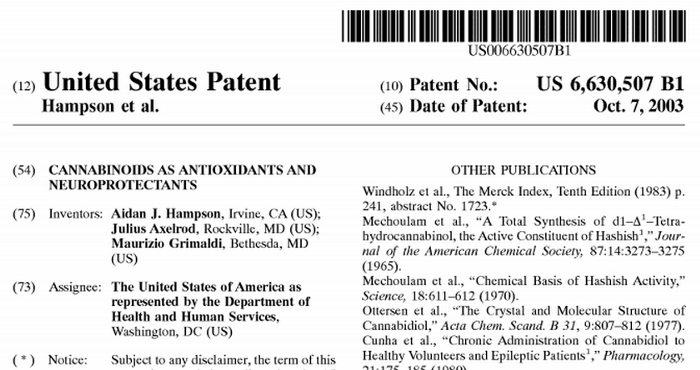
In 2003, patent No. 6630507 was granted to the Department of Health and Human Services. Cannabinoids have been found to have antioxidant properties. Patent No. 6630507 also references 12 other U.S. patents related to cannabis dating back to 1942. U.S. Patent No. 6630507 covers the potential use of non-psychoactive cannabinoids to protect the brain from damage or degeneration caused by certain diseases, such as cirrhosis.
Marijuana Patents U.S. Patent No. 6,630,507
The U.S cannabinoids patent lists the use of certain cannabinoids found in cannabis sativa plants as useful in the treatment of certain neurodegenerative diseases such as Parkinson’s, Alzheimer’s, and HIV dementia. The cannabinoids are found to have particular application as neuroprotectants, which is any substance that helps to shield nerve cells from damage or death. As such, said cannabinoids aid in limiting neurological damage following ischemic insults, such as stroke and trauma, or in the treatment of neurodegenerative diseases Moreover, this newly discovered property makes cannabinoids useful in the treatment and prophylaxis of wide variety of oxidation associated diseases, such as age-related, ischemic, inflammatory, and autoimmune diseases. One particular disclosed class of cannabinoids useful as neuroprotective antioxidants is formula (I) wherein the R group is independently selected from the group consisting of H, CH3, and COCH3.
First U.S. Marijuana Strain Patent Granted: Patent No. 9,095,554
Recently, legal-marijuana pioneers have experienced a rising concern in retaining a marijuana intellectual property lawyer in order to protect their creations from imitators, as well as from multinational corporations in the agriculture, tobacco and pharmaceutical industries that appear to be keeping a close eye on the fast-growing marijuana industry from the sidelines. For instance, in 2013 the first marijuana strain patent containing significant amounts of THC ever granted, patent No. 9,095,554. Accordingly, the patent provides compositions and methods for the breeding, production, processing and use of specialty cannabis.
Los Angeles Recreational Marijuana Business Lawyers
If you have questions regarding marijuana laws or or are seeking to start a recreational marijuana business in California, we invite you to call our office for a consultation with a Los Angeles recreational marijuana business lawyer today.
In California, anyone who owns property has a legal obligation to keep it safe from hazards. When determining who is liable in a premises liability or slip and fall case, the plaintiff must show that the defendant(s) had ownership, possession, and control of the premises. The individual(s) who owns, possesses, or controls the premises is the one responsible for any injuries arising from a hazardous or dangerous condition of the premises. Therefore, without the crucial element of "control over the premises", no duty to exercise reasonable care to prevent injury on the property can be found.
What is Premises Liability?
In California, the owner, operator, and/or lessor of property owe a duty to visitors to ensure that the property is in a reasonably safe condition. Furthermore, another crucial element in premises liability cases is the element of "foreseeability" .The foreseeability of harm is a prerequisite for the recovery of damages. The foreseeability of the danger establishes the duty owed.
What Damages Are Recoverable in California Personal Injury Cases?
There are two types of damages that are recoverable in California personal injury cases, which include special damages and general damages. Special damages are those damages that are financial in nature, such as hospital and medical bills or lost wages. On the other hand, general damages are those that are non-financial losses, including pain and suffering, loss of consortium, and emotional distress.
What Do You Need To Prove in a Wrongful Death Lawsuit?
To successfully bring a wrongful death cause of action in California, the plaintiff typically must show the following: 1) The death of a human being; 2) Caused by another's negligence, or with intent to cause harm; 3) The survival of family members who are suffering monetary injury as a result of the death, and; 4) The appointment of a personal representative for the decedent's estate.
Wrongful Death Lawsuit Due To Negligence
If someone dies due to the negligence or misconduct of someone else, the survivors or the decedent's estate may file a lawsuit for "wrongful death". A wrongful death claim is one when a person dies due to the legal fault of another person. The at fault party in wrongful death claims can be a driver at fault in a car accident, motorcycle-auto accident, or a medical professional that misdiagnosed or acted in a negligent manner that caused the death of another.
Who Can Sue For Wrongful Death in California?
Wrongful death lawsuits is generally the personal representative of the decedent's estate, and may include a surviving spouse, children, or immediate family members. There are
California Proposition 213 restricts uninsured drivers from recovering general damages, or compensation for pain and suffering, following a car accident. Unfortunately, often times, insurance gaps happen, and so do auto accidents. In California, drivers are required to carry liability insurance when operating a motor vehicle on a public road.
What Are the Exceptions to California Prop 213
California Prop 213 was created to prevent uninsured drivers from recovering money for pain and suffering following an accident. However, it does not limit your ability to recover medical costs, lost wages, or compensate you for future medical charges, if your accident was caused by a negligent driver. There are exceptions to the rule, and with a knowledgeable Glendale personal injury attorney, you can receive the compensation you deserve. Prop 213 does not apply to:
Passengers: As a passenger, you may not be subject to Prop 213 if the driver is uninsured
Being injured in a slip and fall can leave you with immense pain. Often, not knowing what steps to take in the immediate aftermath can result in prolonged and unnecessary suffering. In order to strengthen your chances of receiving fair compensation that helps you recover, be sure to:
Take pictures of the area
Taking pictures of the area where the slip and fall occurred can help provide vital evidence in determining who was the negligent party
Take pictures of the area from different angles
Take photographs of your injuries
Request an incident report
If the accident occurred in a public place, business establishment, apartment complex or government building request that an incident report be taken and be sure to obtain a copy of the incident report
California Identity Theft , under Penal Code 530 PC usually occurs when: a defendant unlawfully gained unauthorized access to a computer’s information or someone else’s sensitive personal information and used that information for financial or personal gain. This can be achieved by creating a credit card or opening up an account under someone else’s identity in order to obtain money or items which they are not entitled to.
What Is Identity Theft?
As discussed above, identity theft under California Penal Code Section 530 occurs when a person unlawfully and intentionally acquires and retains possession of personal identifying information of another person. In other words, identity theft occurs when a person uses your personal identifying information without permission to commit fraud or other theft related crimes. Identity theft crimes can include obtaining a consumers:
California Elder Care Abuse: Elder Abuse Protection Act
The Elder Abuse Protection Acts focuses on protecting older adults by punishing perpetrators who exploit, abuse, and harm vulnerable seniors.
What Is Elder Abuse?
Elder abuse can occur in various forms such as, physical, mental, emotional, financial and even sexual. Often, the abuse is physical or results from neglect. The law recognizes that factors which contribute to abuse, neglect, or abandonment of elders and dependent adults are economic instability of the family, resentment of caretaker responsibilities, stress on the caretaker, and abuse by the caretaker of drugs or alcohol. Elder abuse can occur in cases involving nursing home negligence. Some of the type of injuries that may appear as:
Unexplained injuries
Bedsores, pressure sores and skin ulcers that don’t heal, which are often times the most common type of negligence
A motion for a new trial in California is found in Code of Civil Procedure sections 656 through 663.2. Section 656 of the Code of Civil Procedures states, “a new trial is a re-examination of an issue of fact in the same court after a trial and decision by a jury, court, or referee.” A motion for a new trial in California may be made in an civil case, such as, unlawful detainer eviction case. It is important to keep in mind that California procedures for new trial motions can be especially tricky and complicated. Courts have construed many of their requirements to be “mandatory and jurisdictional.” That is, if a party including the trial judge, makes a mistake, it often cannot be excused or repaired, even on remand.
Advantages of Filing a Motion for a New Trial in California
The advantages of filing a motion for new trial is that it permits the Court to reexamine an issue of fact or law with respects to the case. The trial court has broad discretion to reweigh the evidence, reassess credibility, disbelieve witnesses, and act as a thirteenth juror as stated by several decisions of the California Courts of Appeal.
Grounds for Filing a Motion for a New Trial in California
If one cannot duplicate a phone number or street address, then why should one have the power to duplicate a domain name? Domain names, similar to words and symbols, can be used to identify a seller’s products and distinguish them from the products of another, and are thus viewed as trademarks. The Ninth Circuit U.S. Court of Appeals recently ruled that a business must use its domain name to sell goods or services in order to protect the name — even if a competitor starts to use the name after you registered the domain. In other words, merely reserving a domain name isn't enough. Thus, its important to register your domain name, because if your domain name has a trademark, the URL has protection under the USPTO.
Establishing Trademark Infringement Under Lanham Act
The Trademark Act of 1946 (“Lanham Act”) prohibits uses of trademarks that are likely to cause confusion about the source of a product or service. 15 U.S.C. §§ 1114, 1125(a). Moreover, to establish a trademark infringement claim under the Lanham Act, a plaintiff must establish that defendant’s use of a mark is confusing similar to plaintiff’s. Id. The main area of inquiry in trademark infringement cases is whether the similarity of the marks is likely to confuse customers about the source of a product or service. ., 174 F.3d 1036, 1062 (1999).
If property owner(s) fail to properly maintain the premises and someone suffers injury as a result, they may be liable for damages under premise liability law. As in any other negligence action, the injured person must establish the following: (1) the existence of a duty on the part of the defendant to use due care; (2) a breach of this legal duty; and (3) the breach as the proximate or legal cause of the resulting injury. If you or a loved one suffered damages associated with an accident which occurred on someone else’s property, you may be entitled to compensation for your injuries. We invite you to contact our Glendale personal injury attorneys at (310) 943-1171, for a free consultation.
Common Causes of Slip and Fall Accidents
Common causes of slip and fall accidents occur when property owners fail to exercise reasonable care in preventing slip or fall hazards, such as:
Wet floors
Grease or oil spills
Food debris
Faulty staircases
Loose staircases
Loose carpets
Spilled drinks or liquids
Property owners are legally responsible to inspect the property for any hazard risks and maintain the property in a safe manner. If there are any latent or concealed perils on the land, the possessor is under a duty to exercise ordinary care either to make the condition reasonably safe for those coming onto the land or to give such persons a warning adequate to enable them to avoid injury. Failure to repair or fix a slip hazard, resulting in a preventable invitee or customer injury, is an act of negligence.
Slip and Fall on Governmental Public Property
Premises liability claims against government entities, due to injuries sustained on public property are often very challenging to litigate. Government entities enjoy greater protections against premises liability claims than do ordinary private persons and businesses. In California, to bring a successful premises liability claim against a government entity, one must prove an additional element that does not exist in premises liability claims against private entities - under Government Code section 835, the injured party must prove either: (a) a negligent or wrongful act or omission of an employee of the public entity within the scope of his employment created the dangerous condition; or (b) the public entity had actual or constructive notice of the dangerous condition under Section 835.2 a sufficient time prior to the injury to have taken measures to protect against the dangerous condition. Are you wondering how to prepare for a slip and fall claim? If you were injured due to a slip and fall accident, our knowledgeable Los Angeles personal injury attorneys can help you get the compensation you deserve. Call us at (310) 943-1171, 24 hours a day, 7 days a week for a free consultation tailored to the specifics of your case, our attorneys speak English, French, Spanish, Russian, Armenian, and Italian.
Loss of consortium is a claim for damages suffered by the spouse or children of a person who has been injured or killed as a result of the defendant's negligent or wrongful acts. Generally, claims for loss of consortium are not awarded unless the person injured dies or suffers a severe and enduring injury. The suing party must show that the injured or deceased family member cannot provide his or her spouse or family member with the same love, affection, companionship, comfort, society, or sexual relations that were provided before the accident.
What is a Statute of Limitations?
Statute of limitations is the period of time you have to file a claim or suit. Personal injury cases have a statute of limitations varies depending on the type of case, but generally, the time limit usually starts on the day the accident or injury occurred and can last anywhere from 1 to 2 years. However, in claims involving government tort or injury involving government entity, such as an car accident with a government city vehicle, requires the injured party to first file a claim with the appropriate governmental agency within 6 months from the date of the accident. Finally, depending on the outcome of the claim, the injured party will then have either 6 months or two years to file suit. If you fail to follow the guidelines for the statute of limitations, you may lose your right to file a claim. Thus, it is vital you speak to a Los Angeles personal injury lawyer immediately to preserve your claim! Our lawyers in Glendale, Los Angeles, California, will be happy to help you through every step of your personal injury case.
Contact Us!
Our personal injury attorneys specialize in various personal injury matters including complex personal injury cases, government torts specifically related to auto accidents, motorcycle accidents, left turn motorcycle accidents, truck accident, multi-car accidents, which involve a government vehicle such as Metro Bus, fire truck, U.S Postal Service, and Water & Power Truck. If you have been in an accident involving an Government vehicle, give our office a call at (310) 943-1171 for a free consultation! This content is for educational purposes only. KAASS LAW is authorized to practice law in California. The above content is for California residents only. This content provides only general information, which may or may not reflect current legal developments. KAASS LAW expressly disclaims all liability in respect to actions taken or not taken based on any of the contents of this website. The above content DOES NOT create an attorney-client relationship. KAASS LAW does not represent you unless you have expressly retained KAASS LAW in person at the KAASS LAW office. KAASS LAW helps clients in: Los Angeles, Burbank, Hollywood, Glendale, Van Nuys, North Hollywood, Studio City, Highland Park, Eagle Rock, Sunland, Tujunga, Sylmar, La Crescenta, La Canada, Beverly Hills, Westwood, Santa Monica, Brentwood. Pacoima, Montebello, Commerce, Alhambra, Downey, Bell, Maywood, Walnut Park, Vernon, Lynwood, Echo Park, Silverlake, Mission Hills, Northridge, North Hills, Porter Ranch, Chatsworth, Reseda, San Diego, La Jolla, El Cajon, Chula Visa, Del Mar
In a California wrongful death lawsuit, the estate generally seeks compensation for the survivors' loss, such as financial support the decedent would have contributed to the family during the lifetime of the decedent or the plaintiff, loss of companionship, and funeral and burial expenses. The damages in wrongful death lawsuits are by "pecuniary and/or financial losses". Courts have interpreted "pecuniary injuries" as including the loss of support, services, medical and funeral expenses. Finally, a damage award may also include interest from the date of the decedent's death. Moreover, the estate of the decedent may also seek non-economic damages including loss of decedent’s love, companionship, loss of support, comfort, care, assistance, protection, affection, loss of the enjoyment of sexual relations, loss of decedent’s training, and guidance.
Wrongful Death Lawyer in Glendale, CA Near Los Angeles
We invite you to contact our Glendale personal injury attorney today for a free consultation and case review. KAASS LAW has successfully represented victims in California wrongful death lawsuits. Call us at (310) 943-1171, 24 hours a day, 7 days a week for a free consultation tailored to the specifics of your case, our attorneys speak English, French, Spanish, Russian, Armenian, and Italian.
This content is intended for educational purposes only. KAASS LAW is authorized to practice law in California. The above content is intended for California residents only. This content provides only general information, which may or may not reflect current legal developments. KAASS LAW expressly disclaims all liability in respect to actions taken or not taken based on any of the contents of this website. The above content DOES NOT create an attorney-client relationship. KAASS LAW does not represent you unless you have expressly retained KAASS LAW in person at the KAASS LAW office. KAASS LAW helps clients in: Los Angeles, Burbank, Hollywood, Glendale, Van Nuys, North Hollywood, Studio City, Highland Park, Eagle Rock, Sunland, Tujunga, Sylmar, La Crescenta, La Canada, Beverly Hills, Westwood, Santa Monica, Brentwood. Pacoima, Montebello, Commerce, Alhambra, Downey, Bell, Maywood, Walnut Park, Vernon, Lynwood, Echo Park, Silverlake, Mission Hills, Northridge, North Hills, Porter Ranch, Chatsworth, Reseda, San Diego, La Jolla, El Cajon, Chula Vista, Del Mar
Employer-owned vehicles: You are not responsible for insurance on company-owned vehicles
Accidents resulting in wrongful death claims: You and your family can recover general damages even if the driver is uninsured
Accidents caused by drunk driving: You are still entitled to general damages if a drunk driver hits you while uninsured
Punitive damages: In addition to compensatory damages, a defendant who is found guilty of a serious crime or violation is also required to pay punitive damages
Private property: The accident occurred on private property,
Owner of vehicle did not have insurance: The owner of the vehicle did not have insurance, but the driver who borrowed the car did have insurance on another car. As such, the driver is considered insured and entitled to his or her full measure of damages.
If you were uninsured and injured in a auto accident, our knowledgeable accident attorneys can help you get the compensation you deserve. Call us at (310) 943-1171, 24 hours a day, 7 days a week for a free consultation tailored to the specifics of your case. Attorneys at KAASS Law speak English, French, Spanish, Russian, Armenian, and Italian.
An experienced slip and fall attorney can help explain the nature of your case and guide you towards a successful settlement
Why Slip and Fall Accidents Requires a Personal Injury Lawyer?
Slip and fall accidents require a lawyer for a number of reasons, including the complexity of a given case. Every slip and fall case is unique and may require a alternative approach in order to successful recover on a claim or lawsuit. Most common slip and fall accidents are usually caused by the following:
Wet or greasy floors
Loose or broken floors, sidewalks, steps, or stairs
Unsecured rugs or carpets
Liquid spills
Improperly placed extension cords
No Warning or Caution Signs Placed Placed Near the Hazard That Caused The Slip and Fall
The absences of warnings or caution signs situated near the hazard that caused you to slip and fall, can be a indicator of the property manager’s negligence. However, there are specific elements that must be proven and evidence that must show. Such as that the property manager failed to put a warning sign within a reasonable time of discovering the hazard or failed to notice the hazard within a reasonable time. The complexities of this type of claim can make it difficult for you to fight alone. Let us do the legwork on your claim so you can focus on your recovery. If you were injured due to a slip and fall accident our knowledgeable personal injury attorneys can help you get the compensation you deserve. Call us at (310) 943-1171, 24 hours a day, 7 days a week for a free consultation tailored to the specifics of your case, our attorneys at KAASS LAW speak English, French, Spanish, Russian, Armenian, and Italian.
Felony identity theft charges in California carry punishment of 3 years in state prison, court order to pay compensatory damages to the victim(s) that suffered damages, other fines, parole, and/or probation. Call now for a free consultation and case review at (310) 943-1171. If you or someone you love got these accusations of identity theft in California, it is important to understand the penalties that accompany a identity theft conviction. We invite you to contact our Glendale criminal lawyers for a free consultation and case review. Call our office at (310) 943-1171, our attorneys at KAASS Law speak English, French, Spanish, Russian, Armenian, and Italian.
KAASS LAW is authorized to practice law in California. The above content is for California residents only. This content provides only general information which may or may not reflect current legal developments. KAASS LAW expressly disclaims all liability in respect to actions taken or not taken based on any of the contents of this website. The above content DOES NOT create an attorney-client relationship. KAASS LAW does not represent you unless you have expressly retained KAASS LAW in person at the KAASS LAW office.
KAASS LAW helps clients in: Los Angeles, Burbank, Hollywood, Glendale, Van Nuys, North Hollywood, Studio City, Highland Park, Eagle Rock. Sunland, Tujunga, Sylmar, La Crescenta, La Canada, Beverly Hills, Westwood, Santa Monica, Brentwood. Pacoima, Montebello, Commerce, Alhambra, Downey, Bell, Maywood, Walnut Park, Vernon, Lynwood, Echo Park, Silverlake, Mission Hills, Northridge, Woodland Hills, Encino, Canoga Park, North Hills, Porter Ranch, Chatsworth, Reseda.
Unexplained infections and ineffective infection control
Dehydration
Malnutrition
Rapid weight loss
Clogged breathing tubes
Medications errors
Falls which are unexplained
Common Types of Physical Elder Abuse and Verbal Elder Abuse
Common types of physical abuse include any unwarranted or unwelcome physical touching including:
Hitting
Beating
Slapping
Punching
Pinching
Pushing
Chocking
Shoving
Kicking
Scratching
Inappropriate use of drugs or restraints
Forced feeding
Some common verbal elder abuse can include:
Yelling
Screaming
Threatening verbal statements
Name-calling
Bullying
Speaking in aggressive tone
California Rights of the Elderly in Nursing Homes?
California Welfare And Institutions Code §15600 provides legal protection and recourse for elderly who have suffered abuse under the Elder Abuse And Dependent Adult Civil Protection Act. The law recognizes that many elders and dependent adults who are at the greatest risk of abuse, neglect, or abandonment by their families or caretakers suffer physical impairments and other poor health that place them in a dependent and vulnerable position. Elder is defined in the statutes as any person 65 years of age or older who is residing in California at the time of the alleged abuse. The term “abuse” is interpreted broadly and includes any of the following:
physical abuse;
neglect;
fiduciary abuse; and
abduction
California Elder Care Giver Negligence
Neglect means that the care giver acted unreasonably by failing to exercise that degree of skill or render that level of care for which a reasonable person would exercise or render under similar circumstances. Under the Elder Abuse Protection Act, you or a loved one are entitled to compensation for any type of abuse, negligence or recklessness on the part of the nursing home facilities caregivers. Further, you or a loved one are entitled to file for damages against each healthcare provider who was involved in the abuse. It is best to seek assistance from an experienced California nursing home attorney. Often times obtaining evidence of abuse and bringing charges against the company or corporation which operates the nursing home can be almost impossible without specialized and experienced legal representation. If you believe that a loved one may be subjected to elder abuse and wish to file a claim, it is imperative to act quickly. There is only a certain amount of time during which you can file a case. The time limits are complicated and strictly enforced by the courts. If you think you have a valid claim, consult with one of our Glendale elder care abuse attorney as soon as possible.
How an Glendale Elder Care Abuse Attorney Can Help
An Glendale elder care abuse attorney can help you review your case and explain the steps that must be taken in order to bring action against the person, nursing home, rehabilitation center, or elder care facility. Speak to one of our Los Angeles personal injury lawyers experienced with elder abuse and nursing home negligence cases. We offer a free consultation and case review. Call our office at (310) 943-1171, our attorneys speak English, French, Spanish, Russian, Armenian, and Italian.
What is The Welfare and Institutions Code Section 1560o?
The California Welfare And Institutions Code §15600 provides legal protection and recourse for elderly who have suffered abuse under the Elder Abuse And Dependent Adult Civil Protection Act and provides that: (a) The Legislature recognizes that elders and dependent adults may be subjected to abuse, neglect, or abandonment and that this state has a responsibility to protect these persons. (b) The Legislature further recognizes that a significant number of these persons are elderly. The Legislature desires to direct special attention to the needs and problems of elderly persons, recognizing that these persons constitute a significant and identifiable segment of the population and that they are more subject to risks of abuse, neglect, and abandonment. (c) The Legislature further recognizes that a significant number of these persons have developmental disabilities and that mental and verbal limitations often leave them vulnerable to abuse and incapable of asking for help and protection. (d) The Legislature recognizes that most elders and dependent adults who are at the greatest risk of abuse, neglect, or abandonment by their families or caretakers suffer physical impairments and other poor health that place them in a dependent and vulnerable position. (e) The Legislature further recognizes that factors which contribute to abuse, neglect, or abandonment of elders and dependent adults are economic instability of the family, resentment of caretaker responsibilities, stress on the caretaker, and abuse by the caretaker of drugs or alcohol. (f) The Legislature declares that this state shall foster and promote community services for the economic, social, and personal well-being of its citizens in order to protect those persons described in this section. (g) The Legislature further declares that uniform state guidelines, which specify when county adult protective service agencies are to investigate allegations of abuse of elders and dependent adults and the appropriate role of local law enforcement is necessary in order to ensure that a minimum level of protection is provided to elders and dependent adults in each county.
Code of Civil Procedure section 657 covers seven (7) grounds for filing a motion for a new trial including:
Irregularity in the proceedings of the court, jury, adverse party, any order of the court, or abuse of discretion by which either party was prevented from having a fair trial;
Accident or surprise and newly discovered evidence that is material and which could not with reasonable diligence have been discovered and produced at the trial;
Misconduct of the jury (such misconduct may be proved by the affidavit of any one of the jurors);
Excessive or inadequate damages;
Error in law, occurring at the trial and excepted to by the party making the application;
Insufficiency of the evidence to justify the verdict or other decision, or the verdict or other decision is against law;
Newly discovered evidence, material for the party making the application, which he could not, with reasonable diligence, have discovered and produced at the trial.
Deadline for Filing a Motion for a New Trial in California
The deadline for filing a motion for new trial in California have strict deadlines. A party seeking to request a new trial, should first file a notice of intention to move for a new trial. The motion should be filed in timely manner or the motion will be denied. Per Code of Civil Procedure § 659a: Within ten (10) calendar days after filing the notice of intention to move for new trial the party must file and serve any supporting affidavits unless a stipulation or court order has been obtained extending the time period. Furthermore, while a memorandum of points and authorities with citations to case law and statutory authority is not technically required it is strongly recommended and should be filed and served at the same time as the supporting affidavits.
Code of Civil Procedure § 659(a)
Pursuant to Code of Civil Procedure § 659(a) The party intending to move for a new trial shall file with the clerk and serve upon each adverse party a notice of his or her intention to move for a new trial, designating the grounds upon which the motion will be made and whether the same will be made upon affidavits or the minutes of the court, or both, either: (1) After the decision is rendered and before the entry of judgment. (2) Within 15 days of the date of mailing notice of entry of judgment by the clerk of the court pursuant to Section 664.5, or service upon him or her by any party of written notice of entry of judgment, or within 180 days after the entry of judgment, whichever is earliest; provided, that upon the filing of the first notice of intention to move for a new trial by a party, each other party shall have 15 days after the service of that notice upon him or her to file and serve a notice of intention to move for a new trial. (b) That notice of intention to move for a new trial shall be deemed to be a motion for a new trial on all the grounds stated in the notice. The times specified in paragraphs (1) and (2) of subdivision (a) shall not be extended by order or stipulation or by those provisions of Section 1013 that extend the time for exercising a right or doing an act where service is by mail.” Note that the power of the court to rule on a motion for a new trial shall expire 60 days from and after the mailing of notice of entry of judgment by the clerk of the court pursuant to Section 664.5 or 60 days from and after service on the moving party by any party of written notice of the entry of the judgment, whichever is earlier, or if such notice has not theretofore been given, then 60 days after filing of the first notice of intention to move for a new trial. If such motion is not determined within said period of 60 days, or within said period as thus extended, the effect shall be a denial of the motion without further order of the court.
KAASS LAW is authorized to practice law in California. The above content is intended for California residents only. This content provides only general information which may or may not reflect current legal developments. KAASS LAW expressly disclaims all liability in respect to actions taken or not taken based on any of the contents of this website. The above content DOES NOT create an attorney-client relationship. KAASS LAW does not represent you unless you have expressly retained KAASS LAW in person at the KAASS LAW office.
Brookfield Communications, Inc. W. coast Entm’t corp
Trademarking a Domain Name
To protect your business or brand from infringement, you may want to trademark your domain name in addition to a logo, slogan, or design. Merely, registering a domain name does not give you trademark rights, rather it identifies your website and generally will not prevent others from using the name. If you trademark your domain name, you have legal protection if a third party uses your trademarked name. You can file a trademark infringement action against the infringing party and recover money damages, financial losses, and other damages you might have incurred.
When Does a Domain Name Qualify as a Trademark?
The domain should function as a "source indicator." It must convey to whoever sees the URL what products or services are behind the name. A domain qualifies as a trademark when it is a "source indicator." Your domain must convey the products or services associated with the name to whoever sees the URL. Not all domain names can be registered as trademarks. The PTO is particular about what can be registered as a domain name.
Third Party Using Similar Domain Name Causes a Likelihood of Initial Interest Confusion Among Potential Consumers
Consumer confusion occurs when another company has a domain name close in spelling to your domain. The other company's name might different by one letter. Generally, consumer confusion matters only if a domain name that's similar to the one you want to use is a protected trademark. To be protected, a trademark must be distinctive. If the trademark owner has been able to register a name with the U.S. Patent and Trademark Office, it is probably distinctive. The dispositive question in trademark infringement cases is whether the similarity of the marks is likely to confuse customers about the source of a product or service. Interstellar Starship Services, Ltd. V. Epix, Inc., 304 F. 3d 936, 941 (2002).
Trademarks: Initial Interest Confusion Among Potential Consumers
Initial interest confusion occurs when the defendant’s use of plaintiff’s trademark sways consumers towards their own product or service by capturing “initial consumer attention.” Brookfield at 1045. In the context of website domain, the defendant’s unauthorized use of the trademark confuses consumers who expect to find the plaintiff’s product or service at that web address. Interstellar at 942. Although actual confusion is not required, plaintiff must prove a probability of confusion, as the mere possibility is not enough. Perfumebay.com Inc. v. eBay, Inc., 506 F.3d 1165, 1176.
Sleekcraft Factors of Likelihood of Confusion
To evaluate the likelihood of confusion, including initial interest confusion, the Sleekcraft factors considered are:
(1) the similarity of the marks;
(2) the relatedness or proximity of the two companies' products or services;
(3) the strength of the registered mark;
(4) the marketing channels used;
(5) the degree of care likely to be exercised by the purchaser in selecting goods;
(6) the accused infringers' intent in selecting its mark;
(7) evidence of actual confusion; and
(8) the likelihood of expansion in product lines.
Courts consider these factors within the totality of the circumstances through the eyes of the “reasonably prudent consumer” in the marketplace, not a person with a legally trained mind. Dreamwerks Production Group, Inc. v. SKG Studio, 142 F.3d 1127, 1129 (1998).
In the context of website domain, courts have held that the three most important Sleekcraft factors in evaluating a likelihood of confusion are (1) the similarity of the marks, (2) the relatedness of the goods or services, and (3) the parties’ simultaneous use of the Web as a marketing channel. Interstellar at 942.
No one factor is to be considered conclusive and the relative importance of each individual factor will be case-specific. CompareBrookfield, 174 F.3d at 1061 (holding that use of the domain name “moviebuff.com” violated plaintiff’s trademark rights in the mark “MovieBuff,” as consumer confusion is likely to result from the relatedness of the products and the companies’ simultaneous use of the Web as a marketing and advertising tool) with Interstellar at 943 (finding that domain name “epix.com” for website showcasing creator’s electronic pictures did not infringe the trademark “EPIX,” used in connection with printed circuit boards and computer programs, because there was a lack of relation between the products and both parties marketed to a different consumer base through the web).
Trademark Owners: Commercial Use in Commerce
The Federal Trademark Dilution Act (FDTA) allows a trademark owner to obtain an injunction against another’s “commercial use in commerce” of a mark or trade name” 15 U.S.C. § 1125(c)(1). “Commercial use in commerce” has been generally interpreted to mean use of mark in relation to any goods or services. Mattel, Inc. v. MCA Records, Inc., 296 F.3d 894, 903 (2002).
If you believe someone is infringing on your trademark or have questions regarding trademark registration, copyright, or any other intellectual property related question, we invite you to contact our office and speak to an experienced Los Angeles trademark lawyer at (310) 943-1171.