Interstate Truck Accidents: Why I-25, I-80, and I-90 Are Dangerous in Wyoming, Montana, and Surrounding States
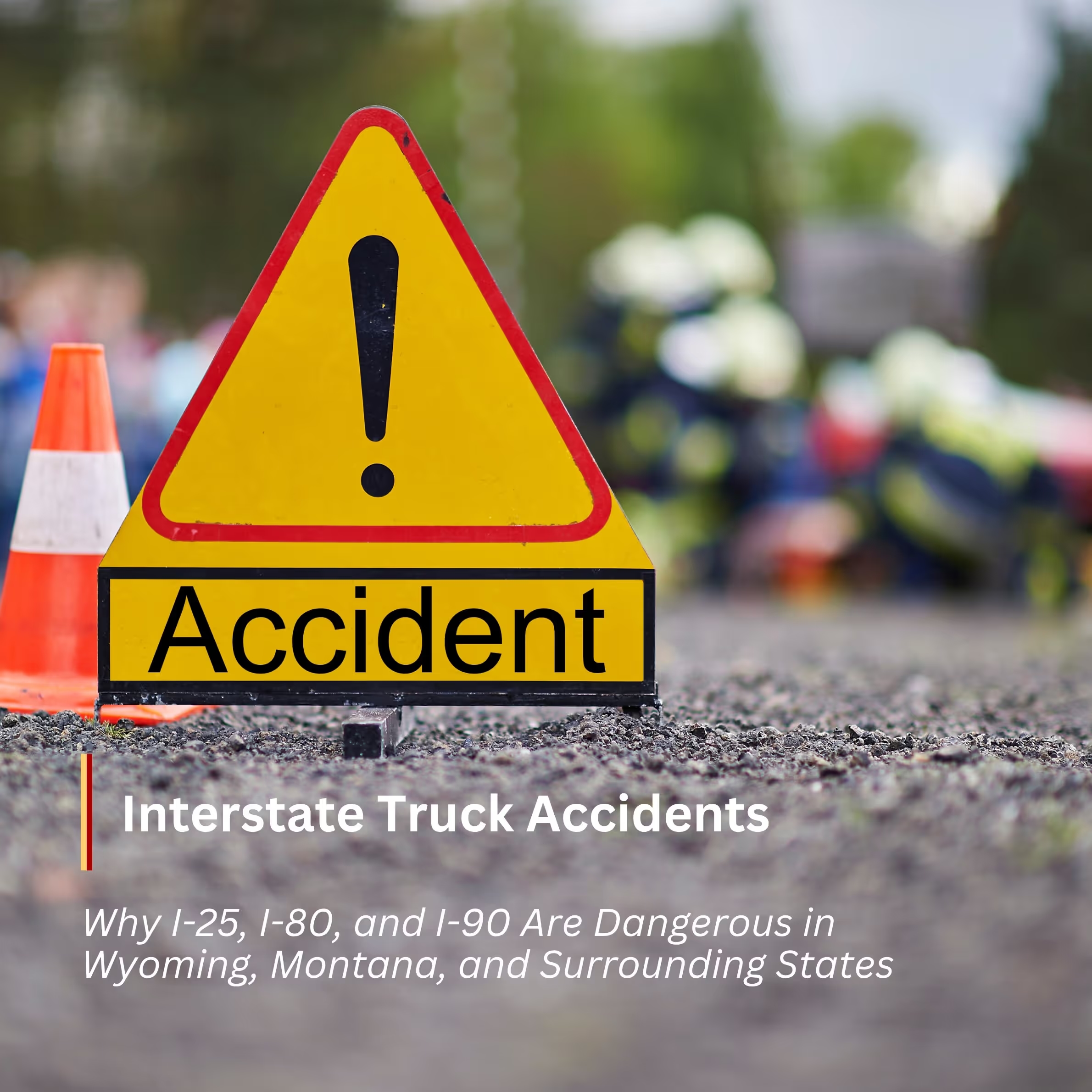
Interstate highways are essential transportation routes connecting communities, businesses, and industries across the United States. However, some of these highways present significant challenges for commercial truck drivers and other motorists. Understanding why interstate truck accidents occur, the risks associated with these highways, and the legal considerations following a collision can help drivers make informed decisions about road safety.
Understanding the Dangers of Interstate Truck Accidents
Wyoming and Montana have extensive highway networks that cross remote landscapes, mountainous regions, and areas exposed to extreme weather. Unlike urban highways, where traffic congestion is often a primary concern, rural interstate highways present different hazards.
Commercial trucks can weigh up to 80,000 pounds under typical federal interstate weight limits, significantly more than passenger vehicles. Their size and weight can make stopping, turning, and maintaining control more difficult, especially during adverse weather conditions. Several factors contribute to interstate truck accidents in these states, including but not limited to the following.
- Strong crosswinds that can destabilize high-profile commercial vehicles.
- Snow, ice, and freezing temperatures that reduce traction.
- Steep grades and mountainous terrain that challenge braking systems.
- Driver fatigue associated with long-distance transportation.
- Reduced visibility during snowstorms, fog, or blowing dust.
- High travel speeds and limited opportunities to respond to unexpected hazards.
These conditions can become especially dangerous when multiple risk factors occur simultaneously.
High Winds, Snow, and Commercial Truck Traffic on Interstate 80 in Wyoming
Interstate 80 is one of the country's major east-west transportation corridors, connecting California to New Jersey. Its route through southern Wyoming is particularly important for commercial trucking operations. The Wyoming section of I-80 is known for challenging weather conditions, especially during the winter months.
Strong winds and truck rollovers
Wyoming's open terrain exposes commercial vehicles to powerful crosswinds. High-profile trucks, especially those carrying lightweight loads or traveling empty, may become unstable when wind gusts strike the side of a trailer.
Snow, ice, and reduced visibility
Winter storms can develop quickly along I-80, creating icy pavement, blowing snow, and dangerous visibility conditions. When truck drivers cannot stop safely or maintain adequate following distances, collisions involving multiple vehicles may occur.
Long distances between services
Some stretches of I-80 pass through sparsely populated areas. Limited access to emergency services, vehicle repairs, and rest facilities can complicate the aftermath of an accident. Drivers should monitor weather forecasts, obey variable speed limits, and follow official highway closure notices.
Interstate 90 in Montana: Mountain Passes and Changing Road Conditions
Interstate 90 stretches across Montana, connecting communities such as Missoula, Butte, Bozeman, Billings, and Livingston. The highway serves as an important route for commercial trucks traveling between the Pacific Northwest and the Midwest.
Although I-90 provides vital transportation access, several sections present challenging driving conditions.
Mountainous terrain and steep grades
Mountain passes, including Homestake Pass near Butte and Lookout Pass near the Idaho border, require drivers to navigate elevation changes, curves, and potentially slippery pavement. Heavy trucks traveling downhill may experience braking difficulties, especially if drivers fail to select appropriate gears or properly maintain braking systems.
Winter storms and black ice
Montana winters usually bring snow and freezing temperatures. Black ice can form on bridges, shaded roadways, and mountain passes, making it difficult for drivers to recognize hazardous conditions.
Interstate 25: Dangers caused by Wind and Storms
Interstate 25 runs north-south through Wyoming and Colorado, connecting major transportation centers such as Denver, Cheyenne, Casper, and Buffalo. Sections of I-25 are especially vulnerable to strong crosswinds because of the surrounding open plains.
The area between Cheyenne and the Colorado border can experience severe wind conditions that threaten the stability of commercial trucks. In March 2026, the Wyoming Department of Transportation reported numerous wind-related truck rollovers across the state, including at least 15 on I-25 during a major windstorm.
Highways That Often Cause Interstate Truck Accidents
Truck accidents on I-25, I-80, and I-90 often involve a combination of environmental conditions and driver-related factors. Severe weather is an important concern, but other circumstances can contribute to collisions.
- Driver fatigue: Long driving hours may affect alertness, reaction time, and decision-making.
- Excessive speed: Traveling too quickly for road or weather conditions can increase stopping distances and the likelihood of losing control.
- Improper cargo loading: Unevenly distributed or unsecured cargo may affect vehicle stability.
- Mechanical failures: Worn brakes, defective tires, and inadequate maintenance can contribute to serious accidents.
Individuals who fail to follow weather restrictions: Ignoring posted wind closures or highway advisories may place truck drivers and surrounding motorists at additional risk. Wyoming has implemented weight-based wind restrictions to address the dangers facing lighter, high-profile vehicles during strong winds.
Types of Injuries after an Interstate Truck Accident
As a result of the size and weight differences between commercial trucks and passenger vehicles, truck collisions may cause serious injuries. These can include, but are not limited to, the following.
- Traumatic brain injuries
- Spinal cord injuries
- Broken bones
- Internal injuries
- Severe soft tissue damage
Multi-vehicle crashes can be especially dangerous when visibility is limited or approaching drivers cannot stop in time. Some injuries may not be immediately visible following a vehicle collision, making immediate medical evaluation important.
The Importance of Seeking Legal Guidance and Support
Speaking to a legal professional after being involved in an interstate truck accident may be beneficial to victims and their loved ones. Oftentimes, determining who may be legally responsible is difficult and can require many forms of evidence. Seeking legal guidance and support may help minimize the additional challenges that may follow these types of accidents.
The Legal Team at KAASS LAW
The qualified personal injury attorneys at KAASS LAW understand the challenges that may follow an interstate truck accident. Oftentimes, these types of incidents may cause serious injuries and leave victims in a state of uncertainty. That is why KAASS LAW is here to help. Our legal team may review the specific facts of your case, speak to insurance companies, and determine potentially liable parties moving forward. Call KAASS LAW today for a confidential consultation.
Related Articles
View All Posts
Learn how fatigued truck drivers and hours-of-service violations may affect truck accident injury claims and liability in California.

Truck accidents frequently cause fatalities and extremely serious injuries. The weight of a fully loaded commercial vehicle can reach 40 tons, which is 20 to 30 times heavier than the typical modern car. In brief, the size and weight of a tractor-trailer, semi-truck, box truck, or other large freight-bearing vehicle are just insurmountable for passenger cars. Smaller cars sometimes sustain severe injuries when they meet in an accident with a big truck or bus. It's critical to get the advice of an attorney with experience in large truck accidents. The legal team at KAASS Law Firm has decades of experience and the expertise you need to pursue justice for the deceased person.
Common Fatal Truck Accident Types
Nine percent of all heavy truck crashes involve a rollover, which accounts for more than half of all truck driver fatalities. Rollover accidents are highly dangerous for both truck drivers and other road users. Semi-trucks and tractor-trailers are more likely to topple onto their sides. For example, their heavy weight and high center of gravity, turn too rapidly or drive too fast. Blind spots on these cars can potentially result in collisions. The blind spot of a truck is the area that the driver cannot see in their mirrors or with their eyes without rotating their head and looking away from the road in front of them. Of course, the size of a vehicle's blind spot will increase with size. When attempting to merge, pass, or cut in front of traffic, blind spots make it difficult for drivers to detect smaller cars, which can result in collisions or push the smaller vehicle off the road entirely.
Large Truck Accidents and Injuries: Common Causes
Law enforcement and organizations that oversee commercial transportation may launch an investigation after a fatal commercial vehicle accident. These deadly truck accidents frequently have similar pre-accident patterns, which most likely influenced how they turned out. For example, these include:
- Driver Exhaustion
- Driver Omissions
- DUI
- Issues With Load and Freight
- Speeding
- Inadequate Vehicle Maintenance
How Is Liability Established in a Wrongful Death Case Involving a Truck?
Anyone who, through their careless or malicious behavior, led to the victim's death may be included as a defendant in a wrongful death lawsuit. Multiple defendants are frequently included in large truck accident wrongful death lawsuits, including:
- The vehicle's driver
- The transport business
- Owner of the truck
- A person who loads or manufactures freight
- Cargo owner
- Maintenance firm for trucks
- The maker of a damaged automotive component
- A tavern that provided a truck driver with excessive alcohol service
Your lawyer will handle the insurance company negotiations, the accident investigation, and the wrongful death lawsuit.
What Losses Are Covered by Commercial Vehicle Insurance?
A wrongful death lawsuit may provide for the recovery of economic, non-economic, and punitive damages. These damages cover things like the price of pre-death medical care, lost financial support, funeral and burial costs, and more. Your lawyer can propose suing for the following things if the dead was the head of the household and the other occupants depended on their wages to survive:
- Loss of future earnings projections
- Loss of advantages like health insurance or a pension plan
- Loss of inheritance as a result of a person's premature passing
Economic damages may also include the cost of products and services, such as child care, that the victim would have provided for the family if they had survived. Non-economic damages can make up for the victim's suffering before death, the survivors' emotional suffering, and loss of consortium, which is the breakdown of a relationship as a result of one party's passing.
Contact Our Wrongful Death Lawyers for Truck Accidents
To conclude, allow your lawyer to represent you. Honoring the memory of the departed by pursuing a wrongful death claim may even assist in stopping future mistakes of those responsible. Such cases are simply one of our many practices. To begin with, a free consultation, get in touch with the team at KAASS Law right away. Call us now at 310.943.1171.
