How to Get Business Coverage: COVID-19 "Stay-At-Home" Orders

How Can You Get Financial Coverage If You Suffered Due to COVID-19 “Stay-At-Home” Orders?
The whole world is suffering nowadays because of the Coronavirus (COVID-19). The United States, like numerous other countries, is on national lockdown. The lockdown affected everyone either directly or indirectly. Both small and large businesses have suffered as a result. Free movement has limits after Los Angeles Mayor’s “stay-at-home” order. This leads to a chaotic environment for numerous businesses. It can be especially crucial for small businesses. Several businesses can not operate at all. It is very important now to provide especially the small and essential businesses with assistance and with new stimulus to overcome this situation. The COVID-19 pandemic brought unprecedented disruptions to businesses and individuals across the globe. Government-imposed "stay-at-home" orders, while necessary to curb the spread of the virus, caused significant financial hardship for many. If your business suffered losses due to these mandatory closures or restrictions, you might have a claim to compensation. At KAASS Law, we commit to helping you explore available avenues for recovery. The following is our attempt to help navigate information about seeking coverage for losses related to COVID-19 "stay-at-home" orders. Any kind of business assistance is worth it now. Additionally, still, several ways may reveal to seek coverage from your insurance for harm caused to your business due to the lockdown.
Business Interruption Insurance: Your First Line of Defense
Business interruption insurance is designed to help businesses recover financial losses incurred due to unexpected events that disrupt normal operations. This coverage typically includes:
- Lost profits: Compensation for income lost due to the interruption.
- Fixed costs: Coverage for ongoing expenses like rent, utilities, and loan payments.
- Operating expenses: Reimbursement for expenses incurred to mitigate the interruption, such as relocating operations or setting up remote work arrangements.
- Civil authority coverage: This specific type of coverage may apply if your business was forced to close due to government orders, such as "stay-at-home" orders.
Challenges with Business Interruption Claims
Many businesses faced challenges when filing business interruption claims related to COVID-19. Insurance companies often denied claims, arguing that the pandemic did not cause "physical damage" to property, which is a typical requirement for coverage. However, several legal challenges and court rulings have provided some hope for businesses seeking coverage.
In Which Scenarios Can You Claim Coverage?
Different types of insurances exist to secure your business from undesired consequences. And each of them has its own policies, which define when, how, in which terms the insured can claim and get coverage. Many entrepreneurs prefer to pay more for insurances, to be premium members, and to be on the safe side, but some of them choose cheaper insurances, without any additional coverage only for the riskiest scenarios. To figure out whether you can claim coverage from your insurance you should read very carefully the policy defined for your insurance. In the policy, you may meet the point that provides you with the lawful right to claim for your coverage. Sometimes it can be very difficult for a non-lawyer to discover that very point in the whole policy and it is important to consult with an attorney experienced in cases related to Insurances.
Who Can Apply?
If you found out that your insurance contains the point that covers the present scene and you strongly believe that there exists the lawful right to claim for coverage, you should figure out now who has the liability to claim. By default, it will be the business owner on behalf of his or her own business. There may be a possibility also for landlords, who are forced to deal with unpaid rent and other related issues stemming from their tenants’ cessation of use with respect to the Insured Premises.
Receive Legal Assistance for Financial Coverage Claims Related to COVID-19 Stay at Home Orders
The nowadays situation is very unusual, it may even become confusing to a lawyer, let alone to a person without any legal discipline at all.
Los Angeles Insurance Attorneys
The COVID-19 pandemic brought unprecedented disruptions to businesses and individuals across the globe. Government-imposed "stay-at-home" orders, while necessary to curb the spread of the virus, caused significant financial hardship for many. If your business suffered losses due to these mandatory closures or restrictions, you might be entitled to compensation. At KAASS Law, we understand the challenges businesses have faced and are committed to helping you explore available avenues for recovery. The State of California also has a guidance and resources available to look into alternative solutions. KAASS Law firm’s lawyers are experienced in cases related to insurances and they can provide you with Coronavirus (COVID-19) legal help. They can help in the validity of the potential claim. They can ensure that the time limit, in your case, is met. Also, to produce the imperative paperwork available. This paperwork plays a huge role in such kinds of processes and is a mandatory part of compliance rules.
Related Articles
View All Posts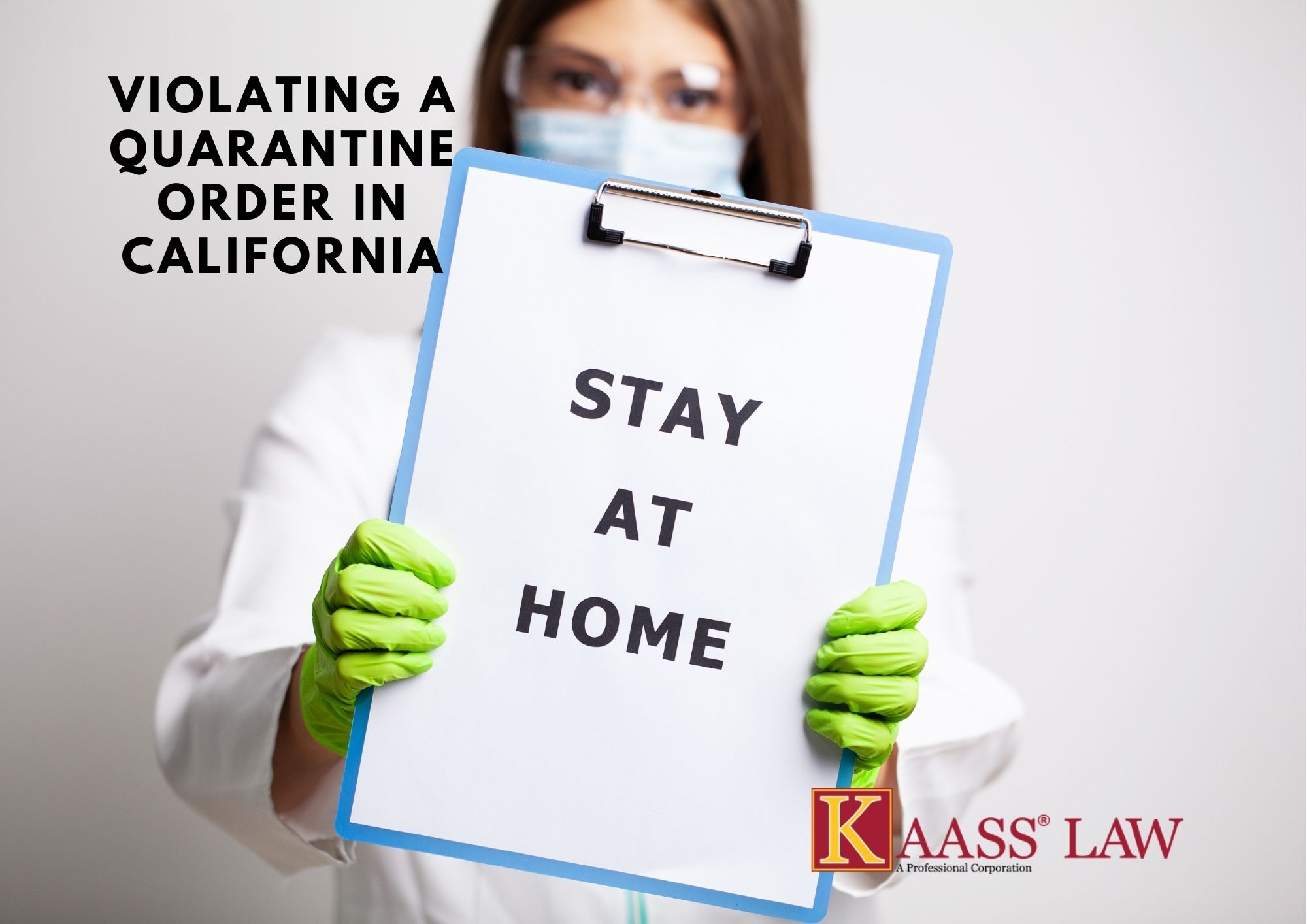
Is It Against the Law to Violate a Quarantine Order in California?
Health and Safety Code 120275:
This statute makes it a crime to violate a quarantine order placed due to a communicable disease or infection. This law directly applies to the current COVID-19 pandemic and stay-at-home orders passed by many leaders of the states. Any person who, after notice, violates, or who, upon the demand of any health officer refuses or neglects to conform to, any rule, order, or regulation prescribed by the department respecting a quarantine of disinfection of persons, animals, thing, or places, is guilty of a misdemeanor.
What Are the Penalties for Violating a Quarantine Order?
Violating HS 120275 is a misdemeanor as opposed to an infraction or felony. May result in:
- Fine up to $1000
- Up to a 6-month sentence in county jail or
- Misdemeanor probation granted by a judge.
In order to be convicted for violating this health and safety code, a prosecutor must prove that the defendant had notice of an order or rule regarding the quarantine from an infectious disease and that they wilfully disregarded the order. The purpose of quarantine is to achieve a certain level of disinfection. Under 120275, “disinfection” can include people, animals, things, or places.
What Should You Do If You Are Charged With Violating HS 120275?
If you have been accused of violating a quarantine order, it is important to seek legal counsel as soon as possible. Although the law classifies the violation as a misdemeanor, it can lead to serious consequences. For example:
First. A criminal record under this article remains on the database. Even if the punishment is limited to a fine or probation. But it can be expunged later, and the mere presence of the record can affect getting a job or renting an apartment. Second. Although a violation of HS 120275 does not result in deportation, in certain cases it may be grounds for denial of entry into the United States. It may also be grounds for denial of visa renewal. This is especially important for international students, visa workers, and those seeking citizenship. Third. A conviction under this article may affect the right to own firearms. In some cases, especially repeat offenders, additional restrictions may be imposed.
Therefore, even if the charge seems minor, the consequences can be significant. It is important not to ignore the situation and not to try to understand the law on your own. On the contrary, it is necessary to consult with an attorney who will help you determine a defense strategy based on all the circumstances. KAASS LAW is ready to protect your rights and minimize possible consequences.
Is There Defense Against a Violation of Quarantine?
Anytime an order of quarantine is placed in effect, people’s constitutional rights are always brought into question. Depending on the reason for violating a quarantine, the misdemeanor charge could violate a number of constitutional rights.
- Violation of your to freely associate.
- Violation of your right to exercise religion
- Violation of your right to travel across states
Another possible defense would be the “necessity” defense. The defendant violated the quarantine due to a necessity like going to the hospital, going to the grocery store, being an essential worker and overall any necessary reason to break the quarantine will give grounds for defense. These circumstances may cause a judge or prosecutor to dismiss charges. A defense that may work, but is less likely to be successful is the defense of no intent. The defendant had no knowledge of the quarantine order and was not aware they were violating it. The only time a constitutional rights defense would work, is if the quarantine is due to a communicable disease. Only then is it not a violation of constitutional rights because it is an order that seeks to protect citizens.
Other Information Regarding HS 120275
- Convictions under HS 120275 may be expunged given that the defendant has paid their fines, served their sentence, or have been placed on probation.
- Convictions under HS 120275 does not have negative consequences against immigration, although sometimes in California, convictions result in deportation or denial of future entry to the U.S.
- Convictions under HS 120275 does affect the future gun rights of the defendant.
Possible Related Charges
In California, law enforcement usually doesn’t arrest someone for violating HS 120275 alone; the person typically breaks additional laws as well, such as:
- HS 120290 intentional exposure to infectious disease
- Penal Code 408 unlawful assembly, and
- Penal Code 415 disturbing the peace; which can include loud music, fighting, or loud swearing.
Are you in need of legal assistance for violating HS 120275? Get in touch with KAASS Law by calling us at (310) 943-1173 or by using the contact form below! [contact-form-7 id="5673" title="KAASS LAW Contact Form"]
Calling off work due to getting sick is the worst. As a result, you lose days of wages and puts financial pressure for a lot of hard workers. The COVID-19 pandemic brought unpredicting challenges to workplaces and individuals across California. Employees faced illness, quarantine requirements, and caregiving responsibilities, often leading to lost wages and financial strain. Fortunately, California's Short-Term Disability Insurance (SDI) program provides crucial financial support to eligible workers who need time off work due to COVID-19. At KAASS LAW, we understand the complexities of navigating SDI benefits and are dedicated to helping individuals access the support they need during challenging times. The following provides comprehensive information about California SDI benefits for COVID-19, including eligibility requirements, benefit amounts, and how to apply.
What is California's Short-Term Disability Insurance (SDI)?
The short-term disability (SDI) insurance program provides short-term benefit payments to employees who are off work due to a non-work-related injury or illness. State of California has announced numerous changes in SDI rules in response to the COVID-19 outbreak.
Eligibility for California Short-Term Disability Insurance
To receive short-term disability benefits in California, a person is required to meet the following requirements:
- He is employed or is actively looking for work at the time he became disabled.
- He has lost wages because of the disability.
- He has earned at least $300, from which state disability insurance deductions were suspended.
- He is under the treatment and care of a licensed doctor or public health officer
- He has filed a claim form within forty-nine days of the date he became disabled.
- His doctor or public health officer completed the part of the form which provides medical certification of a person’s disability.
California’s New Short-Term Disability Rules
According to California law, a person is eligible for short-term disability payments in case he is incapable to work due to having coronavirus or being exposed to the novel coronavirus.
Medical Certification
In case an employee already has a coronavirus, he must submit a medical certification signed by either by a doctor or public health officer, which must contain the following information:
- A diagnosis of a coronavirus
- The start date of the illness
- Probable duration of inability to work
Quarantine
In case an employee is quarantined due to COVID-19 exposure or potential exposure, he must be able to qualify for a short-term disability benefit if his quarantine is certified by a doctor or public health officer.
Laid Off
An employee can be able to collect short-term disability benefits in case he was laid off and searching for work at the time he became unable to work due to coronavirus or coronavirus exposure. Though in this case a person can’t collect unemployment benefits and SDI at the same time.
When Can a Person Start Receiving Benefits?
California has waived the seven-day waiting period for collecting benefits and an eligible employee can start to receive SDI benefits for the first day off work.
How to Submit a Claim for SDI?
You can apply for SDI benefits online through the EDD website or by mail. When applying, you will need to provide:
- Your Social Security number
- Your EDD customer account number (if you have one)
- Your contact information
- Your employer's information
- Your medical provider's information
- Dates of your disability or quarantine period
- A completed medical certification from your healthcare provider
Important Considerations
- Waiting Period: There is typically a seven-day unpaid waiting period before SDI benefits begin. However, this waiting period may be waived in certain circumstances, such as for COVID-19 related claims.
- Concurrent Benefits: You may be able to receive SDI benefits concurrently with other benefits, such as Paid Family Leave (PFL) or your employer's paid sick leave. However, the total amount of benefits you receive cannot exceed your usual weekly wages.
- Appealing Denied Claims: If your SDI claim is denied, you have the right to appeal the decision. An experienced disability attorney can assist you with the appeals process and advocate for your rights.
KAASS Law: Your Partner in Navigating SDI Benefits
Applying for and receiving SDI benefits can be a complex process, especially during the challenges of a pandemic. At KAASS Law, we are dedicated to helping individuals understand their rights and navigate the SDI system. If you have questions about SDI benefits for COVID-19 or need assistance with your claim, contact us today for a free consultation. We can help you:
- Determine your eligibility for SDI benefits.
- Gather the necessary documentation to support your claim.
- Complete and submit your application accurately.
- Communicate with the EDD on your behalf.
- Appeal a denied claim.
Don't Navigate SDI Alone
If you're facing the challenges of COVID-19 and need financial or legal help, don't hesitate to seek legal assistance. KAASS Law is here to help you access the SDI benefits you deserve and protect your rights as a California worker.
Get in touch with our legal professionals at KAASS LAW for more information. [contact-form-7 id="5673" title="KAASS LAW Contact Form"]

Plant closings and mass layoffs are devastating events for workers, families, and entire communities. The sudden loss of income and benefits can create significant financial hardship. This can also be an emotional toll since unemployment can be equally devastating. In the United States, while the right to close a plant or lay off workers generally rests with the employer. However, there are federal and state laws in place aimed at providing some protection and assistance to affected employees. Here at KAASS LAW, we want to explore these laws. The following will aim towards focusing on the key federal legislation for plant closings and layoff laws. The decision to close a plant or lay off employees is a very serious matter. It carries significant consequences for both the company and its workforce. In the United States, a complex web of federal and state laws governs these actions. This aims to protect workers' rights and provide some level of support during difficult transitions. California employees have some certain rights in case their employer closes a facility, conducts a mass layoff, or otherwise cuts a huge number of jobs. Though employees don’t have a legal right to keep their jobs. Nor to be hired into other positions with the company or be considered for rehire, but they have the right to a certain amount of notice before a large-scale layoff or a plant closing. According to the federal Worker Adjustment and Retraining Notification Act (WARN) employees are entitled to damages in this case employer fails to give proper notice. California also has its own version of the WARN Act
Differences Between Federal and California Warn Laws
According to the Federal WARN Act, companies that employ a certain number of employees are required to provide affected employees, their representatives and specified government officials and agencies with sixty days’ advance, written notice prior to any mass layoffs or plant closings. California’s WARN Act is much broader in scope than the federal law and affects more employers. Accordingly, companies must comply with the requirements of both laws and penalties, including up to sixty days’ back pay per employee, could be assessed for failing to provide required notice.
Who Are the Covered Employers?
Federal Worker Adjustment and Retraining Notification Act and California’s WARN Act require employers to give advance notice of mass layoffs or plant closings which will result in a certain percentage of employees losing their jobs.
Covered Employers Under Federal Warn Act
Under federal WARN Act employers are covered in case they have at least one hundred full-time employees or at least one hundred employees who work a combined 4,000 hours or more per week.
Covered Employers Under California's Warn Act
According to California’s WARN Act employers are covered in case they own a commercial or industrial facility, which employs at least seventy-five employees.
Covered Layoffs Under Federal Warn Act
Mass layoffs are job cuts at a single work location. This can trigger specific legal requirements:
- A reduction in force resulting in job loss at a single site of employment for hive hundred or more full-time employees.
- Fifty to four hundred ninety-nine full-time employees, in case the number of employees laid off makes up at least 33% of the total number of employees.
- Plant closing, which is defined as the shutdown of a single site of employment, or at least one operating unit or facility within a single site of employment, which results in job loss for fifty or more full-time employees during a thirty-day period.
Covered Layoffs Under California’s Warn Act
California law is applicable in the following cases:
- Closing of a commercial or industrial facility with at least seventy-five employees
- Layoff, defined as job loss for at least fifty employees in a thirty-day period.
- Relocation of a commercial or industrial facility with at least seventy-five employees to a location at least one hundred miles away.
Consequences of Non-Compliance
Failing to comply with the WARN Act or state layoff laws can have serious consequences, including:
- Back Pay and Benefits: Employers may be liable for back pay and benefits for each day of violation.
- Civil Penalties: Significant fines can impose for non-compliance.
- Legal Fees: Employers may be responsible for the legal fees of employees who bring successful claims.
- Reputational Damage: Negative publicity and damage to employee morale can result from non-compliance.
Beyond Legal Compliance: Ethical Considerations
While legal compliance is essential, ethical considerations should also guide your actions. Treat employees with dignity and respect throughout the process. Provide support and resources to help them transition to new opportunities.
Contact Us
Here at KAASS LAW, we strive to best serve our clients with the fullest extent. We also attempt to inform our readers and any potential clients to strive to learn more.
Plant closings and layoffs are complex events with significant legal and human implications. By understanding the applicable laws, seeking expert legal counsel, and prioritizing open communication and ethical treatment of employees, you can navigate this challenging process with greater confidence and minimize potential risks.