How Do I File a Lawsuit for an STD Infection Injury?

You may be able to file a civil lawsuit against your sexual partner if you have been infected with a sexually transmitted disease (STD). You may be able to hold the other person responsible for the emotional distress even if you were not infected. In some cases, the threat of exposure is the cause. In bringing a civil lawsuit for STD infection, you may be able to rely on a number of different legal theories. The most appropriate legal theory will depend on the facts of your case. However, the most common theories are negligence and civil battery.
Negligence
One potential cause of action is negligence. With this type of claim, the plaintiff must be able to prove that
- Defendant knew or should have known that he was a carrier of a disease
- Owed the plaintiff the duty to disclose this information
- Infected the plaintiff with a sexually transmitted disease
- Defendant’s action caused harm to the plaintiff
The keystone of a negligence claim is that the defendant must have disclose the information about STD so that the plaintiff could make a decision about his wish or lack to have an intercourse with defendant. In some cases, liability for negligence lies if the defendant exposed the plaintiff to a sexually transmitted disease, even if the transmission didn’t occur. Usually, damages in this situation are based on the mental anguish and emotional distress.
Civil Battery
A battery cause of action for transmission of a sexually transmitted disease involves the defendant’s intentional, unconsented, and harmful contact with the plaintiff. In an STD case, while the plaintiff may consent to sexual contact, he is not consenting to a contact accompanied by the known risk of contracting an STD. Furthermore, the defendant does not have to have intended to transmit the STD. It's enough to proceed with sexual contact despite the possibility of transmission. For a civil battery claim, the victim must prove that the defendant has actual knowledge that he is a carrier of an STD or is likely to have one.
Fraud
The person who infected you could face criminal charges under the laws of your state. Even in states where it is illegal to intentionally transmit an STD. You'll have to prove more than just that the person was aware of his or her HIV status and intended to have sexual contact with you. In order to prove fraud, the plaintiff must establish the following:
- Defendant knew that he had a sexually transmitted disease.
- Defendant hide, concealed, or otherwise failed in his duty to disclose that knowledge with the intention to have sexual intercourse
- Plaintiff contracted the disease as a result of sexual intercourse
Accordingly, a person who knowingly and intentionally fails to disclose knowledge of his sexually transmitted disease to a sexual partner can be liable for any injuries that the partner suffered from.
Intentional Infliction of Emotional Distress
A person who contracts an STD experience suffers emotional distress, including guilt, depression, anxiety, humiliation, or even self-destructive thoughts. An injured person can recover damages for such emotional distress and hold the person with STD legally liable. Frequently, a claim for intentional infliction of emotional distress for transmitting an STD is brought along with another legal theory, such as negligence. This is because demonstrating the elements of emotional distress and determining damages is usually very difficult.
Liability for Disclosing Another Person’s STD
Generally, disclosure of another’s person’s HIV status may be illegal, with narrow exceptions like court cases and medical procedures and. A violation of the statute can provide grounds for a civil lawsuit. Remember that you're looking for monetary compensation for the harm you've experienced as a result of your STD infection. Compensation will include the costs of your medical treatment and your emotional. A civil lawsuit does not, at least not in terms of criminal penalties, punish the person who infected you.
Damages
In lawsuits involving the transmission of an STD, the same types of injury compensation that are available in other personal injury cases are usually available. The emotional distress a plaintiff experiences after contracting an STD would account for the majority of damages. If there were no severe physical symptoms or medical costs, along with the change in lifestyle. In civil lawsuits, the plaintiff may be eligible to the following damages, including:
- The medical costs to treat the condition and costs of receiving psychological counseling after being receiving an STD
- Pain and suffering
- Emotional distress and mental anguish
- A jury may also award punitive damages to deter similar conduct in the future.
The damages in the case of STD exposure without infection would be based on the plaintiff's fear and extreme anxiety after learning that they may have contracted an STD. Damages for STD disclosure would be based primarily on the emotional distress caused by embarrassment, stigmatization, and/or discriminatory treatment that can occur when an STD is made public.
Glendale Personal Injury Lawyer
If you or a loved one has been harmed as the result of being infected with a sexually transmitted disease, then you may be entitled to compensation. If that is the case, contact our Glendale personal injury lawyer today for a consultation and case review. Please feel free to give our office a call at 310.943.1171.
Related Articles
View All Posts
A wrongful death attorney at Kaass Law could file a wrongful death claim on your behalf if your loved one died due to the battery. Our firm's attorneys are aware of the financial burden battery death places on the surviving family. During this trying time, a wrongful death attorney can represent the family in civil court, allowing family members to concentrate on moving on following an unexpected, wrongful death.
What is a Battery?
California Penal Code Section 242 PC brings the definition of battery. According to this section, it is prohibited to knowingly and unlawfully contact another person in an offensive or damaging way without that person's agreement. A battery consists of the following parts:
- Unlawfully grabbing or hitting another person
- Knowingly doing so
- Doing so in a way that is hurtful or insulting
Can Another Party be Liable for a Wrongful Death Occurring as a Result of Battery?
Sometimes, you may be able to bring a negligent security claim against the owner of the premises where the assault took place. If the third party's negligence led to or contributed to the wrongful death of your loved one, the third party may be held accountable. To hold a landowner accountable for your damages, we must demonstrate each of the following four elements:
- The owner of the property had a duty of care to the victim. Landowners must take reasonable precautions to safeguard guests legally on their land and its accesses (sidewalks and entry areas).
- The defendant breached his obligation. The store's owner didn't give customers warning signs, request more police presence, install security cameras, or hire a security firm to patrol the store's exterior. It was negligent of me to do nothing.
- The victim's death was the result of lax security. The thief assaulted and hurt him when the customer attempted to enter the store. The victim died due to the owner's inability to react to the known threat to customers.
- The crime may have been avoided with adequate security. The crime was expected, and having more protection would have stopped it. If there is inadequate security, the store owner may be accountable to the victim of the crime. Business owners must protect their patrons against potential criminal activity.
Who Can Bring a Wrongful Death Claim in California?
According to the California Code of Civil Procedure, Section 377.60, relatives of the victim can file wrongful death lawsuits. The list of relatives includes:
- Partner
- Registered Domestic Spouse
- Child
- Grandchild
- Parents
Anyone legally entitled to the deceased's estate, such as dependents financially or through a successional relationship, may file the action if there are no remaining direct family members.
When Must Surviving Family Members Bring a Wrongful Death Claim in California?
A "statute of limitations" is a requirement that establishes a deadline for filing litigation. The statute of limitations in California is two years from the decedent's passing for wrongful death claims. The "discovery rule" is a significant exemption to the statute of limitations. The amount of time that a person's family has to bring a wrongful death lawsuit may be longer in circumstances where the cause of a person's death was unknown at the time of the person's death but was later identified.
What Kinds of Damages Are Possible in a Wrongful Death Claim?
Victims' family members can get financial compensation. Awards for damages could consist of the following:
- The accident-related medical costs before the victim's death,
- Pain and Suffering
- Loss of friendship
- Costs of burial and funeral expenses
Kaass Law Wrongful Death Attorneys Are Available Right Now!
Experienced attorneys at Kaass Law can assist you in recovering from the losses you have sustained in a battery-related death of a family member. Our firm's wrongful death attorneys are available for consultation and legal evaluation of the incident's circumstances. Call us at 310.943.1171 or visit our website for other practices.
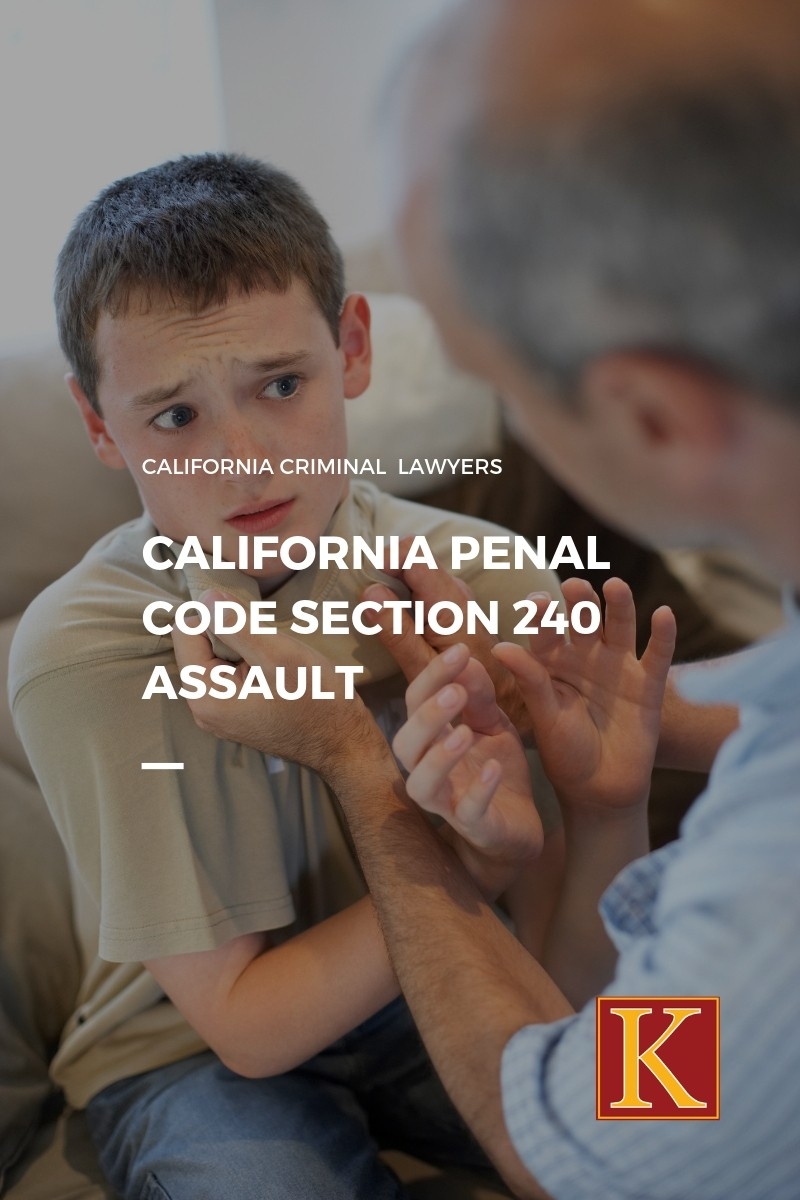
California Penal Code Section 240 (PC 240) defines assault as an attempt to commit a violent injury on someone else.
Assault is usually discussed in connection with the battery, though they are two different offenses. Penal Code 242 battery is different from an assault as it requires that the defendant actually use force or violence against someone else.
What Is the Prosecution Required to Prove to Convict Defendant of Penal Code 240 Assault?
To be convicted of assault the prosecution must prove the following elements:
- Defendant committed an act that directly and probably would result in the application of force against another person;
- Defendant did so intentionally and willfully;
- When committing the act the defendant had facts that would make a reasonable person realize the act would result in applying force to someone;
- When committing the act the defendant had actual ability to apply force to another person
"Application of Force" in California Criminal Assault Charge
Application of force is any harmful or offensive touching. The touching doesn’t need to cause an injury or to be done directly. The slightest touching will be considered enough if it is done in a rude or offensive manner.
What are the Legal Defenses to Penal Code Section 240 Assault?
Legal defenses to Penal Code Section 240 Assault include the following:
- Defendant did not have the actual ability to inflict force or violence on someone else
- Defendant acted in self-defense or defense of others
- Defendant did not act with required intent or willfully
- Defendant was wrongfully accused
What are the Penalties for Penal Code 240 Assault?
Under California Penal Code Section 240 assault is considered a misdemeanor. The possible penalties include:
- Up to six months sentence in a county jail; and/or
- A maximum fine of to one thousand dollars
Assault and Related Offenses
There are various charges that fall under assault related offenses in California including the following criminal charges such as Penal Code Section 245(a)(1) assault with a deadly weapon.
California Penal Code Section 245(a)(1) Assault with a Deadly Weapon
Under Penal Code Section 245(a)(1) assault with a deadly weapon, known also as ADW, is assault committed by means of a deadly weapon or force likely to inflict great bodily injury.
To be convicted of assault with a deadly weapon the prosecution must prove the following elements
- Defendant committed an act that directly and probably would result in the application of force against another person;
- Defendant committed the act either with a deadly weapon or by means of force likely to produce great bodily injury
- Defendant did so intentionally and willfully
- When committing the act the defendant had facts that would make a reasonable person realize the act would result in applying force to someone;
- When committing the act the defendant had actual ability to apply force with a deadly weapon or force likely to produce great bodily injury
What Is Considered a Deadly Weapon in California?
A “deadly weapon” is any instrument, object or weapon which use can likely produce death or great bodily injury (like a knife or a gun).
Penalties for Penal Code 245(a)(1)
Under California Penal Code 245(a)(1), assault with a deadly weapon is considered a wobbler, and depending on the specific circumstances it can be charged either as a misdemeanor or a felony. Prosecutor's decision about whether to charge ADW as a misdemeanor or a felony is based on several factors, such as:
- The type of used instrument or weapon
- The severity of the injury caused to the victim
- The identity of the victim
Penalties for Misdemeanor Assault With Deadly Weapon
Penalties for misdemeanor assault with deadly weapon include the following:
- Up to one year sentence in county jail; and/or
- A fine of up to one thousand dollars
Penalties for Felony Assault Charges
Under Felony California Penal Code 245(a)(1), assault with a deadly weapon penalties include the following:
- Two, three, or four, years in California state prison; and/or
- A fine of up to ten thousand dollars
Penalties for ADW with a Firearm
If a deadly weapon was an ordinary firearm, then the above mentioned penalties still apply. However, the misdemeanor ADW with a firearm carries up to six months in county jail.
In case the used deadly weapon was a semiautomatic, then the defendant is sentenced to a prison term of three, six or nine years. In case the weapon was a machine gun or assault weapon, then the defendant will be subject to a prison term of four, eight, or twelve years.
California Penal Code Section 244 Assault With Caustic Chemicals
California Penal Code 244 Assault with caustic chemicals occurs whenever a person willfully and maliciously places or throws, or causes to be placed or thrown any caustic chemical, a corrosive substance, flammable substance or vitriol with the intention of injuring another person’s flesh or disfiguring the body.
In order to be convicted in assault with caustic chemicals the prosecution must prove every single of the above mentioned elements.
What Is Considered to Be a Caustic Chemical?
Under Penal Code section 244 a caustic chemical is any corrosive, flammable substance that can burn living tissue.
Kerosene, acid, gasoline, petroleum products, or flammable liquids with one hundred fifty degrees Fahrenheit or less are examples brought in Penal Code section 244.
Penalties for Penal Code Section 244
Assault with dangerous chemicals is considered a felony and penalties for a Penal code 244 convicts can include:
- Two, three, or four years in California state prison; and/or
- A fine of up to ten thousand dollars
- Instead of prison, the defendant can be sentenced to felony probation and serve up to a year in county jail.
Get Help Defending Criminal Battery Charges from an Experienced Lawyer
Hire the most dedicated Glendale criminal defense lawyer to the legal services you require! Our attorneys at KAASS LAW are highly dedicated to help our clients in every way possible. You can rely on our experienced lawyers in Glendale, Los Angeles, California, to carefully analyze the facts of your case to prove the facts necessary. We back all of our clients and we invite you to give us a toll free call at (310) 943-1171 to speak to our experienced Glendale criminal battery attorney today. Get in touch with us at KAASS LAW, 815 E Colorado St #220, Glendale, CA 91205, (310) 943-1171at any time!
California Penal Code Section 242 (PC-242) outlines the crime of battery as "any intentional and unlawful use of force or violence upon the person of another."
The following elements must be established in order to prove a charge of battery:
- Defendant willfully and illegally touched another person in offensive or a harmful way (for example, grabbing another person's arm in anger or touching the private parts of another person would be considered battery);
- Defendant did not act in self-defense or in defense of someone else
Battery is often discussed in connection with the criminal offense of assault. Although battery and assault are considered two completely different offenses.
California Assault Penal Code 240
Assault is described in Penal Code Section 240 as an action that may impose physical harm or unwanted touching on someone else. While, on the other hand, pursuant to Penal Code 242 battery is the actual infliction of force or violence on someone else.
Actual Physical Contact is Not Necessary for Assault
In case of assault, any actual physical contact is not necessary to be present, whereas a battery cannot be accomplished without a touching of the victim. A person can be charged with battery even if no injury or pain is caused to the victim. The slightest touch is enough for a battery charge if it is done in an annoying, disrespectful or rude manner.
Defenses to California Criminal Battery Charge
You acted in self-defense or defense of another person: You cannot be convicted of battery in case you reasonably thought that you or someone else was in danger of bodily injury or death and you reasonably used force to defend against that danger.
You did not act willfully or intentionally when committing the harmful touching: You cannot be found guilty of the offense, if the battery was the result of an accident or the outcome of events.
PC 242 Battery Penalties
Under California PC 242 simple battery is prosecuted as a misdemeanor.
The potential penalties for a criminal battery conviction include:
- Up to six (6) months in county jail; and/or;
- A fine of up to two thousand dollars ($2,000)
Battery and Related Offenses
Battery causing serious bodily injury under Penal Code Section 243(d)
A defendant can be charged under California Penal Code section 243(d) if the victim of a battery suffers serious bodily injury. Battery under this section is also known as “aggravated battery.” A serious bodily injury is any serious impairment of physical condition. Aggravated battery in California law is considered a wobbler and it may be charged as either a felony or a misdemeanor, depending on the specific circumstances of criminal offense.
If convicted of a misdemeanor charge for this offense you can face up to one year in a California county jail. If it is charged as a felony you can face two, three, or four years in a California state prison.
Domestic Battery Under Penal Code Section 243(e)(1)
In case the victim of a battery is a family or household member you can be charged with domestic battery. Under Penal Code section 243(e)(1) you are considered guilty of domestic battery if alleged victim is a:
- Current or former spouse;
- Current or former boyfriend
- Cohabitant or former cohabitant;
- The parent of your child;
- A person with whom you have or used to have a dating relationship.
Domestic battery is considered a misdemeanor and is punishable by up to one year in a California county jail and/or a fine of up to $2,000.
According to California Penal Code Section 187 the defendant faces 25-years-to-life in the California State Prison for a first-degree murder. In case the conviction is based on a “hate crime,” the defendant faces life in prison without any possibility of parole or early release. Factors that can lead to a conviction for a hate crime murder include the victim's race, sexual orientation, disability, or nationality.
Get Help Defending PC 242 Charges from an Experienced Lawyer
Hire the most dedicated Glendale criminal defense lawyer to the legal services you require! Our attorneys at KAASS LAW are highly dedicated to help our clients in every way possible. You can rely on us to carefully analyze the facts of your case to prove the facts necessary. We back all of our clients and we invite you to give us a toll free call at (310) 943-1171 to speak to our experienced Glendale criminal battery attorney today. Get in touch with us at KAASS LAW, 815 E Colorado St #220, Glendale, CA 91205, (310) 943-1171 at any time!