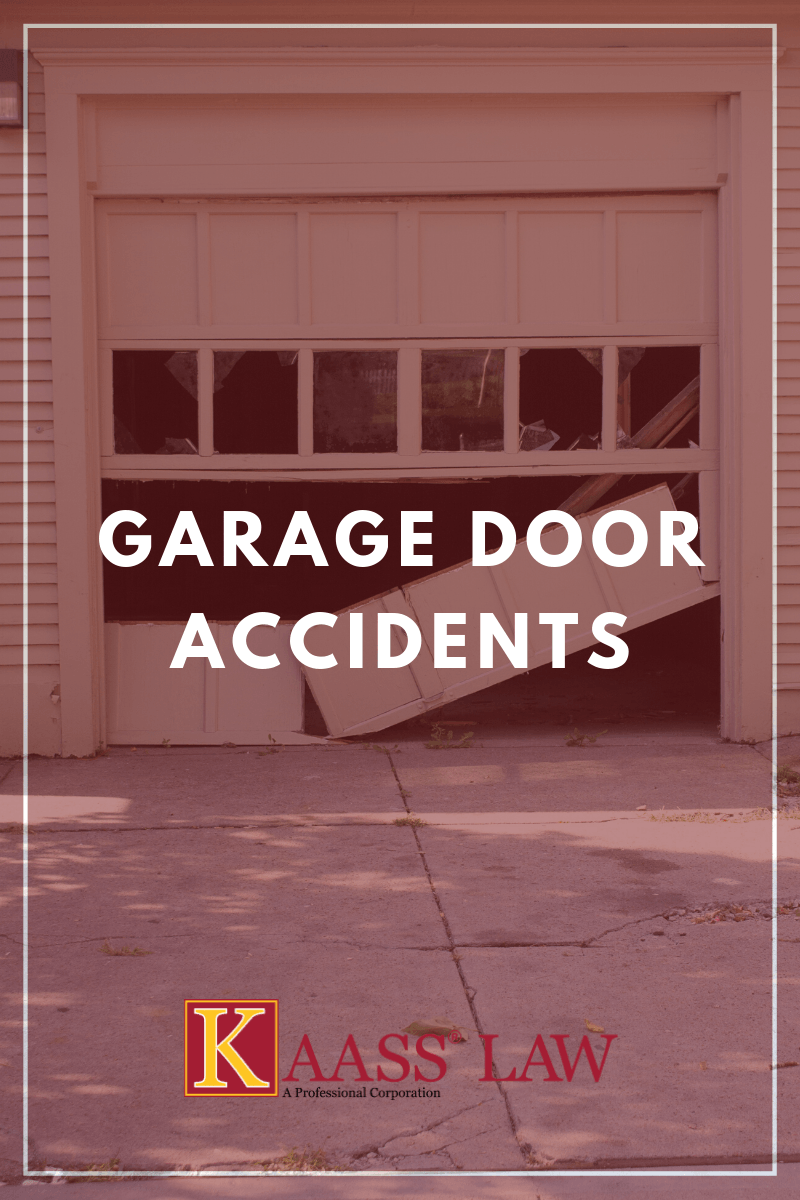
Garage Door Accidents
PublishedMarch 11, 2021
Garage Door Accidents

What Types of Garage Door Accidents Can Occur?

Garage door accidents are not uncommon but they can still occur due to poor installation and lack of maintenance. Whether the accident happens inside your own home, someone else’s home, or a public place, a garage door accident can be very serious. Some common garage door accidents include:

  • Falling garage door hitting you
  • Body part in between the moving parts
  • Suffocating from under a closing garage door
  • Lacerations from broken glass of a garage door

What Types of Injuries can be a Cause by a Garage Door Accident?

A garage door malfunctioning can cause any number of serious injuries, depending on the severity of the accident. Injuries that can be a cause by a garage door accident include:

  • Lacerations on face/body
  • Head trauma/concussion
  • Internal organ damage
  • Suffocation and lung damage
  • Broken bones

Who can be Liable in a Garage Door Accident?

To figure out who is liable in a garage door accident, it is crucial to know what caused the accident or any malfunction of the garage door. Among those that can be a consideration in a liable party include:

  • Property owner or tenant 
  • Garage door seller
  • Garage door manufacturer
  • Garage door designer
  • Garage door installer

What Damages can I be Compensated for in a Garage Door Accident?

If you file a lawsuit after a garage door accident injury, then compensations are applicable for damages or losses due to the accident. For instance, these include both economic and non-economic damages, including:

  • Medical bills
  • Physical therapy
  • Lost income and/or earning capacity
  • Property damage
  • Pain and suffering
  • Emotional distress
  • Loss of enjoyment of life

Legal Grounds for Filing a Lawsuit for Injuries Caused By a Garage Door Accident 

To file a lawsuit for a garage door accident, a plaintiff must prove that the injury occurred as a result of:

  • Negligence
  • Design defect
  • Equipment malfunction

In such cases, both negligence and strict liability may apply. If improper installation caused the accident, the property owner may face liability.

Property Owner Negligence 

Under California law, property owners have a duty to maintain their property in a safe condition. This includes ensuring that garage doors are in working and safe condition. If an owner was aware of a defective gate and failed to repair it, he or she may be found guilty of negligence. Liability can also arise if the victim was on the property with permission. For example, as a guest.

Manufacturer and Seller Liability 

In cases where the accident was caused by a defect in the design or mechanism of a garage door, the manufacturer or seller may be held liable. California law provides for strict liability for defective products. This means that a plaintiff does not have to prove that the manufacturer was negligent. He or she need only prove the existence of the defect and the causal connection between the defect and the injury. In addition, distributors and retailers may also be liable under certain circumstances.

Documenting the Incident and Evidence 

To increase the chances of a successful case, it is important to gather and preserve as much evidence as possible. This includes:

  • Photographs of the scene
  • Surveillance video
  • Medical reports
  • Witness statements
  • Copies of gate sales contracts and service records

The more complete the information provided, the greater the likelihood of a successful claim.

Statute of Limitations 

The statute of limitations under California law should be considered. Typically, an injured person has two years from the date of injury to file a personal injury lawsuit. If the product has a defect, the time frame may change. Missing the statute of limitations may result in the loss of your right to recover damages, so it is important to act in a timely manner.

Legal Assistance 

Because garage door injury cases can involve multiple sides of a cause of action, legal assistance is crucial. The attorneys at KAASS LAW are experienced in handling these types of cases and will help determine the best strategy to protect the injured party's interests.

What Should I do if I Was Injured in a Garage Door Accident?

If you or a loved one have been injured in a garage door accident, we invite you to contact our office at (310) 943-1171 for a free consultation with a Los Angeles garage door personal injury lawyer. Our attorneys will help you determine the liable party and proceed accordingly. 

Related Articles

View All Posts
Defective Car Seat Wrongful Death

Child seats save lives and protect the most vulnerable passengers in motor vehicles. Young children must also ride in proper booster and safety seats for their height, weight, and age in California. However, defective car seats and boosters can cause significant injury and even death to young children.

Common Booster and Safety Seat Defects

According to state laws and regulations, all children under the age of eight must be in an appropriate car seat, with certain exceptions for older children whose parents are in the vehicle. To guarantee that tiny children are safe in the case of an accident, these standards differ based on the child's age and weight. While victims of catastrophic automobile accidents nearly always experience some injuries, the assumption is that a child safety seat, booster seat, or harness should decrease these risks and save the lives of little children. When car seat and child seat manufacturers fail to regard kid safety, the civil court system can frequently find them legally accountable.

Our Lawyers Can Represent Clients Whose Children Have Injuries

  • Driver seatbacks that collapse and injure children in the back seat,
  • Backless booster seats that provide no head or neck protection,
  • Shield-type booster seats that allow children to hit their heads or slip out of the seat,
  • Convertible child carriers that come apart,
  • Insufficient designs on car seats.

Car Seat Industry Safety Standards Are Inadequate

Part of the problem with child car seat injuries stems from the absence of proper safety requirements for car seat manufacturers. There are presently no industry-wide regulations for safe performance in a kid seat in a rear-, side-, or rollover collision. Children who are too big for a child seat but too tiny to be securely secured by the vehicle's seat belt system are also in danger of harm.

What Can I Do to Avoid Purchasing an Improper Child Car Seat?

It may be upsetting when you rely on a product to keep your children safe, and that product fails. Keep up with safety recalls and unfavorable publicity for any seats or manufacturers to avoid purchasing a faulty kid car seat. The NHTSA offers a webpage dedicated to informing customers about the most recent recalls.

What Causes a Defective Child Car Seat?

The following are examples of common car seat flaws:

  • A shattered foundation,
  • Handles that are defective,
  • Latch failures,
  • Failure to properly lock and unlock buckles,
  • Flammable substance.

If you're tempted to buy or give away an old car seat, resist. Child car seats have a shelf life. You will not be penalized or charged if you use an expired or used car seat. They can develop cracks and lose their straps with time, resulting in catastrophic failure in an accident. Also, do not purchase a secondhand child car seat from the internet. You don't know the seat's history, which puts your child at risk in an accident. When your children are close in age, this is an exception. You can hand it down to the younger child as long as the seat is still safe to use.

Defective Child Car Seats Can Lead to Catastrophic Injuries

Child car seats are designed to safeguard young passengers during vehicle crashes. Unfortunately, when these products are defective, such as collapsing seatbacks, faulty buckles, or poorly designed boosters, the consequences can be devastating. A lack of federal safety standards for side, rear, and rollover collisions further increases the risk. Manufacturers may be held liable if their negligence contributes to a child’s injury or death. At KAASS LAW, we’re committed to holding them accountable and protecting your family’s rights.

Get Legal Support for Child Car Seat Injury Cases

If your child was harmed due to a defective car seat, you deserve justice. Our attorneys at KAASS LAW understand the emotional and financial toll these cases can bring. We use our legal experience and investigative resources to pursue maximum compensation for families affected by design flaws or manufacturing failures. Let us help you hold negligent companies responsible. Call us at 310-943-1171 or explore more of our legal services online.

Fighting for Defective Child Car Seat Victims

Children who survive a vehicle accident with a faulty safety seat may miss out on a lifetime of chances ranging from lifelong paralysis to traumatic brain damage to spinal cord injuries - and regrettably, many of the tiniest children cannot survive such a crash at all. Our experienced personal injury attorneys at KAASS LAW have considerable investigative tools to assist you in exploring all legal options following a tragic death or catastrophic injury. You can contact us at 310-943-1171. We believe in finding justice for families and ensuring that no parent has to endure the same pain because we've seen firsthand the devastation that vehicle faults can bring. You can rely on our team to offer the compassionate representation you need following a vehicle accident. Visit this link to be introduced to our additional practices.  

Product Liability: Defective Toys & Wrongful Death

Product liability is a common cause of wrongful death. The loss of a child can be a tragedy beyond comprehension for the parents who must go through it. Toys for kids are a constant source of damage and health concerns. The carelessness of toy producers, distributors, and retailers results in kids' injuries every year. No matter how old your child is, an accident brought on by a hazardous or defective toy can have long-lasting effects. According to a child psychologist, such an encounter may negatively affect a youngster's behavior and associations with various things and situations.

What Injuries Can A Kid Suffer From Defective Toys?

Among the injuries brought on by product liability are:

  • Eye damage
  • Choking accidents
  • Discoloration and scarring
  • Head trauma
  • Fractures and broken bones
  • Asphyxiation
  • Psychological harm
  • Wrongful death

What Are The Safety Standards For Children's Products And Toys?

Kids regularly throw toys, stuff them in their mouths, and mistreat them in general. Because of this, toy producers and merchants need to handle children's toys carefully. Unfortunately, businesses produce dangerous toys all too frequently, which can lead to lead paint exposure and choking concerns. Then they fail to give parents enough caution. Children may consequently sustain critical injuries or possibly pass away.

Product Liability the Reason of Wrongful Death

In general, three types of flaws can result in a product liability claim:

  • Defects in product design. Mass product recalls of defective products can occasionally result from design flaws.
  • Manufacturing defects are mistakes during the assembly or production of a particular product. An error in manufacturing suggests that other items with the same design did not cause malfunction.
  • Marketing defects are those that occur from a user not receiving adequate instructions on how to use a product safely, which causes a fatal accident.

How To Determine Whether The Product Is Defective Or Not?

  • Compliance With Safety Testing Guidelines And Procedures

Toy designers and producers must abide by industry guidelines while creating new toys. These parties may be held accountable for injuries caused when they fall short of acceptable standards.

  • Defective History of the Business or Product Line

Allegations of present flaws may be supported by documentation of past defects and injuries. This data can also demonstrate that the manufacturer was aware of potential issues and risks.

  • Age-Appropriate Recommendations

Age recommendations help consumers to determine when they should use them. When buying toys for their children, parents rely on these rules. Improper categorization can put younger children at risk. Types of paints and chemicals used in manufacturing Younger kids, in particular, frequently put items in their mouths.

  • Adequate Instructions and Warnings

Toys come with warning labels, instructions, and age designations to help parents. When these guidelines are insufficient, kids could damage themselves by using the toy in an unsafe way.

  • Easily Disassembled Toys

Some toys that are simple to disassemble can be hazardous. The toy's little bits pose a risk of choking. Electric burns or shocks can also result from small electronic components.

Who Can Be Liable for a Wrongful Death Caused by a Defective Toy?

A toy may have a flaw at any point during its development, production, or marketing. Anyone involved in the supply chain could potentially be held accountable if a child is killed in an accident brought on by a defective product, including:

  • The product's creator
  • The company that makes any component of the product, such as the brakes on a car,
  • The one who put the item together The wholesaler
  • The store where the consumer actually purchased the good

Financial Compensation for a Wrongful Death

Our wrongful death lawyers at KAASS Law are devoted to ensuring that you get the compensation you deserve. You might be entitled to compensation for the following damages if you file a claim with our legal firm:

  • Future and Past Medical Expenses
  • Lost Salary
  • Loss of Potential Future Wages
  • Distress and Suffering
  • Emotional distress (such as PTSD, depression, and anxiety)
  • Punitive Damages

Contact KAASS Law Experienced Wrongful Death Attorneys Today!

Helping our clients acquire the financial means required to pay for medical care and rehabilitation services is a top concern for our lawyers. Through conversations with your child's doctor or other medical experts, we will learn about your child's medical requirements and pursue financial compensation for all additional economic and noneconomic damages in addition to medical costs. Call us now at (310) 943-1171

Product Liability Lawsuit: Wrongful Death

When you buy a product made by a corporation, you anticipate it to function in a particular way. The directions on the product label and the ads for the product are typically the foundation for this assumption. When a product does not perform as the instructions direct it to and results in a fatality, a wrongful death case may begin with the help of a wrongful death attorney. A wrongful death lawsuit in this case would be based on the theory of product liability. Understanding how the law works and when a situation like this might be brought under it is crucial.

Product Liability Lawsuit Types

According to California law, depending on the kind of product's flaws, it is normally possible to launch three different forms of product liability claims. Take a peek at these now.

Manufacturing Defect

If a manufacturing error was a cause of death, you can file a lawsuit against the manufacturer. An example of that is car breaks. They might have not properly made and failed to bring a car to a full stop. Liability will be on the manufacturer if that happens. A wrongful death lawsuit based on manufacturing defects must demonstrate that the defect directly caused the incident or injury that resulted in the fatality. It must be proven that no other factors contributed or that the other contributing factors were not as significant as the defect itself.

Design Defect

To file a lawsuit for design defect you need to provide evidence that the product is defective. To file a wrongful death lawsuit the accident has to result in death. Liability will be on the manufacturer if that happens. You will need to demonstrate that the flaws were big enough for the person to be in danger. Examples of Design Flaws Include:

  • Airbags that aren't working properly. The purpose of an airbag's design is to protect a car's occupants in the case of a collision. An airbag has a clear design flaw if it hurts the passengers instead of protecting them.
  • Defects in Weapon Design. Handguns often have safety features. A design flaw in a pistol can result in injuries and deaths if it fires on its own. Such weapon flaws, which have traditionally existed in the creations of top arms producers, may give rise to product liability claims.

Problems with Label Warnings

California law requires businesses to make any potentially hazardous components of a consumer product explicit. A product liability lawsuit can be filed if a company fails to clearly warn consumers about any harmful components.

Product Liability Lawsuit Punitive Damages

If a manufacturer or business may be liable for punitive damages. That is if it is aware of the dangerous flaws in a product and continues to sell it. These damages are in addition to any personal injury or wrongful death damages sought for the harm caused by the product. It is best to consult with an experienced wrongful death attorney. They can help determine whether punitive damages are appropriate in your product liability lawsuit.

Choosing a Reliable Los Angeles Wrongful Death Lawyer

A wrongful death lawsuit stemming from product liability issues can be legally complex. If you have lost a loved one as a result of a defective product, do not wait to contact us. You should contact a qualified lawyer as soon as possible. At Kaass Law, we assist you in gathering the necessary evidence to support your product liability claims. We also work with you to ensure that the responsible company pays the full extent of your tragic loss. Contact our office for assistance at 310.943.1171 or visit our website for other practices.