

Treatise: Motorcycle Helmet Product Liability in California Product liability lawsuits frequently arise as a result of motorcycle accidents, and a common product at issue is the rider’s motorcycle helmet. For instance, in California, manufacturers, distributers, and retailers of motorcycle head gear can liable for injuries and damages that occur as a result of defective protective gear.
In California, lawsuits brought under the theory of products liability are strict liability cases, meaning the plaintiff does not have to show negligence on the part of the manufacturer or seller in order to prevail on a claim of defective product. The basis for strict products liability is grounded on the public policy considerations that parties involved in the commercial enterprise who make a profit by placing defective products into the marketplace should bear the responsibility of the injuries caused to consumers by those products. V 61 C.2d 256 (Ca. 1964). In order for a plaintiff to prevail and be awarded damages under the theory of products liability the plaintiff must show: (1) there was a defect in the manufacture or design of the helmet or the helmet’s product warning was defective or did not exist; (2) the defect was the cause of the plaintiff’s injury; and (3) injury did in fact occur. , 137 Cal.App.4th 292, (Ca. Ct. App. 2006).
Product defects can determine by: (1) manufacturing defect; (2) design defect; or (3) warning defect. The mere fact that a plaintiff suffered an injury from the normal use of a product does not itself establish that the product was defective. Hennigan v. White, 199 Ca.App.4th 395 (Ca. Ct. App. 2011). For example, a plaintiff who suffers a head injury while wearing a motorcycle helmet in its normal use is not, by itself, sufficient to establish a claim for products liability. Instead, there has to be some kind of legal defect in the motorcycle helmet.
Manufacturing defects are most common. Strict products liability for a manufacturing defect can be found in two scenarios: (1) when the product left the manufacturer’s control, it differed from the manufacturer’s intended result or (2) when the product left the manufacturer’s control, it differed from apparently identical products of the same manufacturer. Barker v. Lull Engineering Co., Inc., 20 Ca.3d 413 (Ca. 1978). Additionally, the defective product must have been used in a manner reasonably foreseeable by the manufacturer and yet still caused the plaintiff’s injury. Id. The following scenario highlights the “reasonably foreseeable use” element of a manufacturing defect claim: Plaintiff wears her motorcycle helmet on backwards, shorty thereafter gets into a collision due to her vision obstruction. A defect in the face shield of the helmet causes injury to the back of her head. Plaintiff would not be able to maintain a products liability case against a motorcycle helmet manufacturer because, even though the face shield was defective, she was not using the helmet in a manner that would be reasonably foreseeable by the manufacturer. California’s Civil Jury Instructions require that in order for a plaintiff to establish a claim for manufacturing defect, all of the following must be proven: (1) that the defendant manufactured or sold the product at issue; (2) that the product contained a manufacturing defect when it left the defendant’s possession; (3) that the plaintiff was harmed; and (4) that the product defect was a substantial factor in causing the plaintiff’s harm. CACI No. 1201. “A product will be considered as containing a manufacturing defect if the product differs from the manufacturer’s design or specifications or from other typical units of the same product.” CACI No. 1202.
In terms of analyzing a plaintiff’s claim under the consumer expectation test, a jury will be instructed that the following elements must be proven before judgment can be awarded in favor of the plaintiff: (1) that the defendant manufactured or sold the product (2) that the product did not perform as safely as an ordinary consumer would have expected it to perform when used or misused in an intended or reasonably foreseeable way; (3) that the plaintiff was harmed and; (4) that the product’s failure to perform safely was a substantial factor in causing the plaintiff’s harm. CACI No. 1203. Alternatively, when reviewing a claim for design defect under the risk-benefit test, a plaintiff must prove: (1) that the defendant manufactured or sold the product; (2) that the plaintiff was harmed and; (3) that the product’s design was a substantial factor in causing the plaintiff’s harm. CACI No. 1204. If a plaintiff can prove these three facts, then the jury is instructed to decide in favor of the plaintiff unless the defendant can prove that the benefits of the product’s design outweigh the risks of the design. Id. In deciding whether the benefits outweigh the risks, the jury is instructed to consider the following factors: (1) The gravity of the potential harm resulting from the use of the product; (2) The likelihood that the harm would occur; (3) The feasibility of an alternative design at the time of manufacture; (4) The cost of an alternative design; (5) The disadvantages of an alternative design; and (6) Any other relevant factors. Id.
A plaintiff must prove all of the following to establish a claim for warning defect: (1) that the defendant manufactured or sold the product; (2) that the product has potential risks or side effects that were known or knowable in light of scientific or medical knowledge at the time of manufacture or sale; (3) that the potential risks or side effects presented a substantial danger when the product is used or misused in an intended or reasonably foreseeable way; (4) that ordinary consumers would not have recognized the potential risks or side effects; (5) that the defendant failed to adequately warn or instruct of the potential risks or side effects; (6) that the plaintiff was harmed and; (7) that the lack of sufficient instructions or warnings was a substantial factor in causing the plaintiff’s harm. CACI No. 1205.
The defective product must have actually caused the plaintiff’s resulting injury. Horn v. General Motors Corp., 17 Cal.3d 359 (Ca. 1976). It is not enough that the defect played some role in causing the injury, however, the defect must have been a substantial factor that lead to the plaintiff’s injury. Soule at 572. In fact, a defect is considered legally and factually irrelevant if it played no part in bringing about the injury. Id. (Holding that if the external force of a vehicle accident was so severe that it would have caused identical injuries in spite of the defect in the vehicle’s collision safety, then the defect cannot be considered a substantial factor in bringing about the plaintiff’s injury.) Practically, in cases of motorcycle helmet product liability, this would mean that if a plaintiff suffered a head injury during a motorcycle crash such that was so severe the outcome would have been the same regardless of whether or not the plaintiff was wearing a helmet, then a claim cannot be made for products liability even if the helmet was found to be defective.
Injury must occur. In terms of products liability, a defendant can be strictly liable for physical injuries which connects to persons or property. As the old saying goes, "No harm no foul." However, it is important to note that a plaintiff cannot prevail on a claim of strict liability for purely economic loss. Absent a claim of personal injury or damage to other property, there is no strict liability for loss of value, cost of repair, or replacements of the defective product. Jimenez v. Superior Court, 29 Cal.4th 473 (Ca. 2002). Additionally, California courts have held that the injury suffered by plaintiff must have actually occurred, meaning it is insufficient to claim only the likely potential for injury. KB Home v. Superior Court, 112 Cal.App.4th (Ca. Ct. App. 2003).
A broad range of plaintiffs may recover under the theory of product liability. Recovery from injury is not limited to the first purchaser of the product, but rather to anyone whose injury was reasonably foreseeable. Elmore v. American Motors Corp., 70 C2d 578 (Ca. 1969). This can include innocent bystanders injured by defective automobiles or employees injured by defective equipment owned by their employers. See Elmore v. American Motors Corp., supra, 70 Ca.2d 586 (Ca. 1969). See Barker v. Lull Engineering Co., Inc., 20 Cal.3d 413 (Ca. 1978). A practical example of this concept in a motorcycle helmet product liability case can is as follows: Biker Son purchases a motorcycle helmet for Biker Dad’s birthday. Biker Dad has a motorcycle accident while wearing the helmet and suffers a brain injury as the result of a design defect in the helmet. Although Biker Dad was not the direct purchaser of the helmet, he is a proper plaintiff who can bring suit against the helmet manufacturer.
In instances of product liability, the manufacturer is normally the most obvious defendant, but they are far from the only defendant available. Originally, the doctrine of strict liability only applied to the manufacturers of defective products. Greenman v. Yuba Power Products, Inc., 59 Cal.2d 57 (Ca. 1963). However, over time, California courts have expanded the doctrine to reach parties involved in the commercial chain of distribution of the defective product. Peterson v. Superior Court, 10 Cal.4th 1185 (Ca. 1995). This means that not only the manufacturer of a defective motorcycle helmet can be liable in a claim of products liability, but also the distributor and the retailer can be liable as well.
Although there are several potential defendants available to the plaintiff in a motorcycle helmet products liability action, not everyone can be under the doctrine of a lawsuit. You will note that manufacturers, distributors, and retailers have one common theme that exists between them – they are all involved in the chain of custody of a product. One party that cannot hold liability under the doctrine of products liability is a party who provides a service. Strict products liability will always involve a tangible product that places into the stream of commerce, so if the potential defendant is offering a service, rather than a product to the plaintiff, the plaintiff cannot bring suit against the service provider under the theory of products liability.Gagne v. Bertran, 43 Cal.2d 481 (Ca. 1954). For example, a plaintiff would most likely not be able to bring a products liability suit against a business that provides motorcycle riding lessons, even if the business provided the plaintiff with a defective helmet to use during the lesson. The plaintiff may be able to sue under another legal theory, but not products liability. In some cases there may be a dispute over whether the business is providing a product or services, and in those instances, the court must determine whether the dominant role of the defendant should identify as a service or a sale. Murphy v. E.R. Squibb & Sons, Inc., 40 Cal.3d 672 (Ca. 1985).
Product liability among defendants is joint and several, meaning that any defendant established by the plaintiff as involved in the stream of commerce of the defective product is responsible for all of plaintiff’s damages.
Below is a list of various California jury verdicts and settlements for cases regarding product liability connection to a defective motorcycle helmet:
• Esposto v. City and County of San Francisco; State of California; Shoei Helmet Corporation; Paulson Manufacturing Company; David Golden Motorcycles, Inc., JVR No. 43984 Superior Court, San Francisco County (1986). A plaintiff in his mid-30s is a victim in motorcycle accident, resulting in becoming a quadriplegic. The plaintiff sued the city of San Francisco and State of California arguing that poor road conditions contributed to his accident. Additionally, the plaintiff sued the motorcycle manufacturer and retailer and claimed that the bike, helmet and visor were defective. The manufacturer and retailer maintained that the products were not defective. The plaintiff eventually settled for a total amount of $865,000. The city and county paid the large bulk of the settlement.
• Sheryl Suglia v. Nexl Sports Products, LLC, Lifestyle Custom Cycles, Gilbert J. Williams and Mark Skolnick Jr., 2009 WL 3260089, Superior Court, Los Angeles County (2009). Plaintiff and her late husband got into a collision with their motorcycles, head-on, by a drunk driver, resulting Plaintiff having severe injuries the passing of her husband .At the time of the crash, plaintiff and her husband were wearing “beanie” type helmets manufactured by Nexl Sports Products and sold by retailer Lifestyle Cycles.The particular "beanie" type helmets did a recall in 2003 for failing to pass Department of Transportation penetration and impact-absorption tests. The plaintiff sued the manufacturer and retailer under the theory of strict products liability and negligence, claiming that both defendants should have made her aware of the product recall. Plaintiff sought more than $2 million in economic damages. The jury found in favor of the defense, reasoning that the impact between the car and motorcycle was so major that no helmet could have prevented the resulting injuries.
• Sally Doe v. Daytona Helmets Inc.; Jeffrey McKinley; Big Dawg Custom Cycles & Rodney Chatwin, individually, 2006 WL 4589449, Superior Court, Alameda County (2006). Plaintiff is dealing with head injuries due to a motorcycle accident. One of the claims brought by plaintiff was for products liability against the motorcycle helmet manufacturer. The crux of plaintiff’s argument was that the helmet failed to meet DOT safety requirements, despite the fact that it displayed a DOT compliant sticker. The parties reached a settlement agreement and the plaintiff received approximately $1 million from the helmet manufacturer and an additional $1 million from the remaining defendants.
• Grant Thor and Sara Guerrero v. Kerr Leathers, Inc., Sunright International and Visalia Harley-Davidson, 2007 WL 2872337, Superior Court, Tulare County (2007). Plaintiff's late father received severe head injuries due to an motorcycle accident, resulting his late fathering from passing away. Plaintiff brought a products liability suit against the manufacturer. The retailer of the helmet claiming that it was defective after it failed a “retention” test by the Federal Government. The defendants recalled the helmet, but there was no evidence of the plaintiff’s father ever receiving notice of the recall. Plaintiff settled for approximately $2 million.
• Riley v. Grandon, 5 Trials Digest 17th 7, Superior Court, Riverside County (2013). The Decedent was a motorcycle passenger when the bike struck a speedbump, lost control, and crashed. Unfortunately, the Decedent fractured her skull and died as a result of her injuries. The Decedent’s estate brought suit against the driver of the motorcycle under a theory of negligence and also alleged strict product liability against the manufacturer and retailer of the helmet the Decedent was wearing at the time of the accident. At the end, the plaintiff claimed that the helmet did not meet motorcycle safety standards. Plaintiff reached a $1 million settlement with the helmet retailer. THIS ARTICLE IS FOR EDUCATIONAL PURPOSES ONLY, NO ATTORNEY CLIENT PRIVLIGE, CONSULT, OR ADVICE. PLEASE CONSULT WITH A PROFESSIONAL. Contact KAASS Law for further assistance and representation!
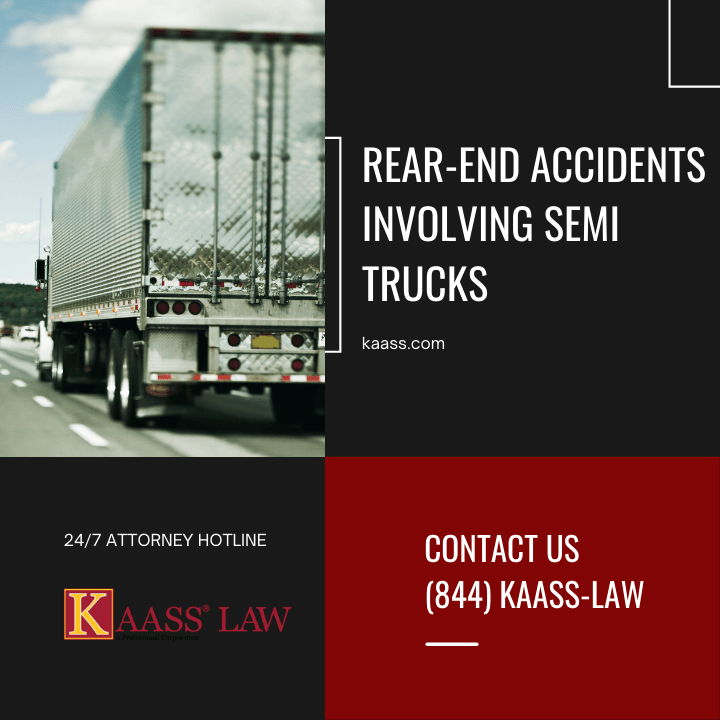
A rear-end collision between a semi-truck and a passenger vehicle is something that happens often. The first thing that comes to mind when you hear the words "rear-ended by a semi-truck" is most likely the severity of damage such an accident can cause. This is primarily due to the overwhelming size and weight of the semi-truck can pose a serious risk of catastrophic injury or wrongful death in an accident.
There are many causes for rear-end accidents involving semi-trucks. Some common causes as to why a semi-truck driver may rear-end another vehicle include:
California Civil Code section 1714 outlines the requirements to prove that a defendant is liable for your accident on their premises. The four elements required to win a premises liability case are, therefore, the following:
Government buildings are not the only premises that would fall under the definition of government property. Nearly all public spaces are considered government-owned and, as a result, will require a different claim process than those within privately-owned premises. Some examples of government property include:

In California, a government entity can be liable for negligent or intentional acts of its employees committed by a private individual or company. In case a person has injuries as a result of some governmental action, there are some certain rules he must follow to successfully establish his legal rights.
The government entity or agency that is responsible for the employee, property, or carrying out a duty in a California Tort Claims Act suit is usually the government entity or agency that is responsible for the employee, property, or carrying out a duty. The CTCA covers state, county, and local government agencies and departments, as well as city and municipal government agencies.

Under California law manufacturers, distributors and sellers of commercial products have a responsibility to consumers to ensure their products are safe for consumer use. The examples of product liability claims can include unsafe children’s toys, defective autos and auto parts, faulty kitchen, defective motorcycle gear, appliances, defective pharmaceutical drugs, specialized equipment and tools for manufacturing and construction. These are important factors of Product Liability in California.
When a product is more dangerous than a reasonable user would expect, then you can claim the product to be defective. The product is defective in case the consumer is using it in an ordinary way for which of its intent, but it causes injury because of essential fault in the product itself. However, if the consumer uses a product in a dangerous and unusual way, the product cannot apply to it being defective.
Commercial truck drivers are required to maintain a 'logbook" that records the "hours of service". In other words, this log contains the number of hours the drive has been driving. Semi-truck drivers hauling cargo have an 11-hour driving maximum after 10 consecutive hours off duty. Further, semi-truck drivers can work a maximum of 70 hours per week. A driver can then resume driving if they rest for 34 consecutive hours, including 2 nights. Furthermore, all carriers and drivers operating commercial motor vehicles (CMVs) must comply with "hours of service" regulations found in 49 CFR 395.
Driving a semi-truck with unmaintained or worn-out brakes is negligent. Commercial vehicles such as tractor-trailers and semi-truck are moving fast and burdened with a heavy load and therefore generally will need a lot more time to come to a full stop than any SUV. As a result, failing to routinely maintain commercial vehicle breaks will need even more time to come to a complete halt.
Step 1: Firstly, if you are involved in an accident, the first and most important thing to do is call an emergency response to request medical and police assistance. Step 2: Take pictures of the damage to the vehicles, the position of the vehicles, and the entire accident scene. If there is a debate as to how the semi-truck accident occurred, the damage and positions of the vehicles will help the police and accident reconstruction experts to determine what occurred. Moreover, taking a picture of the driver's logbook logs for that day is a plus. Step 3: Attempt to locate people who may have witnessed the collision. Get their name, address, and telephone number. Additionally, exchange information with the other driver, such as insurance information and driver's license information, vehicle registration, driver's contact, and employer information. Step 4: Seek the proper and immediate medical treatment as soon as possible. Going to the emergency room to be examined will ensure there are no internal or hidden injuries, as well as document your injuries. Step 5: Lastly, contact an auto accident lawyer immediately if you have been involved in a semi-truck accident.
A victim involved in an accident with a commercial truck can file a lawsuit against the at-fault driver and the commercial truck company. It is important to keep in mind that the tractor and trailer can have different owners. As such, it is important to ask the driver of the truck who owns the tractor and trailer.
As experienced litigators, we have successfully litigated various personal injury cases including complex personal injury matters. Above all, our attorneys possess the mastery it takes to successfully receive fair settlements during the claims stage of a personal injury case. Don’t accept low-ball offers from insurance companies. An injured truck accident victim may seek compensation for damages which includes:
If you or a loved one has been seriously injured or killed due to a negligent semi-truck driver it is crucial to seek advice from an experienced commercial truck accident attorney as soon as possible in order to preserve your claim and legal remedies. We invite you to contact our commercial truck accident attorney today at (310) 943-1171 for a free consultation.
Kaass Law will connect you with leading medical professionals in your area to diagnose and treat your injuries. If you are unable to pay for the medical treatment we can facilitate treatment on a medical lien basis. This means you pay nothing up front. As the conclusion of your case, your medical bills are paid from the settlement.
[contact-form][contact-field label="Name" type="name" required="true" /][contact-field label="Email" type="email" required="true" /][contact-field label="Website" type="url" /][contact-field label="Message" type="textarea" /][/contact-form]
Filing a lawsuit against government agencies is a process that requires special preparation and precise adherence to deadlines. Even a minor mistake in the paperwork or a missed filing deadline can result in an automatic dismissal of the claim. It is important to note that victims are often unaware that six months is the deadline for filing a claim. After this period, the opportunity to file a claim is completely lost. Government agencies generally possess robust legal defenses. In certain situations, they can invoke "immunity" from liability. This means that they can argue that they are not obliged to compensate for damages.
The most common incidents include: 1. Slips 2. Falls on uneven sidewalks 3. Injuries in poorly lit parks 4. Accidents on unmaintained stairs in courtyards of state buildings
There are also incidents of falling tree branches in public parks and accidents on unimproved roads.
To pursue compensation, it is essential to gather all the evidence you can. For example: 1. Photographs of the accident scene are required. 2. Eyewitness testimonies 3. Medical documents proving the seriousness of your injuries 4. Evidence that the government agency knew of the danger and failed to take action
Before the California Tort Claims Act and Federal Tort Claims Act, it was very difficult to sue the government for any premises liability related issues. These laws established guidelines that allowed people to gain compensation for injuries that occurred on government property. They are very similar to those of a private premises liability cases. The CTCA outlines the elements as follows:
First important step. First of all, it is important to seek medical attention right away, even if the injury does not appear serious. This is necessary for your health and to document the fact that you have been injured. In addition, you should document the scene of the accident with a photo or video: 1. condition of the sidewalk 2. lack of warning signs 3. puddles 4. debris or any other unsafe conditions. This video or photo will serve as evidence.
Second important step. Timely notification of the incident to the government agency. According to the California Tort Claims Act, you must file a written notice within 6 months of the incident. In other words, missing this deadline could completely disqualify you from compensation. In addition, keep in mind that the government may deny your claim on technical grounds. for example: 1. the accident is not accurately described 2. lack of necessary documents Therefore, it is extremely important to contact a lawyer who will help you prepare a competent claim. Unlike private claims, where you file a complaint in court, cases involving public property first go through the administrative stage. Therefore, patience and accuracy in this procedure play an important role. Even if the insurance company rejected your claim, you can still take the case to court.
However, this is only possible after following all the steps of procedures. The KAASS LAW team will guide you through the process step by step. We understand how difficult it can be to deal with the aftermath of an injury, and we are ready to protect your interests. Contact us, a consultation may be the first step to getting justice.
The main difference in filing a CTCA claim vs. a private claim is that the statute of limitations (amount of time one has to file the claim after the injury) is much shorter. Premises liability claims on private property are typically 2 years, though they can sometimes be longer. In contrast, a CTCA claim requires one to file the claim no later than 6 months after the accident occurred. After filing a CTCA claim, the government has 45 days to respond, in which they can reject the claim, accept the offer in full, or compromise with the plaintiff in the form of a settlement. They also have the option to reject the claim based on a violation of the time constraints for claims or for a lack of information included in the claim.
The process of initiating legal action against government agencies necessitates a comprehensive understanding of specialized legal principles. At KAASS LAW our attorneys possess the necessary experience to assist you in properly filing a claim and gathering evidence.
According to California law, there are very strict deadlines to sue the government. A person must file a claim within six months of the date of his injury if he intends to sue a governmental entity or agency in California. In case the claim is not filed within the six-month period, it will be barred by law. This rule is also applicable to minors. Though in some certain limited cases a person can obtain relief from the court to file a claim within 1 year after the injury.
The damage victim must send notice of his or her claim to the State of California, a county government, or a municipal government agency in order to file a claim against them. 6 This could include submitting a report or sending a letter that serves as notice if it meets all of the relevant criteria. Many agencies and towns, on the other hand, provide claim forms that individuals can fill out to notify them of a claim.
Government claims in California must include the following:
If you don't submit all of the information that is a requirement, they may reject your claim. Other reason could be if you didn't file a claim within the time limits.
You have two options for resolving your federal government dispute. First, you'll have the opportunity to negotiate an out-of-court settlement with the government attorney assigned to your case during the administrative claim procedure. If you file a case in federal court, you'll get a second chance to bargain with a new team of lawyers from the Department of Justice. A claimant is entitled to recover damages against the government in the same manner as he would be allowed to recover against a private company, including:
There are two major exceptions in recovering damages in a case against the government:
If you have been injured as a result of governmental negligence, then you may be entitled to compensation. If that is the case, contact our Glendale lawyer today for a consultation and case review. This type of lawsuit is an extremely complex legal process. Please feel free to give our office a call at 310.943.1171.
There are the three main types of product liability claims in California, which include, design defect, manufacturing defect, and marketing/ advertising defect.
A design defect occurs when a product fails to perform as safely as a consumer expects, and the risk of its danger outweigh the benefits of the design. Defective designs have created dangerous products as child products, medical devices, safety products and much more. Defective design claims must include a proof that the whole product line is unsafe, regardless of the fact that the dangerous product is in accordance with the manufacturer’s specifications.
A manufacturing defect takes place when the product differs from the manufacturer's specifications and design, or it differs from other units of the same product line. Manufacturing defects can make a product too dangerous to use. A plaintiff must prove there is a flaw in the manufacturing process, and product is different from the manufacturer's design and it is different than the prototype.
A marketing/ advertising defect is when a company can be liable for advertising a product for a purpose for which it was inappropriate or for failing to include proper warnings or instructions with the product. Companies are responsible to market their products in a safe manner. Marketing a product without promoting off-label use of a product or sufficient warning labels are examples of a marketing defect.
According to California strict product liability, a defendant who is aware that the consumer is using the product in a reasonably foreseeable manner that exposes him to a risk of injuries needs to warn the consumer of the risk of injury or harm. The defendant can be liable for failure to warn when such failure could have been a different outcome. So, in case a typical consumer would have become aware of the risk of injuries or harm on his own, then the defendant can’t be found liable for failing to warn of an already-known hazard.
In California different parties in the distribution chain can be liable for a defective product. Defendants can include, product manufacturer and designer, distributor, parties that assemble or install the product, and retailers.
In the case that someone has suffered due to a defective product, the first thing a person should do is see a doctor and receive sufficient treatment for his injuries, the next thing a person should do is document the defective product by using a camera to photograph both his injures and the defective product. If anyone saw the accident, person should also record their testimony and contact information, lastly it is very important to stop using the defective product and put it with all labels and packaging in a safe place. In case a person is aware about the defect but is still using the product, he can lose his right to make a claim against the defendants.
The type of product liability claim determines what a person must prove for winning his case.
In some product liability claims a consumer must prove that the defective product's distributor, manufacturer or seller was negligent. Other product liability claims a consumer is only required to prove that the product was defective. In product liability claims that are based on negligence, a person must establish that a distributor, manufacturer or seller owed a duty or responsibility to him as a consumer, and they breached that duty.
In product liability claims that are based on strict liability a person must only prove that the product that caused an injury to him was defective. Then distributor, manufacturer or seller must be able prove that the harm was due to abuse, modification or misuse of the product. So a person doesn’t have to prove that the company was negligent, only that the product was defective.
Generally, a plaintiff must be able to establish the following elements, to prevail on a claim for products liability in California, defendant designed, distributed, manufactured, or sold a defective product, product contained the defect when it left the defendant's possession, plaintiff used the product in a reasonably foreseeable manner, as a result of the defect the plaintiff suffered harm.
If the above mentioned elements are proven, a plaintiff may be eligible for compensation. The plaintiff may recover for economic damages, these include costs of medical treatment, rehabilitation, nursing care and lost wages. They can also recover for non- economic damages, these include pain and suffering that are difficult to value in terms of money. These damages are very subjective and usually depend on the harshness of the injury and the degree of care that the distributor, manufacturer or seller took to protect the consumer.
If you or someone you know would like to file a product liability lawsuit in California, contact the attorneys at KAASS Law at 310-943-1171. They can provide you with legal assistance by taking a look into your situation.