
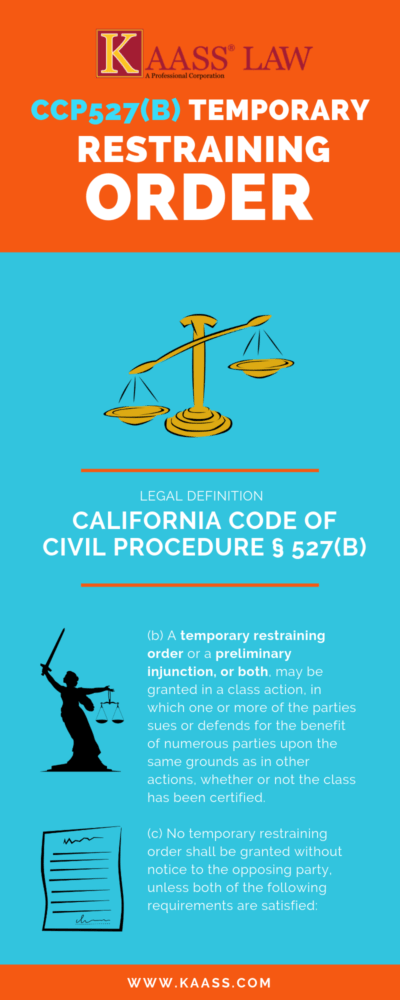
(b) A temporary restraining order or a preliminary injunction, or both, may be granted in a class action, in which one or more of the parties sues or defends for the benefit of numerous parties upon the same grounds as in other actions, whether or not the class has been certified.
(c) No temporary restraining order shall be granted without notice to the opposing party, unless both of the following requirements are satisfied:
(1) It appears from facts shown by affidavit or by the verified complaint that great or irreparable injury will result to the applicant before the matter can be heard on notice.
(2) The applicant or the applicant’s attorney certifies one of the following to the court under oath:
(A) That within a reasonable time prior to the application the applicant informed the opposing party or the opposing party’s attorney at what time and where the application would be made.
(B) That the applicant in good faith attempted but was unable to inform the opposing party and the opposing party’s attorney, specifying the efforts made to contact them.
(C) That for reasons specified the applicant should not be required to so inform the opposing party or the opposing party’s attorney.
(d) In case a temporary restraining order is granted without notice in the contingency specified in subdivision (c):
(1) The matter shall be made returnable on an order requiring cause to be shown why a preliminary injunction should not be granted, on the earliest day that the business of the court will admit of, but not later than 15 days or, if good cause appears to the court, 22 days from the date the temporary restraining order is issued.
(2) The party who obtained the temporary restraining order shall, within five days from the date the temporary restraining order is issued or two days prior to the hearing, whichever is earlier, serve on the opposing party a copy of the complaint if not previously served, the order to show cause stating the date, time, and place of the hearing, any affidavits to be used in the application, and a copy of the points and authorities in support of the application. The court may for good cause, on motion of the applicant or on its own motion, shorten the time required by this paragraph for service on the opposing party.
(3) When the matter first comes up for hearing, if the party who obtained the temporary restraining order is not ready to proceed, or if the party has failed to effect service as required by paragraph (2), the court shall dissolve the temporary restraining order.
(4) The opposing party is entitled to one continuance for a reasonable period of not less than 15 days or any shorter period requested by the opposing party, to enable the opposing party to meet the application for a preliminary injunction. If the opposing party obtains a continuance under this paragraph, the temporary restraining order shall remain in effect until the date of the continued hearing.
(5) Upon the filing of an affidavit by the applicant that the opposing party could not be served within the time required by paragraph (2), the court may reissue any temporary restraining order previously issued. The reissued order shall be made returnable as provided by paragraph (1), with the time for hearing measured from the date of reissuance. No fee shall be charged for reissuing the order.
(e) The opposing party may, in response to an order to show cause, present affidavits relating to the granting of the preliminary injunction, and if the affidavits are served on the applicant at least two days prior to the hearing, the applicant shall not be entitled to any continuance on account thereof. On the day the order is made returnable, the hearing shall take precedence over all other matters on the calendar of the day, except older matters of the same character, and matters to which special precedence may be given by law. When the cause is at issue it shall be set for trial at the earliest possible date and shall take precedence over all other cases, except older matters of the same character, and matters to which special precedence may be given by law.
(f) Notwithstanding failure to satisfy the time requirements of this section, the court may nonetheless hear the order to show cause why a preliminary injunction should not be granted if the moving and supporting papers are served within the time required by Section 1005 and one of the following conditions is satisfied:
(1) The order to show cause is issued without a temporary restraining order.
(2) The order to show cause is issued with a temporary restraining order, but is either not set for hearing within the time required by paragraph (1) of subdivision (d), or the party who obtained the temporary restraining order fails to effect service within the time required by paragraph (2) of subdivision (d).
(g) This section does not apply to an order issued under the Family Code.
(h) As used in this section:
(1) “Complaint” means a complaint or a cross-complaint.
(2) “Court” means the court in which the action is pending.(Amended by Stats. 2000, Ch. 688, Sec. 4. Effective January 1, 2001.)
You have the right to receive assistance from a restraining order lawyer regarding legal matters.
A temporary restraining order (TRO) is a type of Injunction.
A TRO restricts contact with the applicant until the hearing date of the Temporary Restraining Order Hearing. It is limited in time and can be secured with or without notice to the Respondent, depending on the circumstances. outlined in the California Code of Civil Procedure.
A TRO hearing can be considered a quasi-criminal proceeding.
Both the Applicant and the Respondent have the right to a restraining order attorney at the hearing.
KAASS LAW is authorized to practice law in California. The above content is intended for California residents only. This content provides only general information which may or may not reflect current legal developments. KAASS LAW expressly disclaims all liability in respect to actions taken or not taken based on any of the contents of this website. The above content DOES NOT create an attorney-client relationship. KAASS LAW does not represent you unless you have expressly retained KAASS LAW in person at the KAASS LAW office.
KAASS LAW helps clients in: Los Angeles, Burbank, Hollywood, Glendale, Van Nuys, North Hollywood, Studio City, Highland Park, Eagle Rock, Sunland, Tujunga, Sylmar, San Bernardino, La Crescenta, La Canada, Beverly Hills, Westwood, Santa Monica, Brentwood. Pacoima, Montebello, Commerce, Alhambra, Downey, Bell, Maywood, Walnut Park, Vernon, Lynwood, Echo Park, Silverlake, Mission Hills, Northridge, Woodland Hills, Encino, Canoga Park, North Hills, Porter Ranch, Chatsworth, Reseda.
Restraining orders are commonly referred to as "RTO"s. Being served with a restraining order can be stressful, especially if it is a domestic violence restraining order. In California, there are a few different types of restraining orders such as civil harassment, domestic violence restraining orders, restraining orders involving elder abuse, workplace violence, emergency protective orders, and criminal protective orders. Each type of restraining order has various components of which the person who filed the restraining order has the "burden of proof" in order to obtain the restraining order, the duration of the restraining order, and the legal elements required to prove in order to obtain that restraining order. The following tips may help you successfully defend a California restraining order action.
The first essential preparation for an effective restraining order defense is to carefully review the allegations made against you order to determine if those allegations do or do not apply to each element required for the particular order of protection being requested.
If you are defending against a restraining order, you have to keep in mind that the court doesn't have all day to listen to your case and thus you must be prepared when you come into court. First, it is important that you prepare your evidence and bring them with you to court. You may bring declarations from other people that have personal knowledge of the facts that surround that basis of your restraining order, your own declaration, along with any photographs, videos, text messages, emails, or any other piece of evidence you intend to show to the court.
If you are also facing criminal charges which stem from the matter of which is the basis for the restraining order, keep in mind of your Fifth Amendment right against self-incrimination. This means, if you testify during a restraining order trial, your testimony may and most likely will be used against you in the pending criminal case. Therefore, being mindful of the statements you make during court is very important. The prosecutors can request the transcript of your testimony from the restraining order hearing from the court, which may aid them in building their case against you in the pending criminal case. If you are in a situation where you face both criminal charges and a restraining order action, it is imperative that you seek legal help in order to insure the best possible outcome, as these types of criminal matters become extremely tricky.
Keep in mind that if the person that intends to file a restraining order against you, they are further legally obligated to have you personally served with the restraining order.
It is always wise to consult with an experienced local attorney who has vast experience in defending against restraining orders to discuss your various options. In order to ensure you have the best possible outcome and an effective defense is to have an experienced restraining order lawyer handle your case for you. Your restraining order lawyer will prepare a solid defense and attempt to persuade the court that the allegations asserted by the other party do not fit the definition of abuse.
Often times, defendants are not properly prepared for these type of hearings and almost immediately make damaging admissions that necessitate a restraining order be issued, even if the admitted activity was in fact innocent. Defending yourself against a restraining order can be difficult if all that you have are the statements made by the victim against your own word where there are no pictures or witnesses to support your side of the story. Further, if the person who filed the restraining order against you is represented by an attorney, it is even more imperative for you consider hiring a restraining order attorney immediately, as opposed to defending yourself If you were served with an restraining order or temporary restraining order, our knowledgeable restraining order attorney in Los Angeles, CA with KAASS LAW can help defend you. We are highly dedicating to serving the needs of all our clients. Call us at (310) 943-1171, 24 hours a day, 7 days a week for a free consultation tailored to the specifics of your case, our attorneys speak English, French, Spanish, Russian, Armenian, and Italian. You may also get directions to our law firm on Google Maps fast and easy.