

The Paycheck Protection Program is a government loan program established through the CARES Act for businesses who employ less than 500 people to gain assistance because of the impact of COVID-19. Small businesses are eligible for up to $10,000,000 to cover expenses such as payroll, mortgages, rent and utilities. The debt is forgivable if the money goes towards these “qualified expenses”.
Committing PPP loan fraud is to take advantage of the loan program and CARES Act by dishonestly obtaining money. You may face guilt of PPP loan fraud if you purposely obtain or attempt to obtain funds through the CARES Act.
PPP loan fraud and CARES Act violations are serious crimes. They can have severe legal consequences. Given the importance of the PPP program and its role in supporting businesses during the COVID-19 pandemic, it is important to follow the program rules. However, if authorities accuse you of PPP loan fraud, it is important to contact professional legal counsel immediately to protect your rights.
Understand the terms and conditions of the program. This is the first step in avoiding violations. You should only use a PPP program loan for qualifying expenses. For example:
And other expenses that help keep the business afloat during a pandemic. Misuse of funds or providing false information to obtain a loan is considered fraud.
Filing errors. Often, potential fraud allegations arise not from malicious intent, but from simple reporting errors. For example, misstating the number of employees or overstating payroll costs can appear as fraud. It is important to carefully review all information on the filing form to avoid mistakes that could lead to charges. Demonstrate good faith. If authorities accuse you of PPP loan fraud, presenting evidence of good faith may be key to your defense. For example, if you made mistakes inadvertently and without intent to defraud the program, this may provide grounds for acquittal. It is also important to preserve all documents and correspondence with financial institutions. Incorrect data in reports or bank statements can lead to suspicions of fraud.
What to do if you are accused of fraud. It is important to seek legal counsel immediately. The attorneys at KAASS LAW can help you understand complex legal issues and develop a defense strategy. Loan fraud charges can result in serious fines and jail time. Therefore, it is important to act quickly and effectively. The assistance of an attorney in such a situation can significantly affect the outcome of the case. An attorney can:
Under the Small Business Act, PPP loan fraud is charged as a federal crime. If convicted for making false statements or overvaluing securities you face felony charges punishable by:
If a person faces embezzlement charges under PPP loan fraud, they may face:
Defenses against a PPP loan fraud violation may include:
The Office of the Special Inspector General for Pandemic Recovery is in charge of all PPP loan fraud investigations. All charges are prosecuted by the Department of Justice. Remember that even if your intention was not to commit fraud, legal defense is necessary to minimize risks. If you need advice on PPP loan fraud, contact the attorneys at KAASS LAW. We will provide you with professional assistance and protection of your interests. You may call our office at (310) 943-1171 or by filling out the contact form below. [contact-form-7 id="5673" title="KAASS LAW Contact Form"]
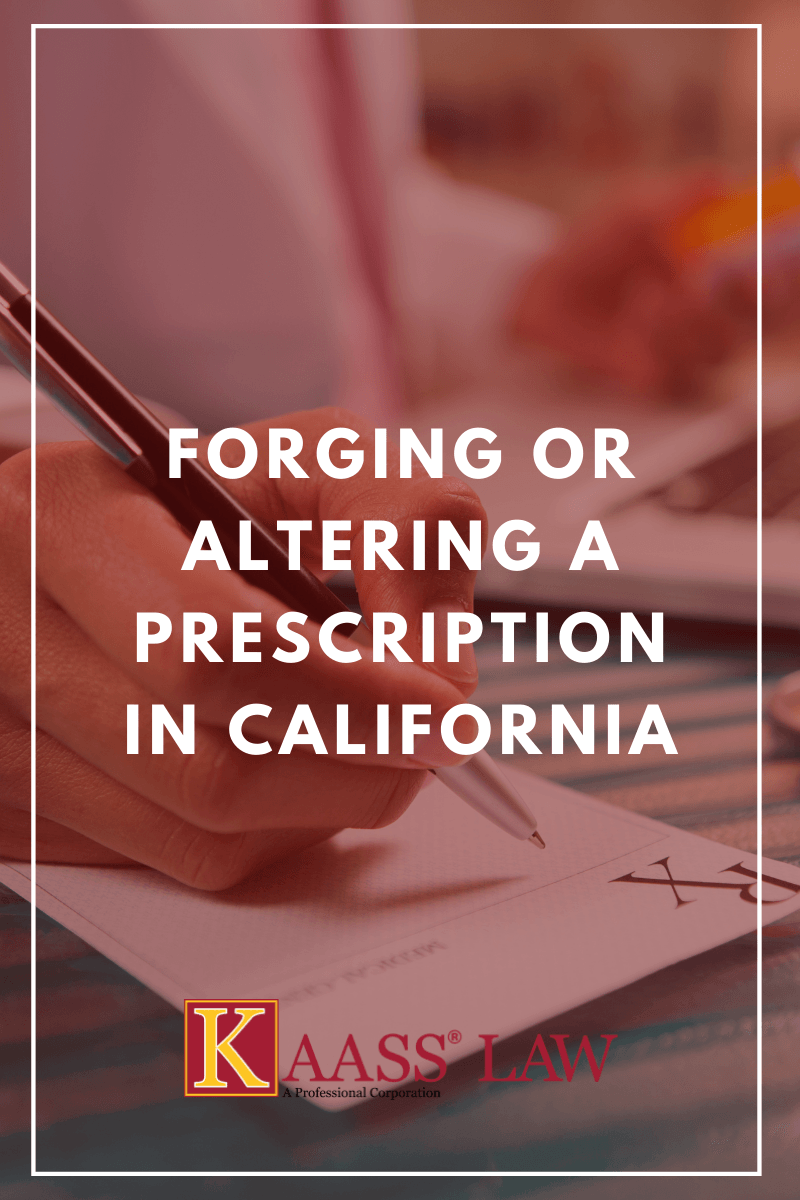
Prescription drugs play a vital role in managing health conditions, but they can also be misused and abused. California law takes a strong stance against prescription fraud, including forging or altering prescriptions. These actions not only endanger public health but also carry severe legal consequences. At KAASS LAW, we understand the complexities of prescription drug laws and are committed to providing accurate legal information and representation. The following will explore the legal ramifications of forging or altering a prescription in California, outlining the potential charges, penalties, and defenses.
Under California Business and Professions Code Section 4324 it is illegal to forge or alter a prescription, or possess drugs acquired through a false prescription. It is a crime in California to forge a prescription or make an attempt to gain possession of prescription drugs. However, in case a person actually got medication as a result of forging a prescription, he will be also liable under Business & Professions Code Section 4324(b). A person can be convicted of both offenses i.e. forging the prescription and obtaining the medication through false prescription.
Unemployment insurance fraud occurs when an individual provides false, incomplete or misleading information, intentionally conceals facts or provides wrong identification for obtaining, increasing or denying benefits.
In California the Employment Development Department (EDD), which is a combination of both state and federal programs, is managing unemployment benefits system.
California unemployment insurance assists people who become unemployed through no fault of their own to keep financial security while they seek new job. There are some circumstances under which a person can qualify for benefits.
A person can recover a maximum of $450 per week and the program can’t last more than one year.
In California both employees and employers can be accused of committing unemployment insurance fraud.
Under California Welfare and Institutions Code Section 10980 welfare fraud is an act of unlawfully obtaining welfare benefits from the government by intentionally submitting false information or withholding relevant information or.
According to California W&I Code 10980, defendant can commit welfare fraud in different forms, including:
Generally California welfare fraud can be classed to two main types: recipient welfare fraud or internal fraud.

California Penal Code Section 332, gaming fraud or gambling fraud is obtaining another person’s money or property through use of any game, device, sleight of hand, pretensions to fortune telling, trick or any instrument. Gaming or gambling fraud falls under and is considered as theft crime in California.
The California Penal Code, under section 332 establishes the elements that the prosecution must prove to a conviction someone of this crime, the main requirements are the following:
Prosecution must prove the following elements beyond a reasonable doubt for convicting a person of fraudulent gaming:
California Penal Code Section 550(a) covers and defines healthcare fraud, which sometimes is also referred to as health insurance fraud and medical billing fraud. Healthcare fraud is submission of false claims or disinformation of healthcare insurers about care or services that may or may not have been provided. Penal Code Section 550(a) lists a range of unlawful conduct and here are some examples that could lead to California health care fraud charges:
California law allows persons to recover damages for intentional fraud as well as negligent misrepresentations if certain elements are sufficiently plead and proved.
There are specific elements that a party is required to prove in order to successfully recover damages suffered due to the fraud or misrepresentation. A false misrepresentation lawyer near you should be able to provide you with legal assistance for your situation.
Fraud is using deceit or dishonest means for the purpose of depriving another of money, property or a legal right.
Intentional Fraud/ Deceit occurs when the defrauder uses deceit or false important facts to convince the victim to rely on the false facts. Then the victim reasonably relied on and was harmed by the deceit.
Promissory Fraud occurs when the defrauded makes a promise that is important to the transaction that he or she never intends to, nor never performs, in order to induce the victim to rely victim rely on the promise. Then the victim must reasonably rely on and be harmed by the false promise. “An action for promissory fraud may lie where a defendant fraudulently induces the plaintiff to enter into a contract.” ( (1997) 15 Cal.4th 951, 973-974; (1985) 39 Cal.3d 18, 30.)
The prosecution must prove the following elements to convict the defendant of forging or altering a prescription:
Prescription forgery is the use of a falsified prescription for purchasing drugs illegally. Forging or altering a prescription is making, publishing, uttering, passing, or attempting to pass a prescription for drugs or possessing drugs acquired by a false prescription. Attempting to transfer another person a falsified prescription, even if you didn’t actually write it, is also a crime.
Prescription is an instruction to provide drugs, either by phone, through writing, or through electronic communications (i.e., facsimile). Generally, a valid prescription must include the following information:
The term “drug” under California Business and Professions Code Section 4025 include:
The defendant is guilty of falsely uttering a prescription in situations where the defendant:
Some common defenses to charges related to forged prescriptions
Business and Professions Code section 4324 forging or altering a prescription is considered a "wobbler offense". As such, the offense can be charged as either a misdemeanor or a felony, depending on the defendant’s criminal history, as well as other factors.
Penalties for misdemeanor Business and Professions Code 4324 conviction include:
Penalties for felony Business and Professions Code 4324 conviction include:
Furthermore, additional penalties a defendant can face include the following:
If you're facing charges for prescription fraud, it's crucial to have experienced legal representation. A skilled criminal defense attorney can:
At KAASS LAW, we understand the serious consequences of prescription fraud charges. Our attorneys dedicate to protecting your rights and fighting for the best possible outcome in your case. If you are under accusation with forging or altering prespeciptions, contact us today for a free consultation. We'll review your case, explain your legal options, and develop a strong defense strategy to protect your future. Moreover, any matters involving a wrongful death due to prescription drugs, please contact us today.
[embed]https://www.youtube.com/watch?v=6uRUMZSCoLI[/embed]
Here are some examples of unemployment insurance fraud committed by employees:
Employers are committing unemployment insurance fraud when they try to deny benefits to a former employee for defrauding the EDD, these include:
The California EDD collects information mostly from public fraud report hotline and their field offices that gather unemployment fraud applications.
After gathering information EDD assigns alleged cases to a special investigation unit. In case unit manages to find adequate evidence that fraud has taken place they are will file unemployment insurance fraud charges. If they don’t get enough evidence they will drop the case or work for obtaining further information.
Unemployment insurance fraud is considered a wobbler and can be charged as either a misdemeanor or a felony, based on the case circumstances, the amount of the fraud and the defendant's criminal history. Defendant can be charged either under Unemployment Insurance Code Section 2101 or California Penal Code Section 550 (PC 550).
Pursuant to the California Unemployment Insurance Code Section 2101 (a): It is a violation of this chapter to willfully make a false statement or representation, to knowingly fail to disclose a material fact, or to use a false name, false social security number, or other false identification to obtain, increase, reduce, or defeat any benefit or payment, whether for the maker or for any other person, under any of the following statutes administered by the department:
Penalties for misdemeanor conviction for violating Unemployment Insurance Code Section 2101 include the following:
Penalties for felony conviction for violating Unemployment Insurance Code Section 2101 include the following:
In case the total amount of the fraud is $950 or less the crime is considered a misdemeanor, punishable by:
In case the total amount of the fraud is more than $950 the crime is considered wobbler.
Are you in need of legal assistance as a result of being charged for unemployment insurance in California? A criminal defense attorney in your area may be able to provide you with the help that you need.
Recipient fraud involves any attempt to receive, secure, retain, or increase a benefit by means of submitting wrongful, incomplete or misleading information. Recipient fraud examples include:
Internal fraud is committed by an employee of a government welfare agency. This occurs when the workers are unlawfully disbursing welfare benefits to themselves, their family members or friends.
Prosecuting agencies in California receive welfare fraud cases from different sources, as public hotlines and websites, local agencies and any other agencies that suspect welfare fraud. Welfare fraud investigations start from gathering evidence and information in welfare fraud cases, including:
The investigator presents relevant information to a deputy district attorney who will determine whether a criminal filing is appropriate or not. District attorney can do one of the following:
According to California WIC Section 10980, welfare fraud is a wobbler and can either be filed as a misdemeanor or felony crime and the type of charges depend of the value of benefits defendant’s criminal history.
In case the defendant made false or misleading statement for obtaining benefits, he will face:
Defendant will be convicted for feeling fraudulent application in case:
Fraudulent application can be charged as a misdemeanor or felony offense. Penalties for felony Welfare and Institutions Code 10980 conviction include:
Penalties for misdemeanor Welfare and Institutions Code 10980 conviction are the following:
In case the total value of the benefit is $950 or less obtaining or retaining fraudulent benefits is a misdemeanor, and is punishable by:
In case the total value of the benefit was more than $950, the defendant will face felony, punishable by:
Selling, buying, or misusing food stamps is a misdemeanor in case the amount involved was $950 or less, punishable by
In case the value is more than $950 the defendant will face felony, punishable by
People convicted of welfare fraud may lose their professional license, job, become disqualified to receive future welfare benefits.
Our California welfare fraud defense lawyers are here to answer any questions If you or a loved one has been charged with Welfare and Institutions Code 10980 and you would like to discuss your case confidentially with one of our criminal defense lawyers at (310) 943-1171.
Acting fraudulently means acting dishonestly and with bad faith, as cheating, misleading and otherwise gaining an unfair advantage for the victim. In case a person won in a game, without playing tricks he can’t be guilty of game fraud. Defendant must be involved in a game where the victim doesn’t have a chance to win as a result of the game. An important element of the legal definition of gaming/gambling fraud is that the defendant must win money or property from the victim.
California Penal Code Section 332 acknowledges that games do not always include cash, or other tangible property. Property for purposes of Section 332 includes chips, markers, tokens, or anything else which has a monetary value.
Common legal defenses to California Penal Code 332 include the following:
Prosecution shall be able to prove is that the defendant had a specific intent to defraud the victim. In case the defendant lacks of fraudulent intent, he can’t be found guilty of this offenses.
If the offense was through the fortune telling or any other similar activity then a first amendment defense can be used, and the defendant can argue that he was exercising his right to free speech. Though, there can be circumstances when fortune tellers can be criminally liable under this statute in case their conduct goes beyond entertainment and actually involves fraud.
Potential penalties for California Penal Code 332 gaming or gambling fraud depend on the monetary value of the property that the defendant obtained from the victim. If the money or the total value of the stolen property is $950 or less the gaming/gambling fraud can only be charged as a misdemeanor. In case the total value of the property is more than $950 then the fraud is treated as a wobbler and can be charged as either a misdemeanor or a felony.
Potential penalties for misdemeanor Penal Code 332 gaming or gambling fraud conviction in California include the following:
Potential penalties for felony Penal Code 332 gaming or gambling fraud conviction in California include the following:
Our California gambling defense lawyers are here to answer any questions If you or a loved one has been charged with Penal Code 332 PC gaming or gambling fraud and you would like to discuss your case confidentially with one of our California criminal defense attorneys, do not hesitate to contact our criminal defense lawyers at (310) 943-1171.
To convict a person in health care fraud, the prosecutor has to do prove his engagement in one of the unlawful behaviors described in Penal Code Section 550(a) and also two additional elements of the crime.
These types of crimes are usually committed by health care providers including chiropractors, physical therapists, nurses, nurse practitioners, dentists, and administrators. If convicted of health care fraud, professional licenses can be suspended or revoked.
In California penalties for health care fraud depend on the amount of the fraudulent claim. Health care fraud claims of $950 or less. In case the claim is $950 or less then the health care fraud is a misdemeanor.
Penalties for misdemeanor medical and or health care fraud depend on the amount of the fraudulent claim, but may include the following:
In case the fraud was more than $950, then the crime of health care fraud is considered a wobbler. The defendant can be charged with either a misdemeanor or a felony conviction. Penalties for a misdemeanor conviction are:
Penalties for felony medical and or health care fraud include the following:
In case the charges involve more than one claim, then the key question is whether all the claims add up to more than $950 in twelve months period.
Hire the most dedicated California medical fraud defense lawyer to help defend and fight your Penal Code 186.10 charges. Our attorneys at KAASS LAW are highly dedicated to help our clients in every way possible. You can rely on our experienced lawyers in Glendale, Los Angeles, California, to carefully analyze the facts of your case to prove the facts necessary. We back all of our clients and we invite you to give us a toll free call at (310) 943-1171 to speak to our experienced Glendale criminal battery attorney today. Get in touch with us at KAASS LAW, 815 E Colorado St #220, Glendale, CA 91205, (310) 943-1171 at any time.
Concealment Fraud occurs when there is a fiduciary or other relationship between the parties where there is a duty of full disclosure. The concealing person, with an intention to deceive, does not disclose important facts that the concealing person knows but the victim does not and could not know. Further, the victim reasonably relied on and was harmed by the concealment.
Constructive Fraud or Negligent Misrepresentation occurs when the perpetrator misrepresents to the victim that an important false fact is true. However, the defrauder may have honestly believed that the false representation is true. Yet, the defrauder had no reasonable grounds for believing the representation was true when he or she made it; and he or she intends that victim rely on the representation. The victim must reasonably rely on and be harmed by the false representation.
In proving intentional fraud in California it requires all of the following elements be proved:
“An action for promissory fraud may lie where a defendant fraudulently induces the plaintiff to enter into a contract.” (Engalla v. Permanente Medical Group, Inc. (1997) 15 Cal.4th 951, 973-974; Tenzer v. Superscope, Inc. (1985) 39 Cal.3d 18, 30.)
Negligent misrepresentation often times referred to as constructive fraud requires that all of the following elements be proved:
California Fraud and Misrepresentation Laws Video
Our misrepresentation and fraud attorney in Los Angeles has experience in complex fraud and misrepresentation cases. If you are an individual victimized by a corporation's commercial deception we welcome you to call to us at (310) 943-1171. Our proven litigators and investigators at KAASS Law will help you with your corporate fraud case.