

It is highly dangerous work to deal with asbestos and underground tank works, which can cause big property damages and serious health injuries if not done correctly. A person (including a licensed contractor) who performs asbestos-related work without certification, or who installs or removes an underground storage tank without certification, is in violation of California's Business and Professions Code 7028.1 BPC.
Asbestos is a high heat resistant fibrous silicate mineral. An underground tank is "a tank and or any underground piping which is connected to the tank, and at least 90 percent of the combined volume of which is underground." Such tanks are usually used to store petroleum and other similar materials. California Business and Professional Code, with its section 7028.1, makes it a crime for a contractor to perform the following actions:
According to the text of the law, it does not matter whether you are a licensed or a non-licensed contractor; you shall be certified to conduct the works mentioned above, as your license does not automatically enable you to conduct asbestos-related or underground tank works.
The above-mentioned section is a misdemeanor. In case you commit the violation for the first time, it can result in:
If you violate the relevant section for the second or subsequent time, this can lead to:
In accordance with the aforementioned sanctions, the judge has the authority to grant probation to the defendant.
Under the California Business and Professional Code, among the related offenses is contracting without a license under section 7028 of the Code. The relevant section makes it a crime for the person to:
The offense is a misdemeanor offense and has these charges:
There are several defenses you can raise to protect yourself from further penalties under the relevant section. Examples of such defenses will be if you were not a contractor while performing the forbidden actions. This means you have not entered into a contract to perform these activities. This defense may work as section 7028.1 applies only to contractors. It can also be if you have not committed the actions knowingly. For example, you touched upon asbestos in the middle of the performance of other types of work, you performed actions not understanding that you are currently dealing with the mentioned material. You can also use types of such defenses as proving that the police applied overbearing measures to coerce you into confession, with the help of which the judge may exclude the confession from other evidence. It is also possible to try to prove that you are falsely accused of violating section 7208.1 of the California Business and Professional Code.
When dealing with hazardous materials such as asbestos and underground storage tanks, it’s critical to understand the legal requirements in California. The certification ensures that workers have the knowledge and skills necessary to handle these dangerous substances safely, preventing health risks and property damage. Certification also guarantees compliance with state laws, which aim to protect workers, property owners, and the environment. Without proper certification, individuals may face legal penalties, including fines or jail time. Thus, obtaining proper certification is not just a legal necessity but also an ethical responsibility to ensure safety.
Learn more about California’s Contractor Certification
To avoid violations under Section 7028.1, contractors must prioritize staying informed about certification requirements for asbestos and underground tank work. Ensure all employees involved in such projects are properly certified and meet the necessary safety standards. Contractors should regularly review the latest regulations and training opportunities to maintain compliance. Additionally, it’s crucial to avoid unlicensed work, as operating outside of these boundaries can lead to severe legal consequences. A proactive approach can help prevent penalties, fines, and potential jail time while ensuring safety and legal integrity in all projects.
Note that it is essential to have a good defense to mitigate or even dismiss a charge against you. Contact our Glendale personal injury lawyer today for a consultation and case review. Please feel free to give our office a call at 310.943.1171.
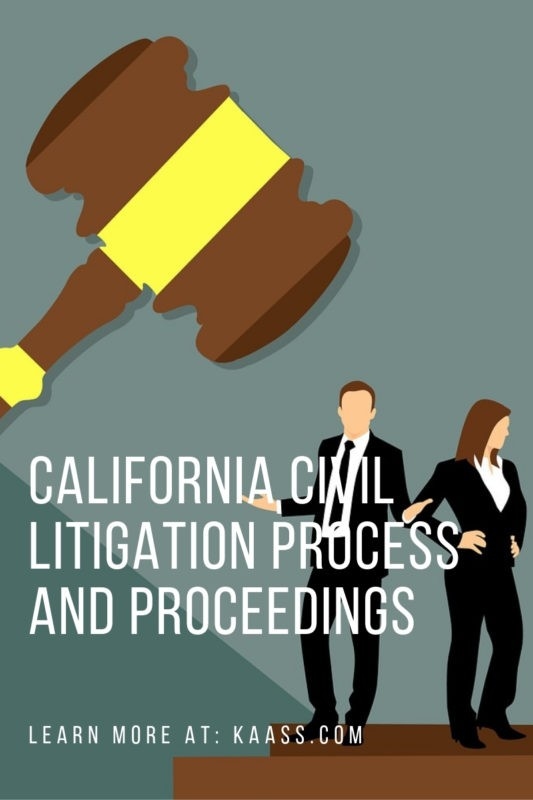
California civil litigation proceedings help resolve private conflicts between people, businesses, and/or the government in Government Tort Claims actions. Litigation is one of the most fundamental aspects of law. It refers to the formal process of resolving legal disputes by filing or responding to complaints through the public court system.
What most people tend to think of when they think about lawyers and courts is typically not very representative of what actually goes on. The classic Law and Order portrayal of law in Hollywood, albeit very immersive and dramatic, does not give a realistic overview of what the legal process entails, or how one goes about it.
A much more reasoned approach to understanding how the legal process works, would be to simply take a look at the process of taking legal action, or litigation. In any case, the process begins when someone files suit. Typically, the plaintiff begins this process when they file a formal complaint with the clerk of the court. At this point, the defendant must be notified that a lawsuit was filed against them, so as to give them the proper notice before a court date. The defendant must then figure out their strategy to deal with the lawsuit and so usually a lawyer or firm gets hired on to help with legal counsel and representation. Then, the court establishes personal jurisdiction and a location is finalized for the court that will have authority over the complaint.
California law allows persons to recover damages for intentional fraud as well as negligent misrepresentations if certain elements are sufficiently plead and proved.
There are specific elements that a party is required to prove in order to successfully recover damages suffered due to the fraud or misrepresentation. A false misrepresentation lawyer near you should be able to provide you with legal assistance for your situation.
Fraud is using deceit or dishonest means for the purpose of depriving another of money, property or a legal right.
Intentional Fraud/ Deceit occurs when the defrauder uses deceit or false important facts to convince the victim to rely on the false facts. Then the victim reasonably relied on and was harmed by the deceit.
Promissory Fraud occurs when the defrauded makes a promise that is important to the transaction that he or she never intends to, nor never performs, in order to induce the victim to rely victim rely on the promise. Then the victim must reasonably rely on and be harmed by the false promise. “An action for promissory fraud may lie where a defendant fraudulently induces the plaintiff to enter into a contract.” ( (1997) 15 Cal.4th 951, 973-974; (1985) 39 Cal.3d 18, 30.)

A stock purchase agreement, or an SPA for short, is an agreement that a company or its shareholders and buyers sign whenever shares of a company or corporation get bought or sold. Stock Purchase Agreements are used most often by smaller corporations when selling their stock publicly to create a certain amount of trust and security between buyer and seller. Both the company itself or its respective shareholders can sell stock to potential buyers. That’s where Stock Purchase Agreements come in very handy as their purpose is to protect you, regardless of whether you’re the buyer or the seller.
It’s important to know that a stock purchase agreement is not the same things as an asset purchase agreement, or an APG. The main difference is that stock purchase agreements only sell shares of a company in order to raise money or to transfer ownership of shares while asset purchase agreements aim to finalize company asset sales. Namely, the stock purchase agreement will outline several key points:

There are many reasons why you might want to incorporate your business. Forming a corporation helps to protect your personal assets from liability on account of your business’s debts and transactions. Furthermore, a corporation can protect you as an individual in the event that a business partner or employee is found guilty of a crime. If this is the business organization model you choose, there are several steps you will have to take in order to finish the incorporation process. Firstly, let’s start with naming it.
This part is one of the most important things you can do for your business. A good name is key because it will help with good product promotion and branding. However, the state you file for incorporation must also be okay with your chosen name. This usually means that the name must not already be taken by another corporation that is registered in your state and that the name is distinct enough from other corporations’ names that it would not bring up issues of copyright. Your chosen name can (but does not have to) include the words “Incorporated”, “Corporation”, “Limited” or any abbreviated version of them. Furthermore, your chosen name cannot be misleading to customers, nor can it contain any offensive or controversial words. It is possible to check to see whether your name of choice is already taken by another corporation online by visiting an online entity name checking service, or by sending a name availability inquiry letter to the Secretary of State’s office. Lastly, you can reserve your name by filing a name reservation request form, which just requests that the Secretary of State hold your chosen corporate name for no more than 60 days while you finish the filing process.

A contract is an agreement to do or not to do a certain thing. Recovering damages for breach of contract, the plaintiff must prove all of the following:
If you entered into a contract and you fail to abide by the terms of the agreement. Consequently, you may face the likelihood of having a lawsuit against you. If a party contracts with you and does not fulfill the terms of the agreement. In return you may also have the right to seek legal remedy and likewise file suit against the breaching party.

Regardless of whether you own an business with a family member, a friend, or hold a position on the board of a large corporation, you know that business and contract disputes can often times cause major problems. Specifically, business owners that face contract disputes with other companies and even more so, between their own ownership structure. For instance, a business contract dispute may arise between two or more partners, when one partner fails to fulfill his responsibilities. Often times business owners do not anticipate disputes until they arise. As a result, income might be lost due to contract breaches; ownership might be in the limbo due to outside lawsuits and claims; and tensions amongst business owners may rise. Lastly, a California business that is facing a lawsuit must be represented by an attorney. As such, a business owner cannot represent themselves in pro per.
As a matter of course, each general partner has an equal right to take part in the . Disputes in the ordinary course of business are decided by a of the . While, disputes or disagreements of or any to the . Be that as it may, in an partnership of any size the will provide for certain electees to manage the partnership along the lines of a company board. Generally, unless otherwise provided in the , no one can become a partner of the However, an existing partner may transfer partnership interests and assign his share of the profits and losses and right to receive distributions.
Bear in mind that most of this process is heavily bureaucratic and involves many back and forth between the two parties. To avoid some of the confusion, both parties must meet and discuss with each other the nature of the case. This is done to determine specific issues, points of disagreement, to broach the possibility of settlement, and to start making plans for discovery and disclosure. In fact, depending on the case, discovery and disclosure can very easily end up taking up a huge chunk of time because during this period, both parties must disclosure to one another the various pieces of information they are planning on submitting and using as evidence in court. If the case ends up having many different pieces of evidence, then the discovery and disclosure period will be very lengthy, and yet also very important too.
This period is one of the few in which both parties must be completely open and honest with one another, and therefore it marks an excellent opportunity for a good lawyer to get enough insight as to how the opposing side is going to approach the conflict. By seeing the evidence that the opposition plans to use against you, you can formulate a general picture of their plan so that you can begin countering it with yours. As such, this step in the legal litigation process is absolutely crucial for both sides.
Once both sides have had their turn to see the other side’s evidence, the court will move to schedule an early pretrial conference. There, at the pretrial conference, both sides meet in a courtroom in front of a judge, who facilitates a discussion of the issues of the case. This discussion is important to have because some cases are not suited to go on trial since there may be a lack of material issue of dispute or disagreement between the parties. Other cases are just simply ambiguous and some clarification is needed for the judge to determine what the key problems are and whether or not those issues can be resolved through trial. As such, the judge will ask questions to both sides so as to clarify the actual points of contention for each party.
After that, the defendant has the ability to file motions and answers, the first of which aims to dismiss or otherwise discredit the plaintiff’s accusations and the latter of which acts as a response to the initial complaint made by the plaintiff. Either way, these motions can be absolutely crucial to the success of the defendant in court because they can make huge strides by eliminating several avenues of argumentation that the plaintiff or prosecutor may use in court. Past this period, both parties once again disclose documentation and the discovery process moves forward; both parties now have another opportunity to file for more motions and finally the court will hold one last pre-trial conference. After all of that has been said and done, the court conducts the trial.
During the trial is when most, if not all, of the action that you see on TV actually takes place. As you can see, there is a lot more to the story that happens leading up to the day of trial and even during the trial the proceedings take place in an organized manner. At the end of the trial, the court decides upon and files its judgment. Once this takes place, post-trial proceedings, such as appeals, can be made. If either party chooses to appeal, they have another opportunity to present their case, which may or may not sway the final decision. Appeals are considered on the basis of briefs or oral arguments which to serve to demonstrate why the judgment that was rendered was unjust or inadequate, as well as to propose another judgment that the court can implement instead.
Finally, the last ruling or verdict is made, which is typically by a jury, and judgment is enforced. This means that whatever the court decides must get carried out and at this point the litigation process finally concludes. This coverage and overview of the litigation process aims to illuminate the various steps, proceedings, and protocols that go into the work that gets put into any given lawsuit case. Folks who work in the legal world all must understand and abide by the legal process and as such litigation is the cornerstone of how our society enforces laws and renders justice. At
KAASS LAW's civil litigation lawyers are well-aware have litigated and tried numerous cases in various areas of law. We believe that going the extra mile to educate and raise awareness will always pay dividends in the end. As such, we are always available to answer and to clarify any questions or concerns our clients may have regarding their case, and it is also why we do pro bono work. If you have any questions concerning a legal matter, feel free to reach out to us at (310) 943-1171 to speak to our experienced litigators today. We will give you the insight, confidence, and security you need to win your case.
Concealment Fraud occurs when there is a fiduciary or other relationship between the parties where there is a duty of full disclosure. The concealing person, with an intention to deceive, does not disclose important facts that the concealing person knows but the victim does not and could not know. Further, the victim reasonably relied on and was harmed by the concealment.
Constructive Fraud or Negligent Misrepresentation occurs when the perpetrator misrepresents to the victim that an important false fact is true. However, the defrauder may have honestly believed that the false representation is true. Yet, the defrauder had no reasonable grounds for believing the representation was true when he or she made it; and he or she intends that victim rely on the representation. The victim must reasonably rely on and be harmed by the false representation.
In proving intentional fraud in California it requires all of the following elements be proved:
“An action for promissory fraud may lie where a defendant fraudulently induces the plaintiff to enter into a contract.” (Engalla v. Permanente Medical Group, Inc. (1997) 15 Cal.4th 951, 973-974; Tenzer v. Superscope, Inc. (1985) 39 Cal.3d 18, 30.)
Negligent misrepresentation often times referred to as constructive fraud requires that all of the following elements be proved:
California Fraud and Misrepresentation Laws Video
Our misrepresentation and fraud attorney in Los Angeles has experience in complex fraud and misrepresentation cases. If you are an individual victimized by a corporation's commercial deception we welcome you to call to us at (310) 943-1171. Our proven litigators and investigators at KAASS Law will help you with your corporate fraud case.
Finally, prior to reaching a lasting agreement, a letter of intent, or LOI, must be produced by the seller, explaining the proposed sale at length. It’s up to the buyer to have the presence of mind to make sure that the purchase agreement contains the same terms as the LOI does to avoid any future discrepancies which may arise.
Stock purchase agreements get broken up into several sections that aim to define what certain terminologies mean and to describe how the transaction process works. The contents of a stock purchase agreement will typically resemble the following:
The first part of a stock purchase agreement is called the preamble. In it, the agreement is formalized and the respective parties are identified as well as the date of the contract and purchase. Typically, parties are referred to as either “seller” or “purchaser”. After these key points of information get stated in the preamble, the next section begins and it is normally called the Recital. This part serves as the main meat and bones of the agreement outline.
The definitions section is the first article on most stock purchase agreements as it defines certain key terminologies and phrases which will get used all throughout the agreement. All of the relevant terminology that gets defined will be either boldfaced or capitalized and they will usually be listed in alphabetical order. The attention to detail with the terminology definitions is very crucial, because while it can be very tempting to skip through this section, understanding exactly what these terms mean in the context of the purchase agreement is key since it can drastically impact the meaning of the agreement. Therefore, you really should take the time to read through the whole section so as to familiarize yourself with the wording and its meanings within the agreement. In particular, words such as “liabilities”, “material adverse effect”, and “seller’s knowledge” can all have huge effects on the contract just depending on how they are defined in a particular context.
In this part of the agreement, the exact terms of the sale will be outlined at length. It will contain a part that refers to the seller transferring ownership or selling to the purchaser or the buyer acquiring from the seller some specified amount of shares. Further, the purchase price and any adjustments made to it will be clearly shown here, including:
In this segment, the seller’s warranties are stated expressly and get defined. Untruthful or incorrect representations of warranties can result in the liability of whichever side made the statements. This may include statements concerning past and future facts related to the business, such as:
For the most part, this part of the agreement is identical in function to the previous section, except that it focuses on the warranties and representations from the buyer’s side. Oftentimes, these two sections mirror each other quite closely. Since the buyer usually pays cash for the stock, their warranties may be more limited than the seller’s.
Most deals have a set time frame from when the parties agree to sign off and the actual closing. Because of this limitation, the covenants segment of the agreement outlines things that each party should avoid doing during that time frame. Typically, this translates into a long list of actions that need to happen during that time period in addition to some actions which are outright prohibited until the closing of the arrangement.
This part of the agreement is comprised of terms and conditions that either need to be met or waived prior to the time that the arrangement closes. These conditions often include both sides carrying out their pre-closing covenants and ensuring that all terms are fulfilled.
Article seven aims to clarify indemnification rights by stating the terms whereby the other party gets compensated just in case one party breaches their contract. It will also typically include a section discussing the losses that may arise from specific cases. You can expect this section to talk about:
In the eighth article, you’ll encounter details about each party’s right to terminate the contract. This will typically cover some of the follow reasons for termination:
The final section of an agreement will always end with a section that goes over any miscellaneous provisions. These provisions touch base on several subjects, like:
Stock Purchase Agreements matter because they articulate the terms of a sale and they put it into writing. They can prevent arguments or misunderstandings that would otherwise end up in court. Furthermore, the agreement also gives the buyer more faith in the transaction since the seller has the chance to describe why they are selling. Lastly, it also details other important details, such as warranties, dispute resolution means, and covering costs when unexpected problems cause loss.
Admittedly, there are few situations where having a Stock Purchase Agreement wouldn’t be useful, such as:
Even then, however, an SPA can only help, never hinder you.
There are a few instance as to why a Stock Purchase Agreement is crucial to use, which may include the following situations:
Some common mistakes that people make is thinking they don’t need to make a Stock Purchase Agreement because the person they’re selling to is someone known. That decision affects your whole company, so there’s no room to leave things to chance or faith. Similarly, simply filling out a pre-made stock purchase agreement template from the internet is probably not a great idea either as it likely won’t contain all of the relevant clauses needed for your business. It’s always best to have legal professionals craft your document after meeting with you to assess the individual needs and interests of your business. That’s where we can help you.
We have extensive experience with drafting and filing Stock Purchase Agreements for our clients. We invite you to give us a call at (310) 943-1171 to speak to a California corporate attorney today. Our lawyers in Glendale, Los Angeles County, California, will ensure that your transactions are always in your best interest.
KAASS LAW, 815 E Colorado St #220, Glendale, CA 91205, (310) 943-1171
KAASS LAW is authorized to practice law in California. The above content is intended for California residents only. This content provides only general information which may or may not reflect current legal developments. KAASS LAW expressly disclaims all liability in respect to actions taken or not taken based on any of the contents of this website. The above content DOES NOT create an attorney-client relationship. KAASS LAW does not represent you unless you have expressly retained KAASS LAW in person at the KAASS LAW office. KAASS LAW helps clients in: Los Angeles, Burbank, Hollywood, Glendale, Van Nuys, North Hollywood, Studio City, Highland Park, Eagle Rock, Sunland, Tujunga, Sylmar, San Bernardino, La Crescenta, La Canada, Beverly Hills, Westwood, Santa Monica, Brentwood. Pacoima, Montebello, Commerce, Alhambra, Downey, Bell, Maywood, Walnut Park, Vernon, Lynwood, Echo Park, Silverlake, Mission Hills, Northridge, Woodland Hills, Encino, Canoga Park, North Hills, Porter Ranch, Chatsworth, Reseda. Get Directions on Google Maps
Next, California corporation's have to prepare and file your Articles of Incorporation to the Secretary of State’s office. These documents are what the state will use to establish your corporation as a business entity. The articles must contain the name of the corporation, its purpose, the name and address of a registered agent, the street address of the corporation, the amount of shares that the corporation is authorized to issue, and the signatures of the incorporators. As it pertains to outlining the shares of the corporation, your Articles of Incorporation must account for some specifics. If the corporation will have only one class of shares, then the articles of incorporation must list out the total amount of shares that the corporation is authorized to issue. On the other hand, if the corporation is to have more than one class of shares, then the articles must account for the total amount of authorized shares in each class, the designation of each class, and the rights and restrictions that may apply to each class.
In California, every corporation must have an agent for service of process in the state. This agent has to be a person living in California or corporation that has registered within the Secretary of State’s office as a corporation. The registered agent agrees to receive legal papers on the corporation’s behalf, in the event that legal action is taken. A corporation cannot be its own registered agent. Lastly, note that the registered agent, be it person or corporation, must have a physical address, meaning a PO box is not sufficient. Next up, you’ll want to set up your records book. California Corporations Code 1500: It Pays to Keep Receipts Pursuant to California Corporations Code 1500, your corporation must keep track of important internal information. For this reason, you must set up a corporate record book (physical or virtual), in which you document important corporate paperwork, including minutes of director and shareholder meetings, stock certificates and stubs and shareholder information. Once again, this record must be quite extensive and thus the information it contains is also highly sensitive. It is vital to ensure that the physical and cybersecurity of the record book is of a high standard. It may pay dividends to see our in-depth article about your options for corporate bookkeeping here.
After you’ve taken care of the method of record keeping, you’ll then need to specify the people who are applying to form the corporation. California law allows for one or more persons, corporations, partnerships, or associations to form a corporation. The people who apply to form the corporation are called incorporators and they are responsible for filing the articles of incorporation. The incorporators should also elect directors and officers, and agree upon corporate bylaws. Upon selecting directors, the incorporators have no further responsibilities. The requirements for specifying incorporators are that the corporation must have at least one incorporator and that their name(s) be listed on the articles of incorporation.
Once the incorporators have named the directors, your new directors will have the responsibility of setting and carrying out corporate policy. From then on, those directors have fiduciary duty to the corporation and its respective shareholders, which ensures that they must always act in the corporation’s and the shareholders’ best interests. The requirements for specifying directors for your corporation are only that there must always be at least one director and that the maximum amount of directors is proportional to the maximum amount of shareholders.
After your corporation has specified its directors, California law requires that your corporation state its purpose. While a statement of purpose may not sound particularly complicated, it is actually a very nuanced part of the procedure to forming your corporation. The reason for this is that you would ideally want to leave the purpose statement as vague as possible so as to cover as much breadth and scope as possible. This would enable your corporation to operate within all possible boundaries of the law as it pertains to business. Therefore, it’s imperative to use generic language for your corporation’s purpose statement. For this part, having legal counseling is particularly useful because a seasoned business lawyer will know the best way to word and compose such statements.
Lastly, the final thing you will want to do is to draft up and sign off on corporate bylaws with the incorporators and directors of the corporation. The irony is that this crucial document is not actually required to be submitted to the Secretary of State’s office like the rest of the Articles of Incorporation are, but they are nonetheless vital to have for the smooth upkeep and maintenance of your corporation. This is because incorporation bylaws describe how the company will conduct its operations, how directors and officers are to be appointed, their duties and the manner by which executive meetings take place. It is required that you have your corporate bylaws handy at the corporation’s headquarters. They must also specify whether there is a maximum limit to the amount of directors the corporation can have, or whether that maximum will be determined later by a board or shareholders. It’s also worth noting that there can’t be anything illegal written into the bylaws because state and federal law supersede its authority. Bylaws are also extremely useful for showing that your corporation is legitimate to potential investors and to the IRS.
The process of forming a corporation can be daunting and tedious, but you do not have to face it alone. As alluded to earlier, experienced business lawyers can greatly speed up and smoothen the process of formalizing your corporation as a legal entity. Our team of California business lawyers have many years of experience with the process and can help your company achieve corporation status quickly and effectively. We invite you to give us a call at (310) 943-1171 to see how a Glendale corporate formation lawyer can help. Our lawyers in Glendale, Los Angeles, California, are dedicating to providing the highest quality legal services for all of our clients.
It is important to remember that a California business owner cannot represent themselves in a lawsuit as pro per, this is because in California, a California business that is facing a suit or wish to file a lawsuit against another must be represented by an attorney. Please review all the provisions in the contract to ensure you don't file a frivolous lawsuit against the other party. Often times contracts can be confusing and thus require the assistance of a business law or contract attorney. Breach of contract can occur in many different ways, such in business service contracts, employment contracts, or business partnership contracts. If you believe that another party did a breach in their terms or didn't fulfill the terms under a contract it is important to speak to a experienced business lawyer, to ensure you rights and remedies are protected.
Businesses can dissolve the entire or part of a company by engaging in the "winding up" or "dissolution" process. The winding up process is subject to a strict legal rights of its partners, as well as creditors and claimants. Terminating a California business, often times involves a "liquidation process", where the company begins to wind-up affairs, pay debts, and dissolve. Furthermore, there are special procedures for dissolving corporations that are undergoing Chapter 7 bankruptcy, or have disposed of all assets, and not conducted any business for the last five years.
During the winding-up process is subject to strict legal rights of the shareholders, thus must be both "just and equitable" Thus, to ensure that all issues are considered and addressed appropriately, its is recommend to that you consult with California corporate attorney prior to submitting termination documents to the California Secretary of State. If you wish to dissolve or terminate your corporation, we invite you to contact our Glendale business corporate lawyers and discuss the proper legal steps you must take in order to property terminate your California corporation. Under California’s General Corporation law (“GCL”) shareholders holding shares with at least 50 percent of the voting power can voluntary elect to dissolve the corporation. It is important that you review your articles of incorporation and bylaws, and speak to a experienced Glendale business lawyer, to ensure that you are following the proper dissolution procedures specifically for your corporation. If a all members have approved that dissolution, your corporation continues to exist only for the purpose of taking care of final matters. As such, all board members have full power to wind up and settle the affairs of the corporation, including paying all known corporation debts and liabilities, and then distributing remaining assets, if any, to persons entitled to those assets.